Zoom out and the peak
grows on schedule
If you run the same magnet at bigger and bigger sizes, does anything about it stay the same — or does every size have its own answer?
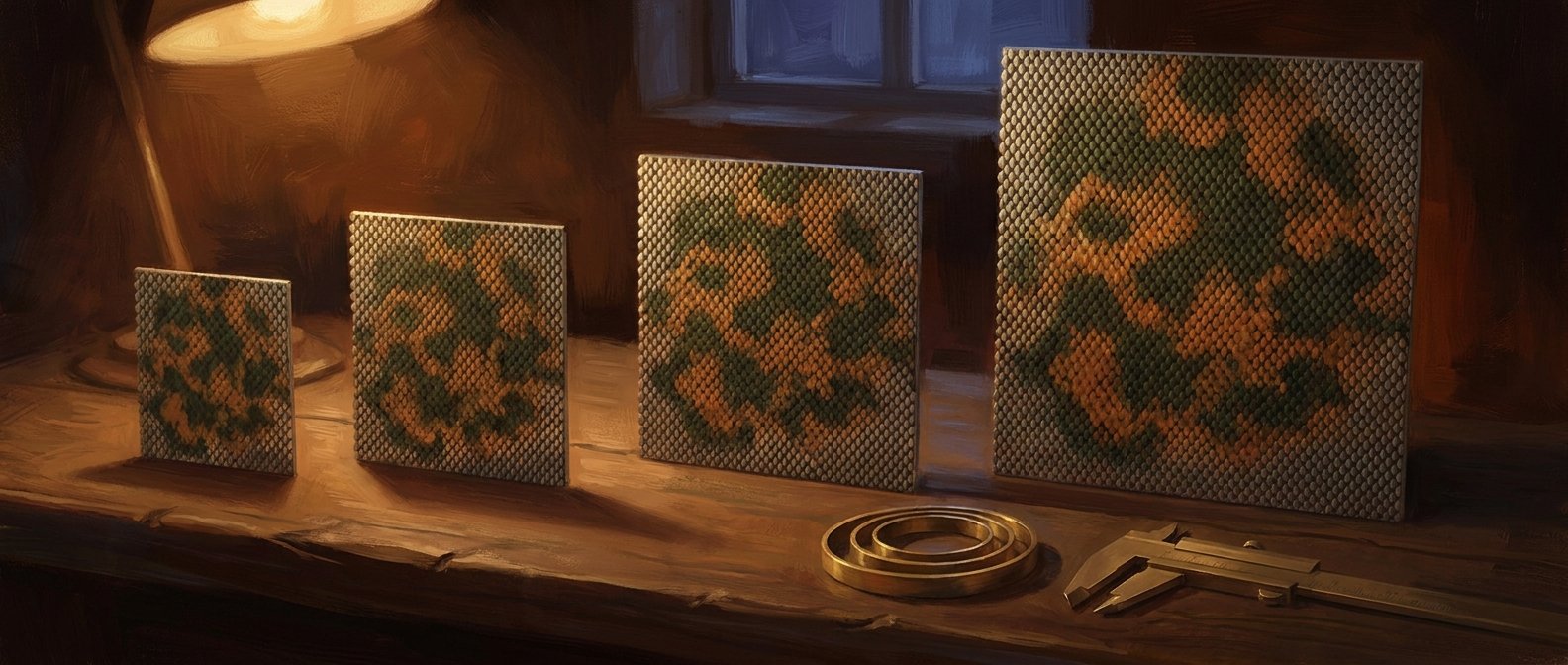
M01 found the temperature where the magnet gives up. But that measurement came from one lattice at one size, and a finite lattice always fudges things a little. So the obvious next question is what happens when you make it bigger.
The quantity to watch is the susceptibility — a measure of how wildly the magnetism swings around rather than how large it is. Near the tipping point the sheet can't make up its mind, so the swings are enormous and the susceptibility spikes. Run a bigger lattice and the spike gets taller. That much is unsurprising. The surprising part is how it gets taller: not by any old amount, but by a precise power of the lattice size. Double the width and the peak grows by a fixed factor, every time.
Theory says that factor is exactly L^(7/4) for this model. That
exponent, 7/4, is not something you can see in any single lattice — it only exists in
the relationship between sizes.
The panel below runs four lattices at once, all at the same temperature. Watch the biggest one — its patches are the largest and its susceptibility bar swings hardest. The plot on the right collects one point per size, and the slope of the line through them is the exponent.
Press sweep near T_c rather than parking. Each size peaks at a slightly different temperature — the smaller the lattice, the further above 2.2692 its peak sits — so a measurement taken standing still at one temperature catches the big lattices near their peaks and the small ones below theirs, and comes out too steep. That shift is not a nuisance; it is the same finite-size effect the exponent is made of. The sweep lets every size find its own peak, and the panel withholds a fitted slope until all four have found one near the transition. The largest lattice also takes the longest to settle at each new temperature — about L² sweeps — which is why the status line spends most of its time saying so.
left · the same magnet at four sizes, drawn at one physical scale so the size difference is real, not normalised away. The bar under each is its live susceptibility. · right · the peak susceptibility each size has reached so far, on log axes. The slate line is slope 7/4, anchored at the smallest lattice — you are comparing tilts, not heights. This browser demo runs L = 16–48 with short chains; the graded run needed L = 32–256 and 9.7 hours on a GPU. Expect the live slope to wander around 1.75, not sit on it — that wandering is the honest width of a measurement done this cheaply.
settling…
The promoted run of 2026-06-15 measured the exponent at 1.816 across lattices from 32 to 256 wide, with the points falling on a straight line to within R² = 0.998. A 2026-08-12 repeat measured 1.761. Both sit above the exact 1.75, and the gap between them is the honest size of the answer — a single number here would imply a precision the pair doesn't support. That repeat is also the lab's longest single run: 35,018 seconds, about 9.7 hours on GPU.