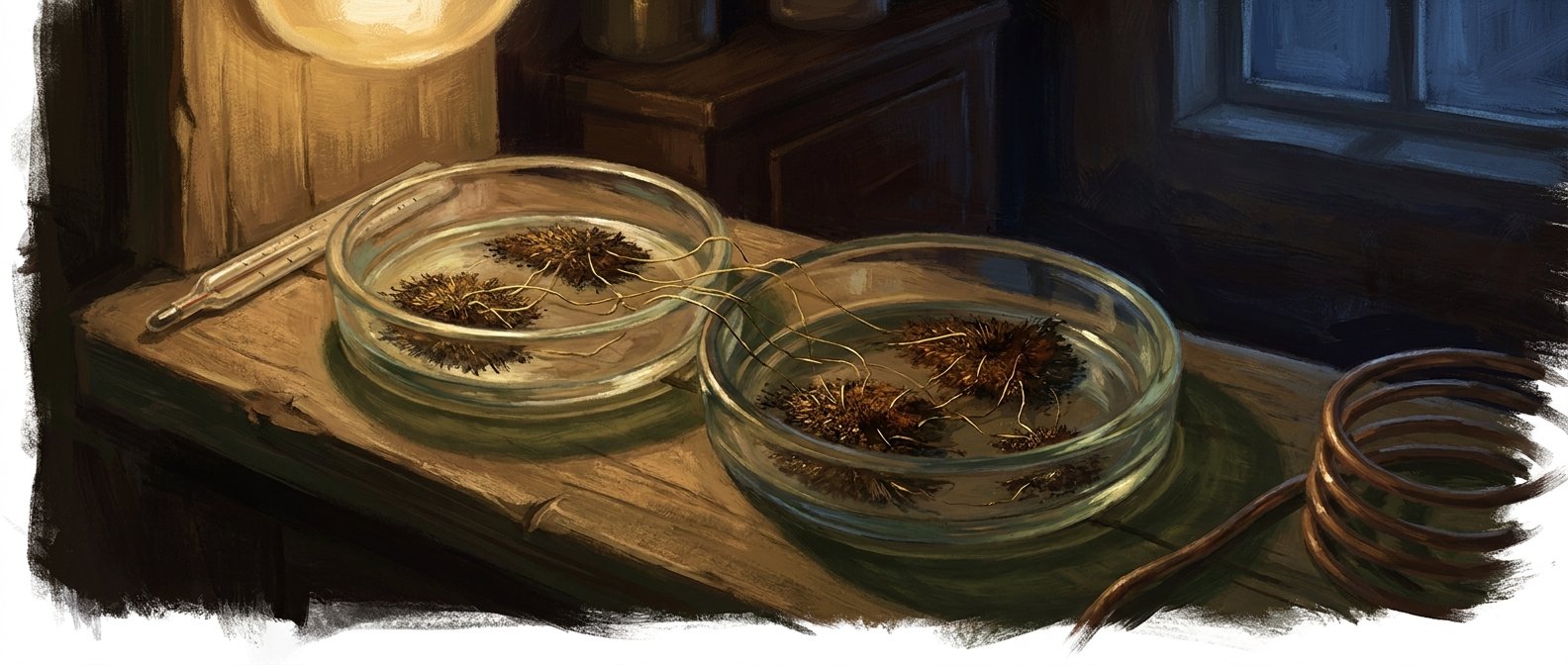
An ordinary magnet is a crowd that agrees. Cool it and every piece lines up with its neighbours, because every piece wants the same thing. A spin glass is a crowd that can't agree. Before you start, you flip a coin for every pair of neighbours: this pair wants to match, that pair wants to differ. Then you freeze those demands in place forever. Now no arrangement can satisfy everyone — go around a square and you may find three "agree" bonds and one "disagree", and something has to give. Physicists call this frustration, and it is the whole subject.
The natural question is when such a system freezes. In three dimensions it genuinely does, at a real temperature — that experiment is M12, and it is still open. In two dimensions the answer is stranger and completely settled in theory: it never freezes at any temperature above zero. Two dimensions sits exactly at the lower critical dimension, the knife-edge below which no glass phase survives. So M11's correct answer is not a transition temperature. It is a slow, unbounded approach to one that lives at T = 0.
The signature is something called the overlap. Run two independent copies of
the same frozen bond pattern — same demands, different starting scramble — and ask how
much of the final picture the two copies share. That number is q. Do it
hundreds of times, over hundreds of different bond patterns, and you get a distribution
of q values. At high temperature the two copies share nothing and
q piles up at zero. As you cool, the distribution widens — the
copies start finding the same large frozen patches — and it keeps widening all the way
down, with no peak ever splitting off, no sudden change, no transition. Just
broadening.
The panel below runs two copies of one frustrated lattice side by side, shows you where they agree, and builds the overlap histogram live as you lower the temperature. The histogram spreading — not any number in it — is the result.
left · the agreement map (ember = the two copies chose the same thing here) with both replicas inset · right · top: P(q), the overlap histogram at this temperature; bottom: its width ⟨q²⟩ against T, filling in as you cool. Cool from 2.00 and watch the histogram spread without ever splitting.
sweeps 0 · bond realizations averaged 1 · samples in this histogram 0 · ⟨q²⟩ — · |⟨q⟩| — · frustrated plaquettes —
The bond pattern rolls to a fresh one every few seconds and the histogram keeps accumulating — P(q) is a property of the disorder average, not of one frozen puzzle. Inside a single realization the sign of q is fixed by the quench, so one puzzle alone builds a lopsided lump. The published run averaged 64 of them, at 60,000 sweeps each; this panel rolls a new one about every second and gets roughly a thousand sweeps from each, so it reaches a narrower ⟨q²⟩ at the cold end than the receipt does. The broadening is the claim, not the endpoint.
The published numbers come from the promoted 2026-06-25 run: the width of the overlap distribution grows from 0.011 to 0.306 as the temperature falls from 2.00 to 0.60 — a factor of 27, monotone at all 15 steps, with no crossing and nothing splitting. An independent rerun on 2026-08-13 repeated the sweep and reached 0.335 instead. The two runs agree on the shape and differ on the endpoint, which is worth saying out loud rather than picking the number you prefer: what M11 measures is a trend, and a trend is exactly the kind of claim that survives a 10% disagreement about where it stops.
The Binder cumulant — the standard test for a transition — rises smoothly from 0.01 to 0.71 across the same sweep and never crosses, which is what a system whose critical point sits at absolute zero is supposed to do. The same measurement in three dimensions, where a real transition exists to be found, is M12, and it has not found it yet. The same ±J bond machinery, walked along a line where theory hands you the answer in closed form, is M14.