The disorder that
survives absolute zero
If you cool something all the way to absolute zero and it still has choices left, can you measure how many?
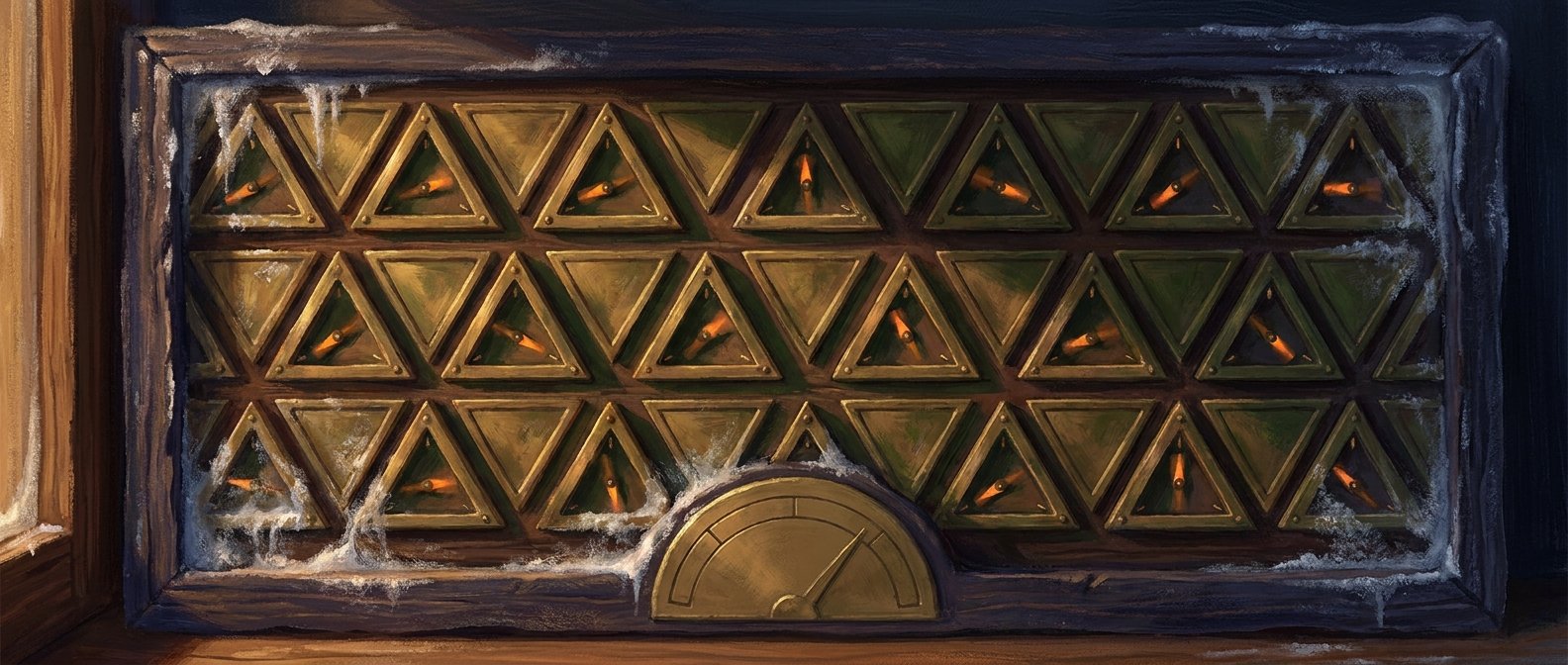
Put magnets on a triangular grid and make every pair want to disagree. Now look at any single triangle. Two corners can disagree easily enough — one up, one down. The third corner has to disagree with both, and it cannot. Whichever way it points, one of its two demands goes unmet. Every triangle in the lattice has this problem, and every triangle solves it by picking a loser. Which corner loses is entirely arbitrary — the cost is the same either way — so the system never actually decides.
The consequence is remarkable. Cool an ordinary magnet to absolute zero and it settles into exactly one arrangement: a single, unique ground state. Cool this lattice to absolute zero and it settles into an astronomically large number of arrangements, all tied for lowest energy, and it goes on shuffling between them at no cost forever. That leftover freedom has a name and a number. It is residual entropy, and for this lattice Wannier computed it exactly: 0.3383 per magnet, in units where a free coin flip is worth ln 2 ≈ 0.693.
Measuring it does not involve counting anything. It involves a thermometer. Entropy at infinite temperature is ln 2 — every magnet is a free coin flip. As you cool, the lattice sheds entropy at a rate the heat capacity tells you, so you can integrate that shedding all the way down and subtract it from ln 2. For a normal magnet the books balance and you arrive at zero. Here you arrive at 0.3338, and stop. The number that refuses to reach zero is the count of arrangements the lattice never gave up.
The panel below cools a frustrated triangular lattice while shading the area under its heat-capacity curve and running the subtraction live. Watch the running entropy fall from 0.693 and stall well short of the floor — and watch the lattice keep twitching after the temperature readout has effectively hit zero.
left · the triangular lattice, drawn on its real sheared geometry so every site has six neighbours. Rings mark the spins that flipped on the last sweep. Cool it all the way down and the picture stops changing at a glance — but the rings never go away. Free motion at zero temperature is what residual entropy looks like from the inside · right · ember is the heat capacity per spin. Because the temperature axis is logarithmic, the shaded area under that curve is the entropy shed, exactly; the moss line is ln 2 minus that area, running downward live. It stalls above Wannier's dashed line instead of reaching zero. The slate line is the same subtraction run on a square lattice, which is not frustrated — its counter goes to the floor, which is what an ordinary magnet does. Only the triangular heat capacity is drawn; the square lattice's own peak is tall and narrow enough to flatten everything else on a shared axis, so its contribution here is the entropy line alone.
The published run — 2026-07-04 — swept 40 geometrically spaced temperatures from 12.0 down to 0.15 at L = 24 and finished in 5 seconds. It returned a residual entropy per spin of 0.3338 against Wannier's exact 0.3383, a gap of 0.0045, with the ground-state energy landing at exactly −1.0000 against an exact −1.
The larger L = 96 run converges toward roughly 0.32 — a few percent lower still. Both bracket 0.3383 from the same side, and the exact ground-state energy anchors the calculation at every size, so the honest pairing is the L = 24 number as the headline and the L = 96 drift as the systematic rather than a second competing answer.