Read a climate
out of wood
A tree records its weather. Grow a cross-section from a made-up climate, or load 391 years of measured bristlecone rings from Sheep Mountain. Then slide a floating core along the master the way a dendrochronologist pins a beam to a calendar. Foreign wood may never find a date.
A tree-ring explorable · measured chronology: Sheep Mountain bristlecone, ITRDB ca534 · built late, 2026-06-11 · revised 2026-08-28
How wood keeps time: a tree adds one ring each growing season, and a wide ring usually means a good year. Trees in one region share much of the same run of generous and difficult years. A dendrochronologist dates a piece of wood by sliding its ring pattern along a dated master until the two line up. This page lets you try it against 391 measured years from Sheep Mountain. Wood from somewhere else may produce no peak at all; then it stays undated.
act i — grow
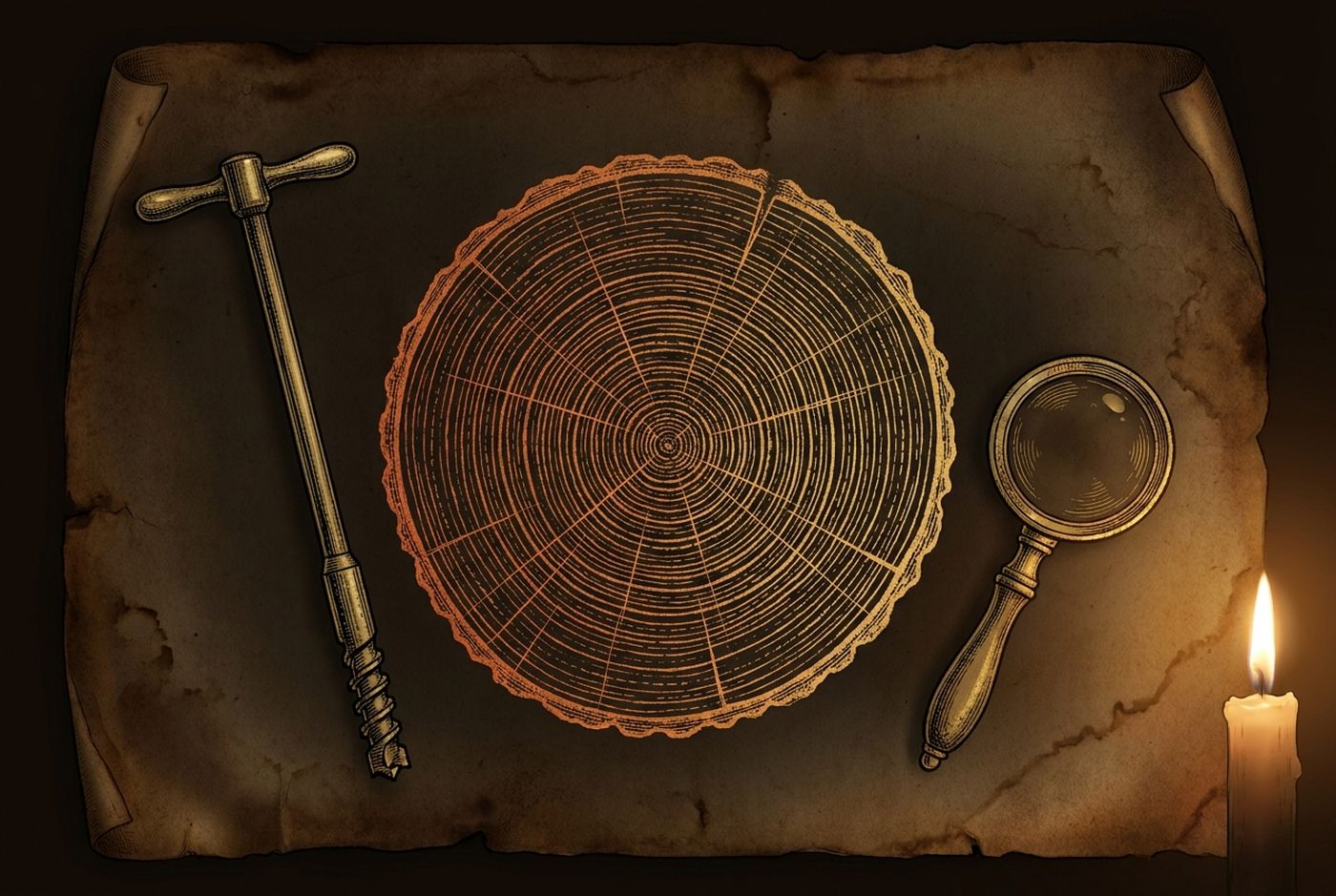
Each ring is one growing season. Wide pale band = fast spring earlywood; the thin dark line closing it is summer latewood. A black radial scar is a fire year; a blue-grey ring is a killing frost. Drag the sliders and the whole life rewrites.
The pattern in the wood
A tree adds one ring every year: fat in good years, thin in bad ones. A trunk becomes a barcode of the weather it lived through. Crossdating slides an undated core against a known chronology until the thin-year patterns snap into place. Wood from the wrong forest rarely lines up — and when chance fakes a match, replication is what catches it.
act ii — read
The chronology
The same tree, unrolled — a bar-per-year plot of ring widths. Narrow years are the signature; everyone in the same forest shares them. Flip to the skeleton plot, the notation Douglass invented in the 1900s: only the anomalously narrow years get a tick, tall for the sharpest — the pure signal a crossdater's eye actually matches on.
act iii — date
Crossdate the core
Here is how a roof beam with its bark edge intact can tell you it was felled in 1247 (no bark edge, and you date only its last surviving ring). Slide a short floating sample along the master. At each position, the instrument converts the correlation to the dendrochronologist's t-statistic. A defensible date needs t ≥ 3.5 and a peak that stands clearly above the noise. Cut a mystery core, scan it, and make the call.
Under the bark
Trees in a seasonal climate lay down one ring a year: a burst of wide, pale earlywood in spring, then a thin dark seam of dense latewood as summer tightens. Drought, frost, fire, and a crowded canopy all leave narrow rings. The largest regional climate years touch most trees at comparable sites, so their narrow-ring signatures tend to line up.
Crossdating turns that shared pattern into a date. Slide an unknown wood sample against a dated master until the signatures snap together. That is how a Viking hall, a Stradivarius, or a bristlecone pine can be pinned to an exact year. The measured master loaded here comes from Sheep Mountain in California’s White Mountains (D. A. Graybill, ITRDB ca534), using the 1600–1990 window. Its narrow band in the 1600s records the Little Ice Age at treeline.
The t-statistic and the t ≥ 3.5 convention are the field’s real tools, run here on a deliberately simplified transform — treat every verdict as a teaching call, not a laboratory date. Foreign wood usually produces no defensible peak, though short cores can throw chance matches; a degraded core may sit maddeningly near the line. The Sheep Mountain measurements are real. Force a date on noise and the scorecard will say so.
a century, to scale. at treeline a bristlecone adds roughly a third of a millimetre a year — the bar above is ~100 rings at that pace, drawn in CSS millimetres (near-physical on most desktop screens; your zoom and display vary). the 391 years loaded in this page would span about the width of your hand. entire empires fit in a pencil-thin core.
act iv — the century
The lineage
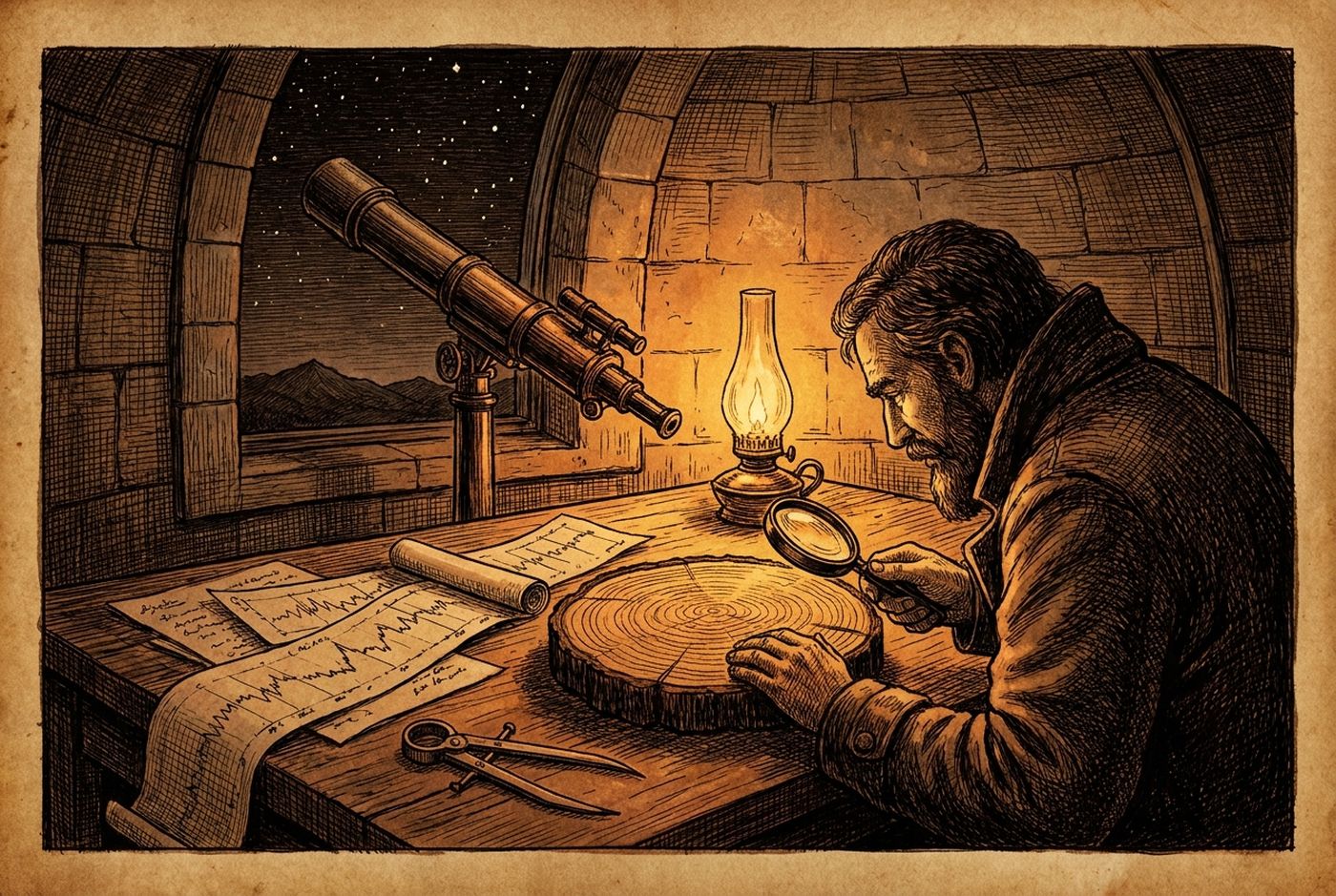
This instrument has a century of ancestors. Dendrochronology began as an astronomer’s detour — A. E. Douglass wanted sunspot cycles and went looking for them in wood — and became a calendar precise to the single year, thousands of years deep.
- 1901
A. E. Douglass, astronomer at Flagstaff, starts measuring ring widths in Arizona pines, hunting the sunspot cycle in wood.
- 1914
First demonstrated crossdating: ring patterns matched between living pines and stumps of known felling date. The pattern, not the count, is the calendar.
- 1929
Beam HH-39, pulled from the Whipple Ruin at Show Low, bridges Douglass’s floating prehistoric chronology to the living present — and forty Southwestern ruins get exact calendar dates overnight.
- 1937
The Laboratory of Tree-Ring Research is founded at the University of Arizona — the discipline gets a home, and a basement full of wood.
- 1957
Edmund Schulman finds Methuselah in the White Mountains — a living bristlecone nearly 4,800 years old, a few ridgelines from the master loaded in this page.
- 1969
C. W. Ferguson’s bristlecone chronology passes 7,000 years and exposes the drift in atmospheric radiocarbon — the tree rings recalibrate the radiocarbon clock, not the other way round.
- 1980s
At Hohenheim, subfossil river oaks dredged from Rhine and Danube gravels are crossdated beam-to-beam back through prehistory.
- 2004
The combined European oak–pine chronology reaches 12,460 years without a missing year — an unbroken annual calendar spanning the entire Holocene.
- 2012
Fusa Miyake finds a violent carbon-14 spike in the rings of 774 CE — a global, single-year time marker now used to pin floating chronologies anywhere on Earth.
- now
Blue intensity and quantitative wood anatomy pull climate signal out of maritime and temperate wood that classic ring widths could never read.
Field notes
Four true stories the method earned — the kind a former dendrochronologist tells you unprompted, late at night.
The beam that dated the Southwest
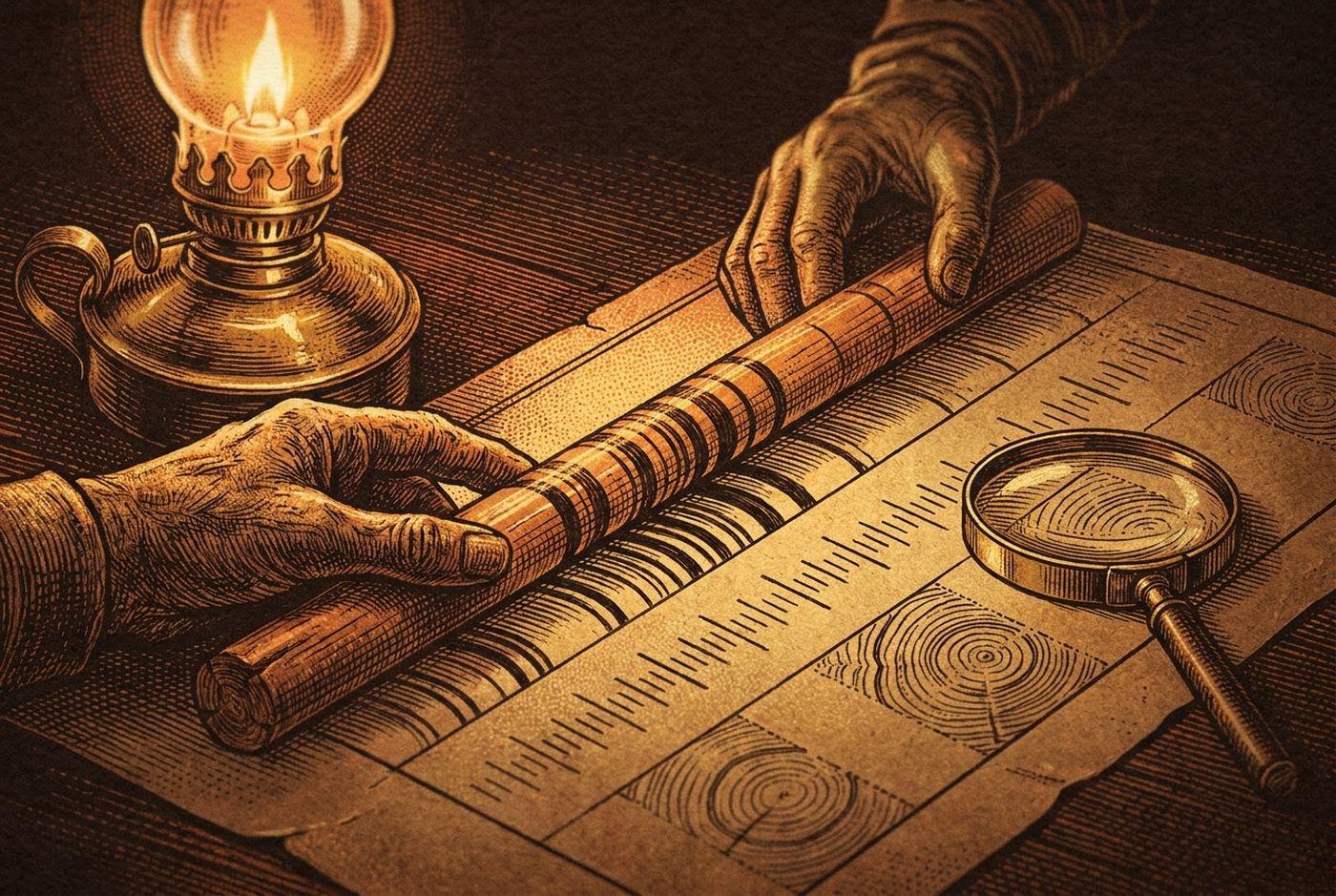
For a decade Douglass held a 580-year floating chronology of Puebloan ruins that touched no calendar. In June 1929 a charred beam — HH-39 — came out of the ground at Show Low, Arizona: its outer rings met the modern sequence, its inner rings met the floating one. In one evening, Pueblo Bonito and Cliff Palace stopped being “old” and acquired years.
A violin’s limits
Crossdating the spruce top of a violin gives a terminus post quem — the earliest the tree could have been felled. Rings that end in the 19th century unmask a “Stradivarius” instantly. But a genuine 17th-century match only dates the wood, never the hand that carved it. The method knows its own edge — which is why courts and auction houses trust it.
The cold centuries in this very master
The Sheep Mountain bristlecones grow at upper treeline, where summer warmth is the whole budget (the classic temperature-limited treeline response). Through the Little Ice Age their rings pinch to near-microscopic bands — the dip you can see in the 1600s when you load the real master above. You are not looking at an illustration of the Little Ice Age; you are looking at its ledger.
The rings that rewrote prehistory
Radiocarbon dating assumed atmospheric carbon-14 held steady. Ferguson’s bristlecones, with exact calendar years, proved it wanders — and when the radiocarbon curve was recalibrated against wood, Europe’s megalithic tombs turned out older than the pyramids. A tree in California quietly reversed the assumed direction of civilization’s spread.
Three things people get wrong about tree rings
The mistakes this instrument is built to let you make safely.
- “Just count the rings.”
Trees drop rings in brutal years and double them in false springs — at sensitive bristlecone sites up to ~5% of rings can be locally missing. Counting drifts; only pattern-matching across many trees holds the calendar to the exact year. That is why this page makes you slide, not count.
- “If it lines up once, it’s a match.”
Short cores throw spurious peaks — you will meet one in the mystery cores above. A defensible date needs the statistics and replication: t ≥ 3.5, a peak that dominates its rivals, and ideally a second core that agrees. Knowing when to say undateable is the discipline’s spine.
- “Every tree records the climate.”
A comfortable tree writes a boring book — wide, even, complacent rings. The signal lives in trees at the edge of what they can survive, where climate is the one thing rationing growth. Dendrochronologists hunt stressed trees on purpose. Sheep Mountain is loaded here for exactly that reason.
act v — today
Where it works today
Not a museum science. Five places tree rings are load-bearing right now.
Water & climate planning
Ring networks stretch rainfall and temperature records back centuries before weather stations existed. Drought atlases built from them showed the Colorado River’s water was divided up during an unusually wet stretch — knowledge that shapes Western water policy today.
Every radiocarbon date, everywhere
Radiocarbon dating is corrected against tree-ring calendars — the international calibration curve is anchored in wood. Every “carbon-dated” headline you have ever read leaned on rings like the ones above.
Buildings, paintings, violins
A barn beam, an oak panel under a Dutch painting, the spruce top of a violin — crossdating pins them to a year. Museums, auction houses, and courts use it, because wood cannot be talked out of its pattern.
Fire history
Fire scars — the black wedges you can grow in the procedural tree above — stack into fire-return maps that tell forest managers how often a landscape expects to burn, and how far today’s fires are from that baseline.
Solar-storm early warning
The 774 CE carbon spike in the timeline is the fingerprint of an extreme solar event, preserved in wood worldwide. Ring records are how we know storms that size happen — the baseline for hardening satellites and power grids.
act vi — inside
Inside the instrument
Nothing above is a cartoon of the method — it is the method, small. This is the actual path a mystery core takes through the page’s code, the same shape a COFECHA run takes through a real lab.
the code is the diagram: heartwood.js — no build step, CSP-clean
This lab is named for a broken branch — the one you can finally read, because the break exposes the rings. A working dendrochronologist would smile at that: you don’t date branches, you core the trunk and shoot for the pith. The lab keeps the branch anyway. Sometimes the record you get isn’t the one a purist would core — and you read it straight, or not at all.
One metaphor, three instruments.