Physics you can poke in the browser. Nothing to install.
 Live
Live
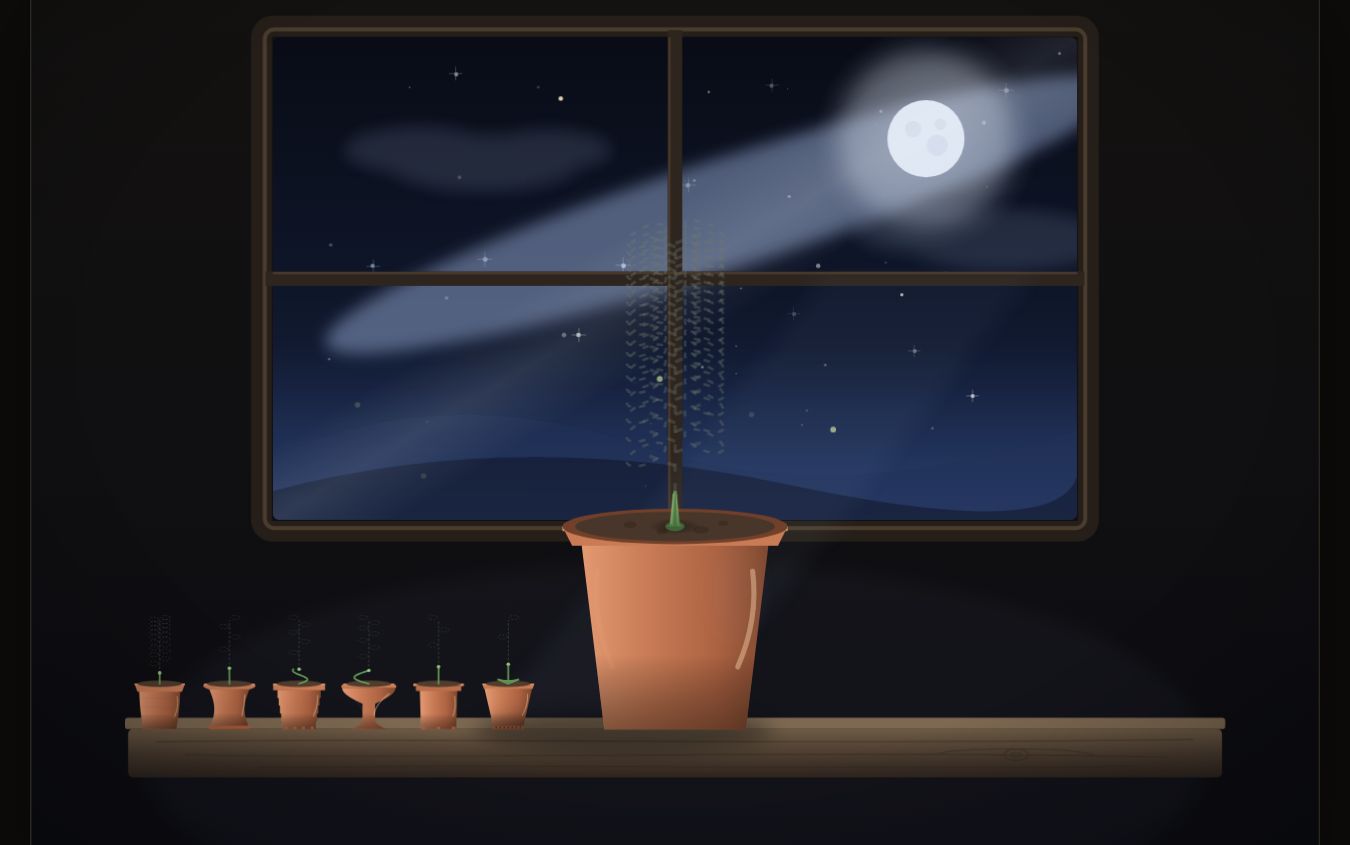
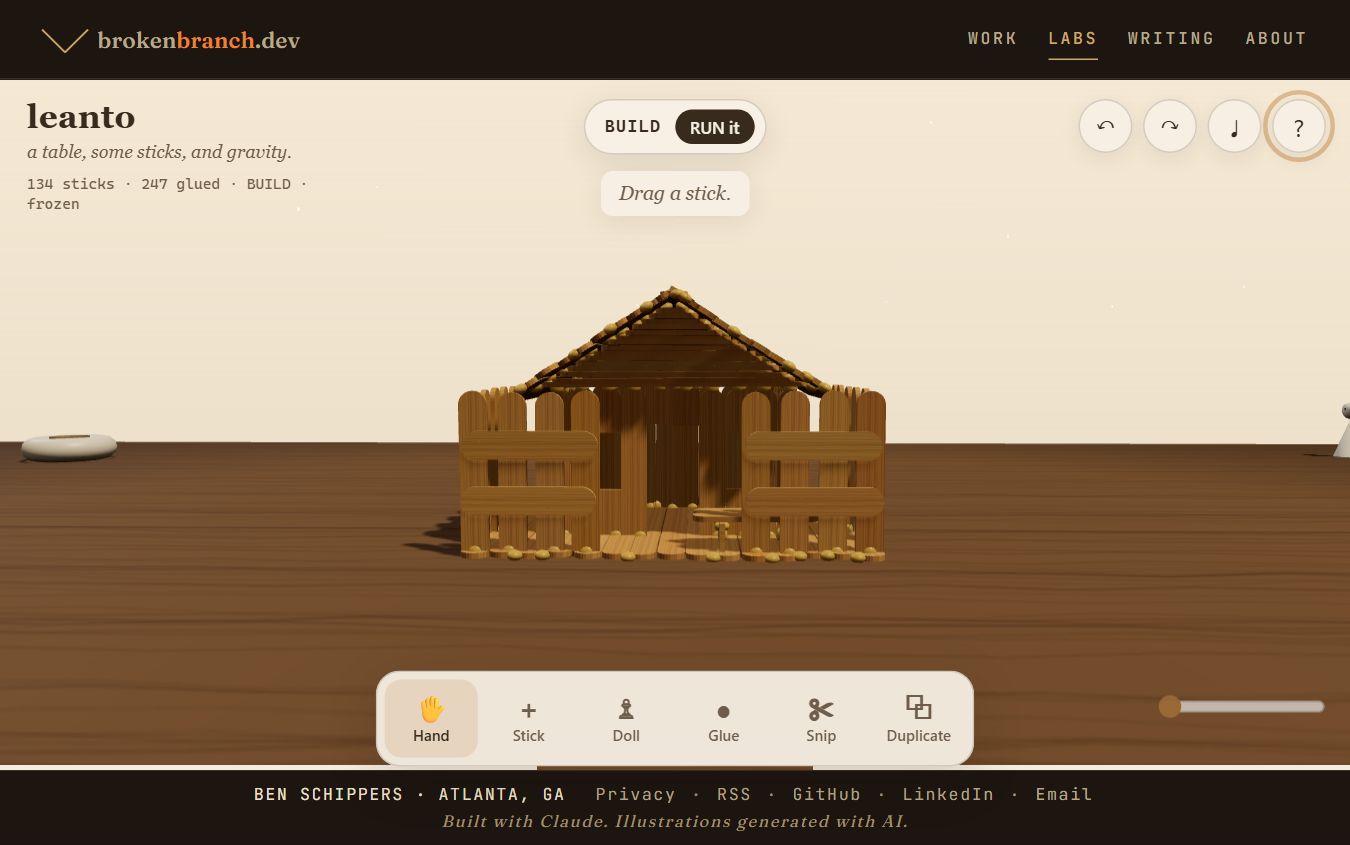
A popsicle-stick craft table in your browser. Real stick dimensions, real gravity, a plain wooden tabletop — grab sticks, prop them, snip them with scissors, dab glue between them. BUILD mode freezes every stick where you leave it, a patient third hand; press B and the whole thing drops into live physics and stands — or falls. There is no grid and no snapping, ever: every stick is slightly different, and the imperfection is the point. A little gabled cottage ships inside — load it, wreck it, build a better one.
Glue cures at the reveal: a bonded build fuses into one rigid body, which is why the 134-stick cottage rides out a full minute of live physics with a quarter-millimetre of drift. Keep a real structure standing for ten seconds and the room quietly celebrates — confetti, a chime, a swell of afternoon light.
three.jsrapier physicscraft toyno build step
 Live
Live
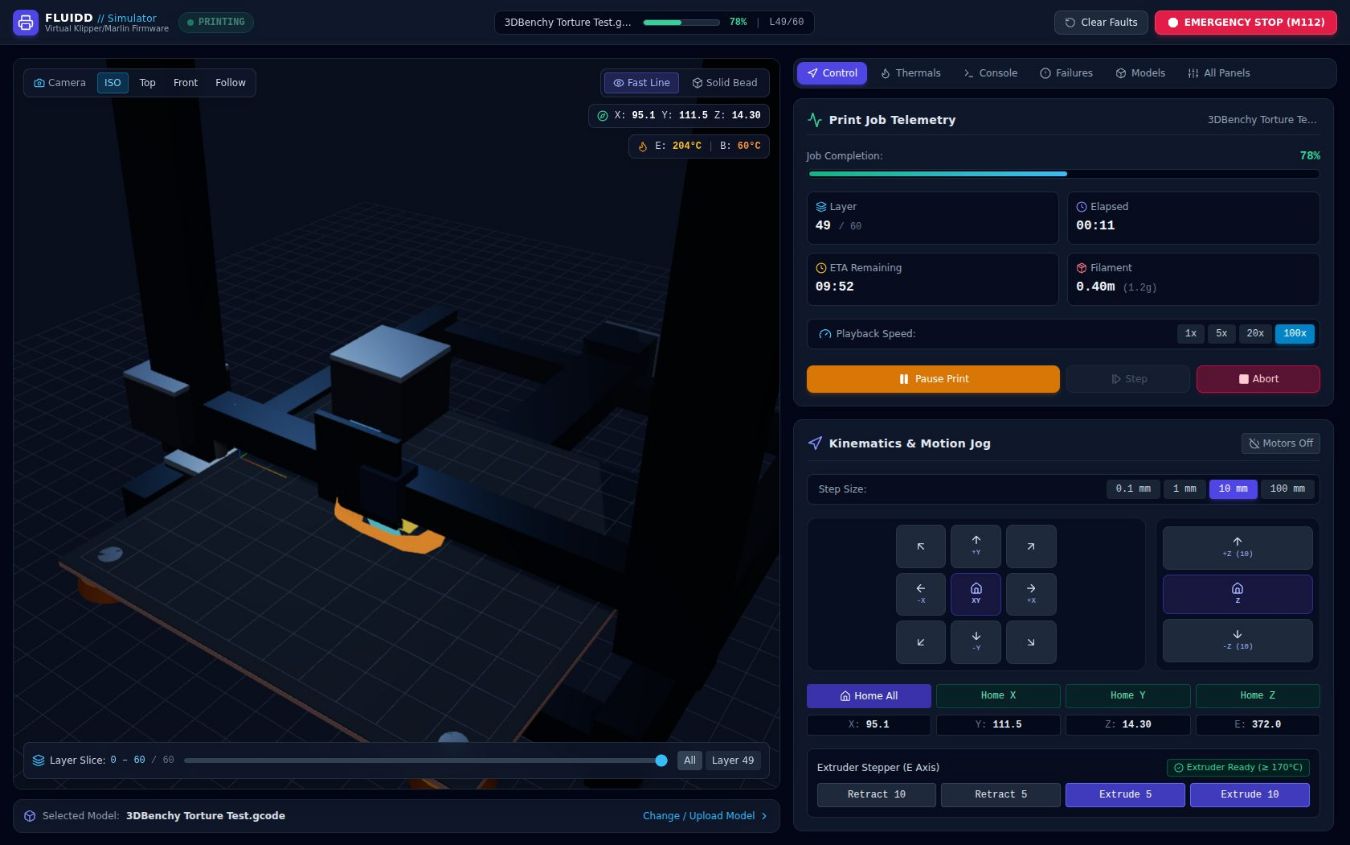
A 3D printer you can't buy, running in a browser tab. Feed it real G-code and a Cartesian machine runs it: the hotend obeys a heat equation rather than a countdown, the bed takes far longer to reach 60 °C because it has the mass to, and the part cooling fan costs the nozzle a few degrees of headroom. The toolhead lays beads along the path the file actually asked for. A calibration cube, a Benchy and a five-layer pad ship inside, and any .gcode you drag onto the panel prints instead.
The failure panel is what makes it more than a G-code viewer. Clog the nozzle and motion carries on while the part stops growing. Skip a stepper and every layer above inherits the offset. Cut the heater's response and Marlin's own runaway watchdog trips, calls M112, and halts the machine — the watchdog is really running.
three.jstypescriptmarlin g-codepid thermal model
 Live
Live
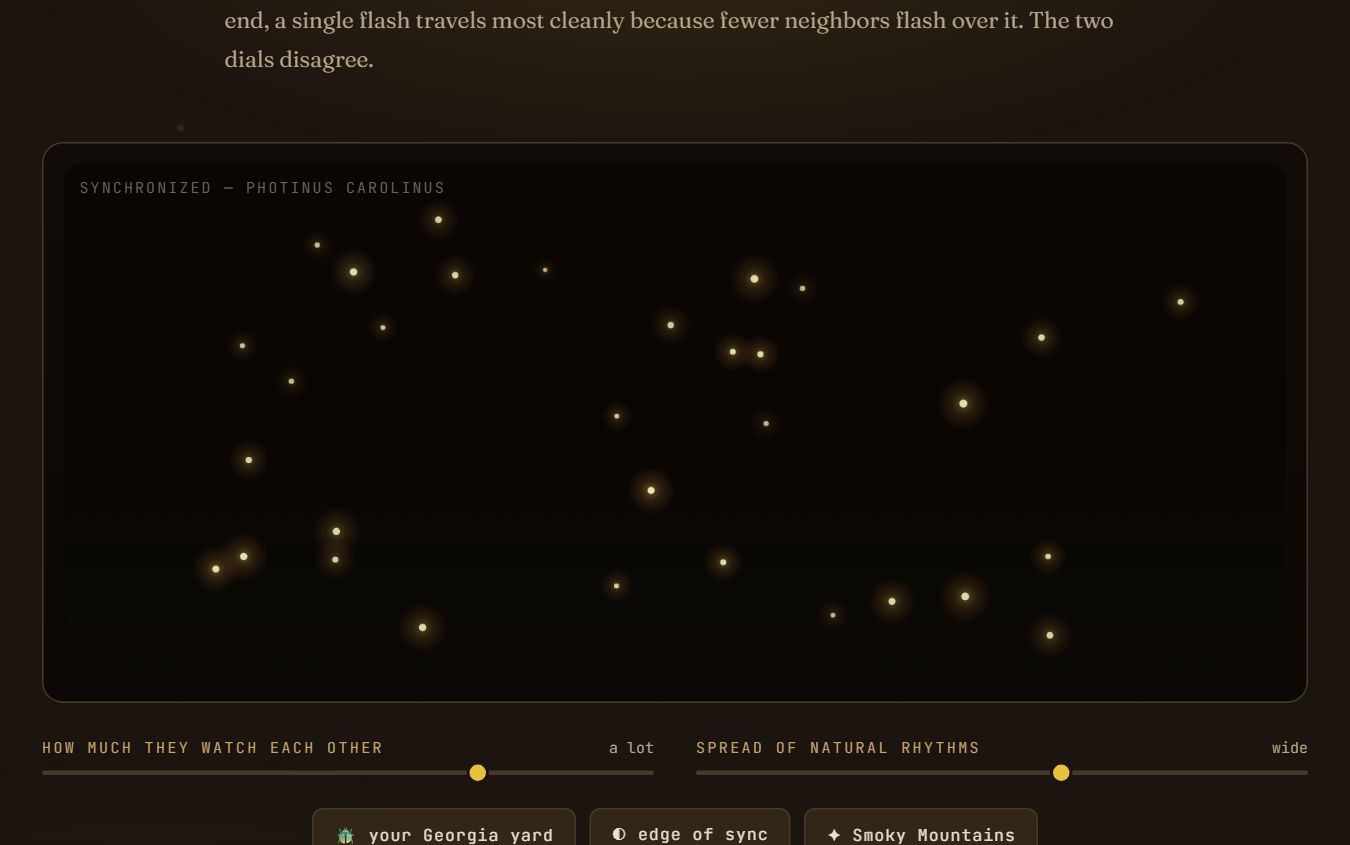
A field of fireflies, each on its own clock. Turn up how much they watch each other and they synchronize, using the Kuramoto model written to explain Southern Appalachian fireflies. A second needle moves the other way: clean signalling wants the field out of step. Responsiveness and coordination pull apart.
Responsiveness peaks at the edge of order; its location moves with crowd size. Coordination peaks out of step. The earlier “structured rhythm wins” story failed, and the toy keeps the correction in view.
canvaskuramotosynchronyno build
 Live
Live
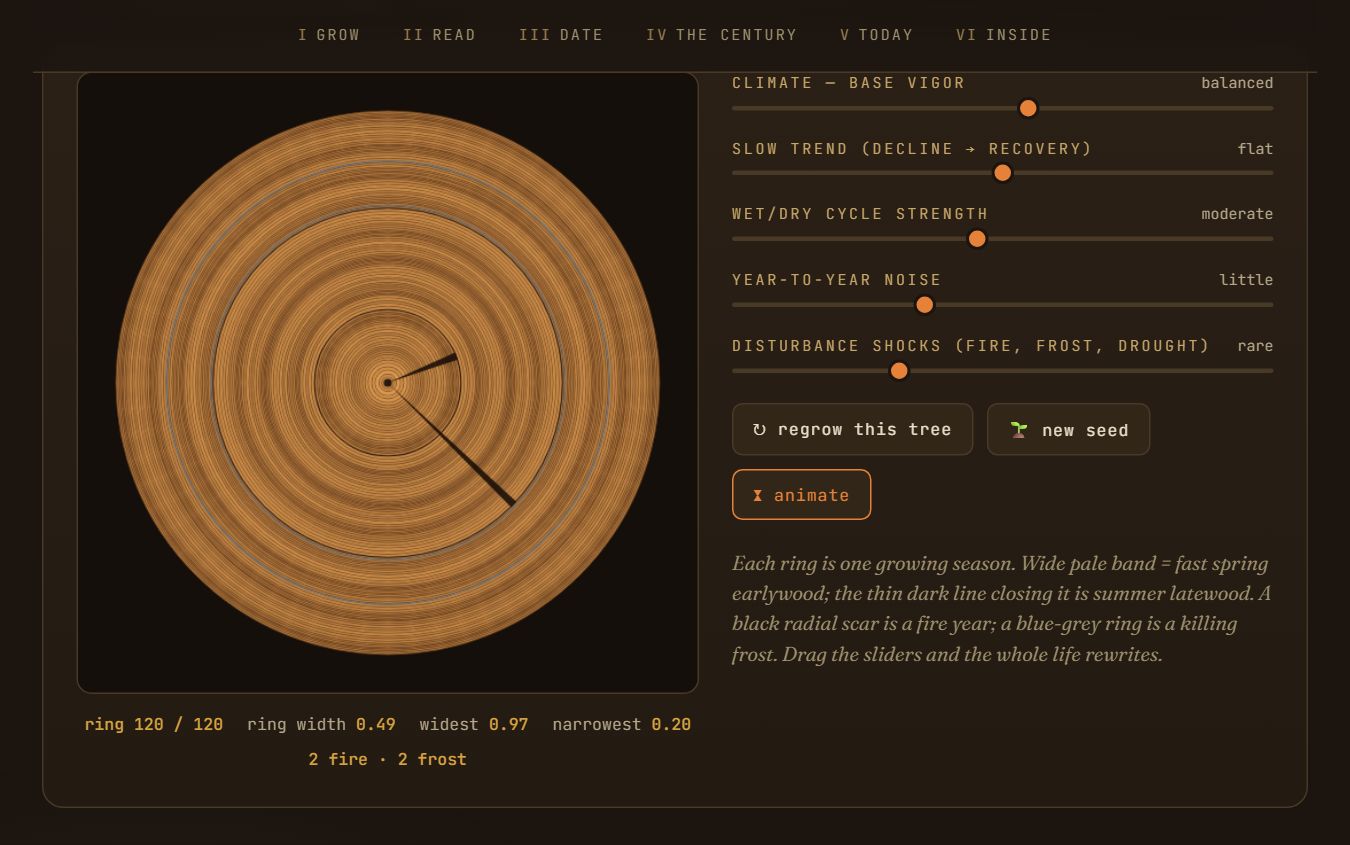
Read a climate out of wood. Grow a cross-section with pale earlywood, dark latewood, fire scars, and frost rings. Then crossdate a floating core against the master chronology, the way a dendrochronologist pins a roof beam to an exact year. The tree rewrites itself as you drag the sliders.
Built by a former dendrochronologist. The page uses a measured bristlecone chronology and the field’s t-statistic; a core can still refuse to date.
canvasgenerativedendrochronologyno build
 Live
Live
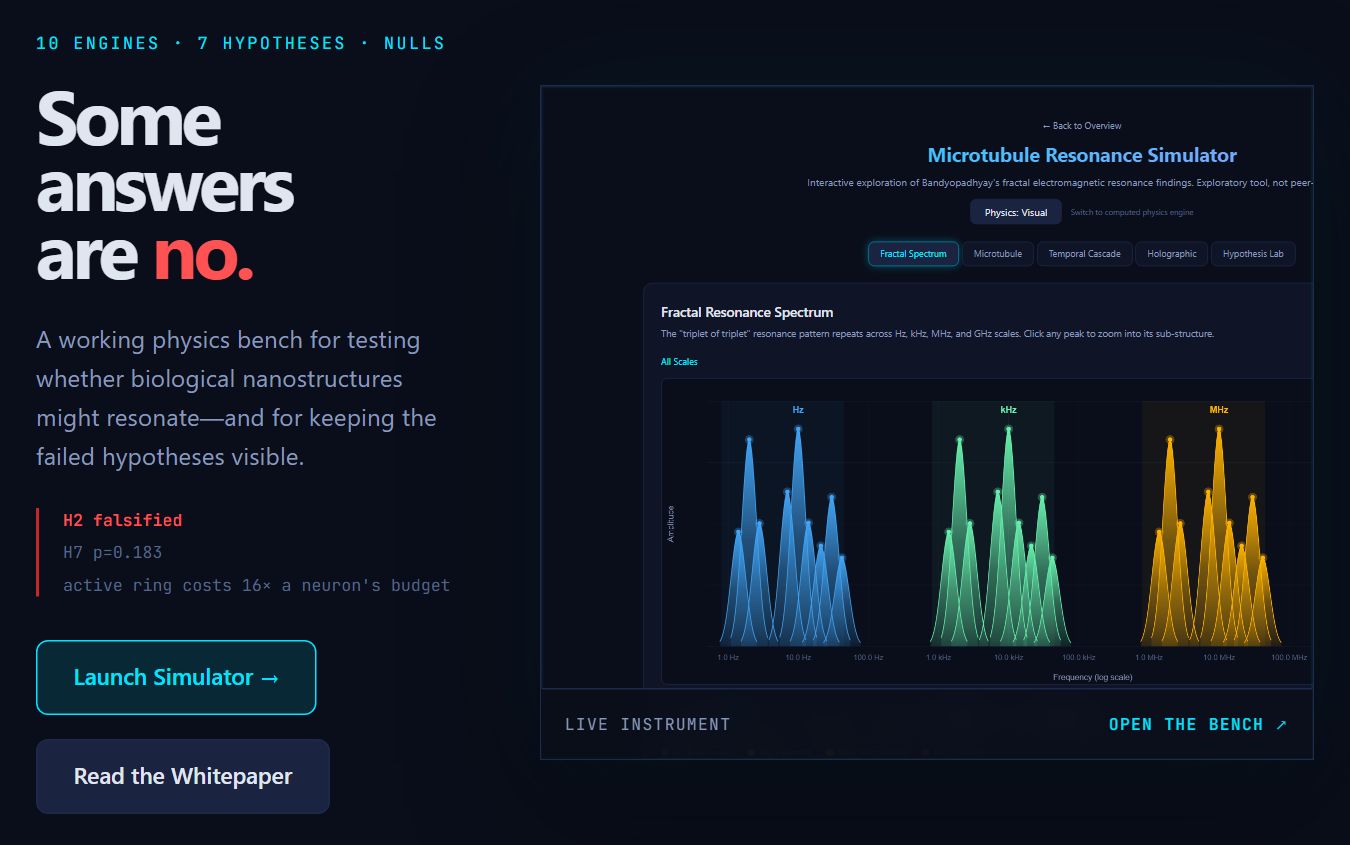
An in-browser explorable that tests seven microtubule-resonance hypotheses from Bandyopadhyay et al. — and reports the ones that failed. Ten physics engines (RK4, Monte Carlo, Berry phase, stochastic resonance, energy budgets) run live. H2 was falsified, H7 came back unvalidated at p=0.183, and the model's own results show a regular lattice beats the fractal one. Explicitly not peer-reviewed — a tool for sharpening questions.
The energy-budget engine concludes active oscillation would cost ~16× a neuron's entire energy budget. The sim quietly argues against its own romantic premise.
html/jsquantum biologyno buildMIT
 Live demo
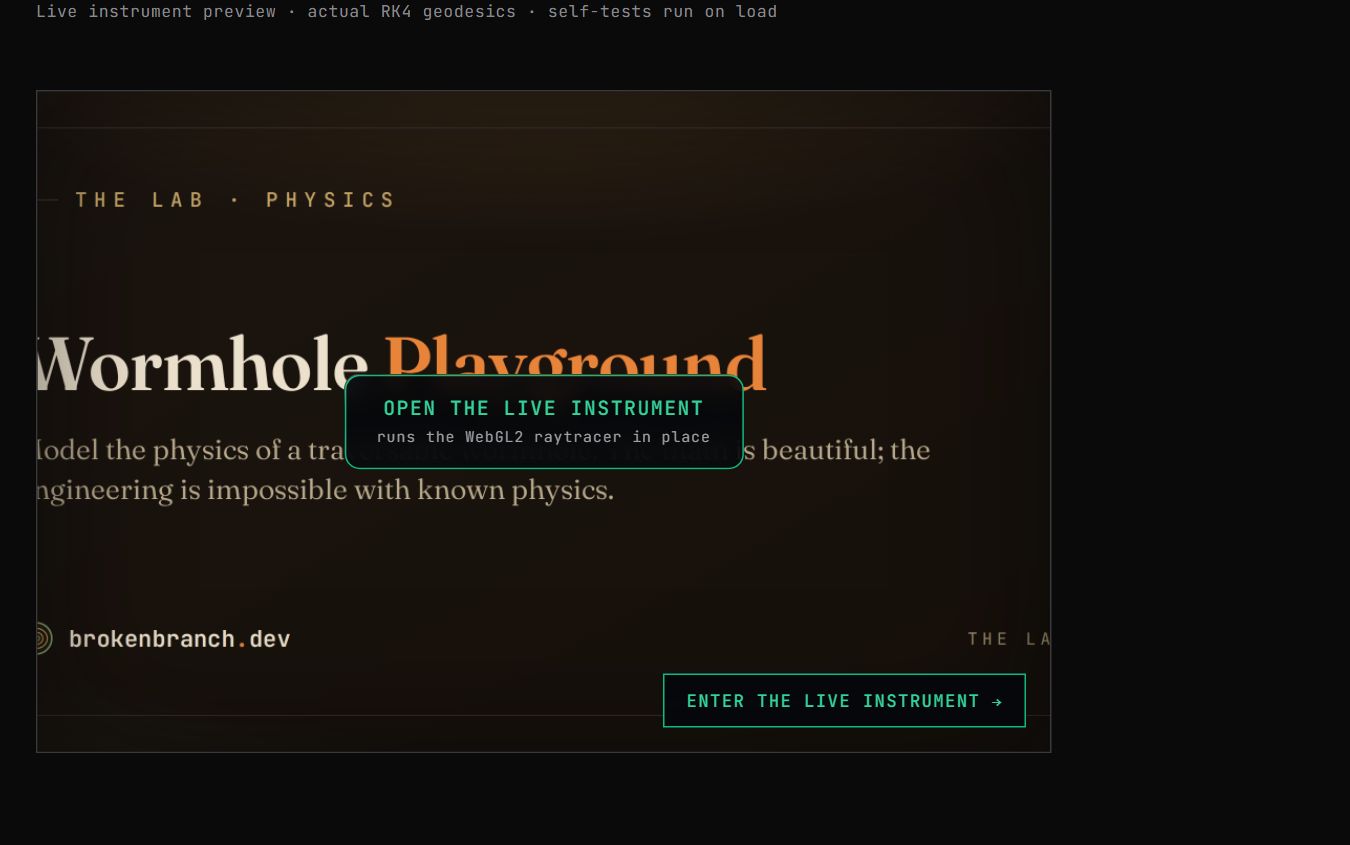
A traversable-wormhole simulator with two results and a hard limit. Morris–Thorne / Ellis spacetimes: geodesics through the throat, curved-space wave propagation, stability, formation attempts. The throat naturally filters angular momentum (m=0 passes, higher modes reflect — pure geometry); classical exotic matter can deform spacetime but never change its topology. The exotic-matter budget for a 1 m throat falls short by about 46 orders of magnitude, and the README says so up top.
It was built as a sibling to the Kozyrev Mirror, which was once said to create angular momentum from zero. The re-test, The Honest Spiral, found that number was an integrator artifact: a spiral twists only the waves that escape it, and the twist is zero in equilibrium. The throat's filtering result is the playground's own; this re-test does not touch it.
general relativityvanilla js + pythonsimulation
 Live
Live
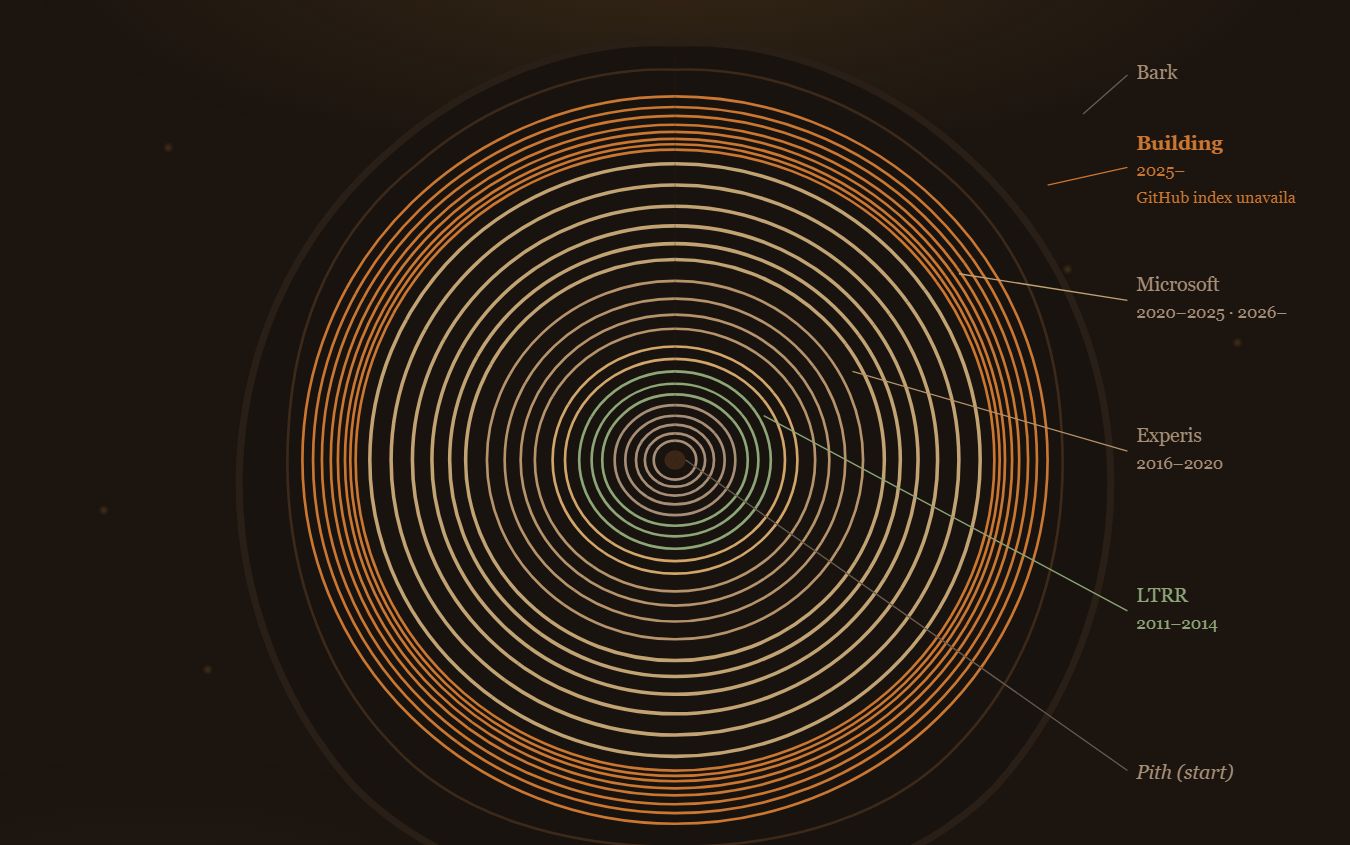
A coding year read the way you'd read a tree. GitHub commit activity drawn as a tree-ring cross-section — one tick on the outer ring per commit, pulled live from the GitHub API. The ring shapes themselves are drawn, not measured.
The dendrochronologist's eye behind Heartwood, turned on git history instead of climate — same crossdating instinct, a different core.
canvasdendrochronologygithub apino build