Prepared 2026-09-14, adversarially re-checked 2026-09-14, corrected and re-scoped 2026-09-18. Nothing has been sent.
0 · Read this first: what changed on 2026-09-18
Three numbers in the previous revision were wrong and one framing decision was open. All four are settled here. The density row was corrected twice on the same day — once wrongly — and the row records both passes, because a package that hides its own retractions is not a package anyone should trust.
| was | is | why | |
|---|---|---|---|
| The ExoFOP upload line in §1 | carried this lab's trapezoid values | carries SPOC's limb-darkened values | §5 already concluded SPOC's ephemeris supersedes ours, but the paste-ready line was never updated. It was the one artifact in the package meant to be pasted, and it was the one carrying the retracted numbers. |
| Stellar density — both sides were in solar units, and only one carried the label | "ρ★ from fit 1.64; catalogue 2.57", the second tagged g/cm³ | fit 1.644 ρ☉ = 2.32 g/cm³; catalogue 2.571 ρ☉ = 3.62 g/cm³ | 0.601 / 0.616³ = 2.571, so the catalogue's "2.57 g/cm³"
is M/R³ in SOLAR units with a cgs label on it. SPOC's
starDensitySolarDensity = 1.64423 is solar too. The
original comparison was therefore like-for-like and the
factor-1.56 discrepancy is real; only the unit label was wrong.
A 2026-09-18 revision of this file briefly claimed the two agree to 11 %
— that was an error, made by converting one side to cgs and not the
other, and it is retracted here. |
| Odd/even statistic | "1.13σ" | 1.288 (significance 0.256) | oddEvenTransitDepthComparisonStatistic value="1.2880648"
in the committed DV XML. |
| Companion exclusion | "every stellar and L-type companion excluded by two orders of magnitude"; survivors "cooler than ~1,000 K" | stars excluded by 10–48×, early-L marginal, survivors cooler than ≈1,800 K | Recomputed by Planck integration over the TESS band in
scripts/tic374861595_secondary_limit.py. The conclusion
holds; the margin was overstated. |
| Baseline and sector count | "259 over ~2,300 d (980 expected; 25+ sectors)"; sector list given as ranges "35–39, 61–69, 87–97" | 259 over 1,897 d; 23 sectors, the first being S27; the sectors enumerated individually | The DV root's own startCadence/endCadence
span 1,365,963 two-minute cadences = 1,897.2 d = 979.5
cycles, which is the DV's own expectedTransitCount
of 980 to 0.05 %. "~2,300 d" implies 1,187 cycles and contradicts that
number by 207. The sectorsObserved bitmap has exactly 23
bits set and none below 27, so the range forms named
six sectors the DV does not cover: S39, S64, S91, S92, S95 and S97. Five
of those six are simply not observations of this target; S97 is
different — the refit reached it (§5f), so it is real and
merely postdates this DV. See §5f's coverage note. Found by the
survey-paper thread; verified here against the committed XML. |
Plus: the AAVSO VSX check that was outstanding is now closed (§5d), and the venue question is answered (§3) — Research Notes of the AAS do not satisfy ExoFOP's rule, because the AAS itself says RNAAS is non-peer-reviewed.
And later the same day, two things that had been waiting on someone else's machine: the Mann+2019 0.72 M☉ line is retracted (§5d, checked against the authors' own posterior), and the refit has been run (§5f) — over 24 sectors rather than three. It derives R★ instead of copying it, explains the O−C drift as the trapezoid's period error, and leaves the radius less determined than before, not more. Read §5f before quoting any radius from this package.
0.1 · The gate
ExoFOP-TESS changed its community-candidate policy on
2026-08-19 (read on
exofop.ipac.caltech.edu/tess/candidate_help.php,
2026-09-14):
"Candidates must be published in a peer-reviewed journal that offers online access before being uploaded to ExoFOP." … "approval to upload candidates is required" (Published Candidate Upload Request form) … "Paper URL (required)".
So "submit a CTOI" is no longer a form. It is a peer-reviewed paper, then an approval request, then the upload. That page disallows automated fetching, so this quote is a human transcription from 2026-09-14 and has not been re-read since — check it against the live page before acting on it.
Confirmed: no existing TOI or CTOI for this TIC (full CTOI table downloaded 2026-09-14, 5,137 rows, zero matches; ExoFOP target page reads "No TOI").
1 · The candidate, in one table
Stellar parameters from TIC v8. Transit parameters are SPOC's
multi-sector Data Validation fit (sectors 1–96, generated
2025-12-24, spoc-5.0.125), not this lab's — see §5 for why,
and §2 for what this lab's independent pass adds.
| value | source | |
|---|---|---|
| Host | TIC 374861595 · Gaia DR3 4756470194913503104 · 2MASS J05542154-6407473 | TIC v8 |
| RA, Dec (ICRS) | 88.5897756°, −64.1297956° (05:54:21.55 −64:07:47.3) | TIC v8 |
| Tmag / G | 14.076 / 15.25 | TIC v8 / Gaia DR3 |
| Distance | 222.2 ± 1.6 pc (plx 4.47 ± 0.03 mas) | TIC v8 (Bailer-Jones 2018) |
| Teff, R★, M★, ρ★ | 3445 ± 157 K · 0.616 ± 0.019 R☉ · 0.601 ± 0.020 M☉ · 2.571 ρ☉ = 3.62 g/cm³ | TIC v8 (cool-dwarf relations) |
| Gaia RUWE | 1.05 (no astrometric binary signal) | Gaia DR3 |
| TIC contamination ratio | 0.070 | TIC v8 |
| Period | 1.9369484 ± 0.0000002 d | SPOC DV s1–s96, 259 transits |
| Epoch (BJD_TDB) | 2459036.54794 ± 0.00005 (BTJD 2036.54794) | SPOC DV s1–s96 |
| Depth | 104603 ± 405 ppm (10.46 %) | SPOC limb-darkened Mandel-Agol fit |
| Duration T14 | 2.1533 ± 0.0063 h (ingress 1.0767 h) | SPOC DV |
| Transits observed | 259 over 1,897 d (980 expected; 23 sectors, first is S27) | SPOC DV |
| Rp/R★ | 0.42988 ± 0.07582 | SPOC DV |
| Rp | 28.90 ± 5.17 R⊕ = 2.59 ± 0.46 R_Jup | SPOC DV |
| Impact parameter b | 0.9000 ± 0.1120 — grazing | SPOC DV |
| Inclination | 83.300 ± 0.799° | SPOC DV |
| a/R★ | 7.71473 ± 0.04768 → ρ★ = 1.644 ρ☉ = 2.32 g/cm³ | SPOC DV; ρ★ re-derived here |
| T_eq (A=0, full redistribution) | 744.5 ± 34.3 K | SPOC DV |
| MES / model SNR / bootstrap FAP | 508.60 / 507.39 / 0 | SPOC DV |
ExoFOP upload line
Pipe-delimited, in the public export's column order for the fields we have. Do not send this until the paper exists and the upload request is approved.
target|flag|disposition|period|period_err|epoch|epoch_err|depth_ppm|depth_ppm_err|duration_hrs|duration_hrs_err|rp_rearth|rp_rearth_err|incl|incl_err|b|b_err|rprs|rprs_err|ars|ars_err|notes
374861595|newctoi|PC|1.9369484|0.0000002|2459036.54794|0.00005|104603|405|2.1533|0.0063|28.90|5.17|83.300|0.799|0.900|0.112|0.42988|0.07582|7.71473|0.04768|Blind BLS recovery in windowsill-lab survey; parameters adopted from SPOC multi-sector DV s1-s96 (2025-12-24); grazing, b=0.90; no secondary eclipse, stellar companion excluded; mass unknown
Tag (ExoFOP convention
YYYYMMDD_username_description_nnnn):
<YYYYMMDD>_<exofop-username>_windowsill-tic374861595_0001.
One thing still needs a human eye: the exact
upload-form column order lives behind the login wall
(add_new.php?param=bulkparams). The line above follows the
public export's order. Open the form once and check the header
before pasting.
2 · Why it is a candidate, and what this lab independently contributes
This lab did not discover the signal — SPOC has it as TCE 1 in every 2-minute sector. What a blind search added is an independent recovery and, more usefully, one measurement SPOC's pipeline does not make: the exclusion of a stellar companion from the absent secondary eclipse (§5c). That is the load-bearing thing.
For.
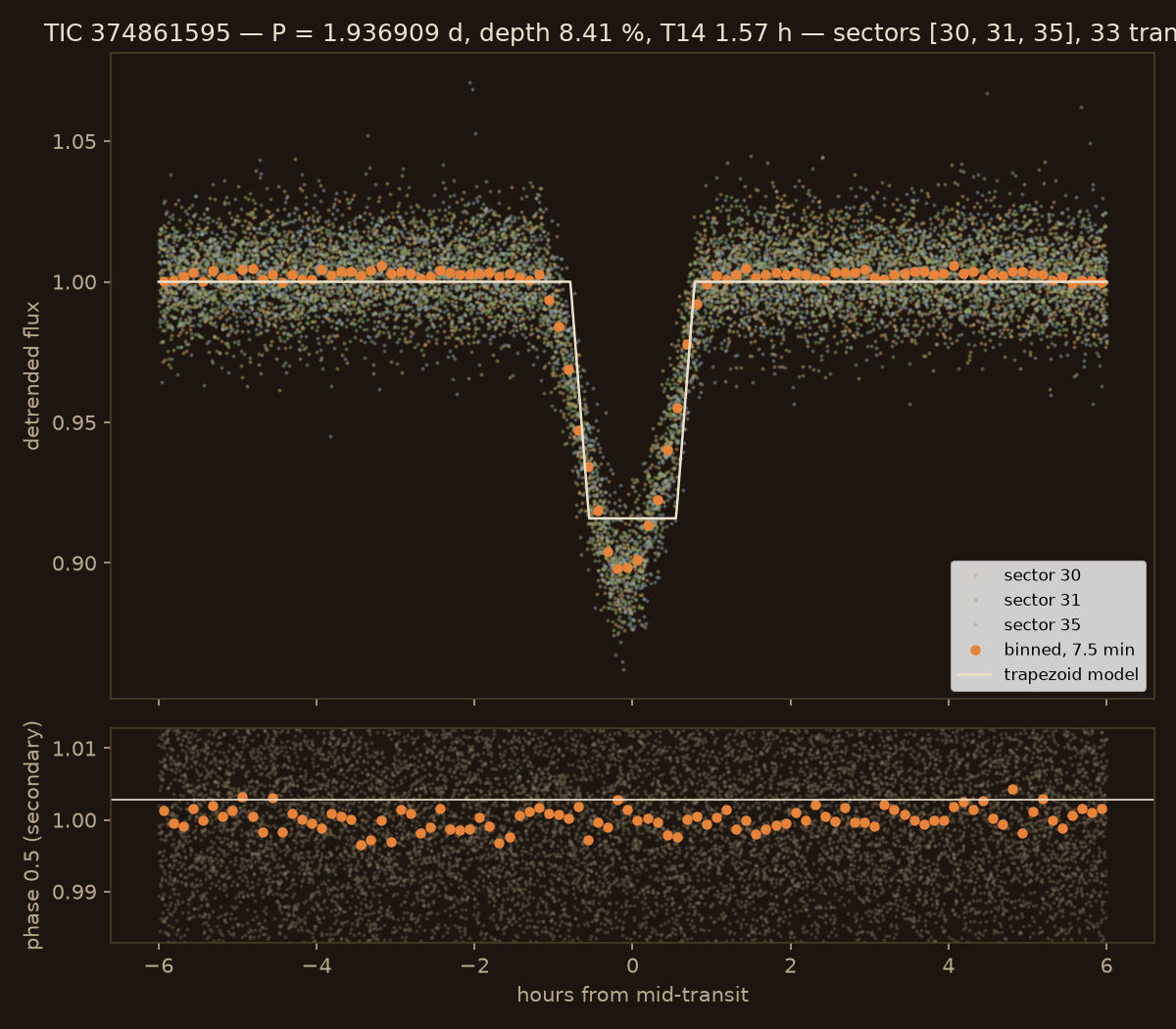
- Blind BLS recovery in sectors 30, 31, 35 with no prior knowledge of the target; period agreement with SPOC's 259-transit ephemeris, depth consistent sector to sector (8.39 / 8.35 / 8.51 % ± 0.07 by trapezoid — under SPOC's limb-darkened 10.46 %, in the direction a trapezoid is expected to err).
- Odd/even eclipses equal: this lab, per sector
0.26σ, 0.59σ, 1.66σ, stacked 2.4σ on 1,088 in-transit points. SPOC, on
all 259: statistic 1.288 (significance 0.256),
suspectedEclipsingBinary: false. Not an EB at 2P. - No secondary eclipse — two independent routes, same null. §5c.
- On-target. SPOC difference-image centroid 0.60″ ± 2.50″ from the TIC position (0.24σ) over 23 sectors, all 23 quality metrics good; this lab's centroid shift 0.002–0.003 px per sector; TIC contamination 0.07; nearest Gaia neighbours at 7.3″ (G 20.75) and 9.8″ (G 20.30) are ~5 mag fainter and could not produce a 10 % dip even eclipsing totally. Gaia RUWE 1.05.
- Ghost diagnostic: core 260.5 / halo 65.2 — the signal is in the core aperture, not scattered light from off-target.
- No TOI, no CTOI, no VSX entry, not in the confirmed-planet table.
Against, or unresolved.
- Size. At SPOC's k = 0.4299 the object is 2.59 ± 0.46 R_Jup — larger than any known planet, brown dwarf or small star. SPOC prints it in red on its own summary sheet. The grazing degeneracy is the likely explanation: k and b trade off hard at b = 0.90, and k ≈ 0.30 (1.7σ low) gives 1.8 R_Jup, which is merely large. This is the single number a referee will go after, and the honest position is that the radius is not measured, only bounded by a degenerate fit.
- R★ is catalogue, not measured. Mann+2015 from M_K = 4.98 gives 0.616 R☉ — which is what TIC uses, so quoting TIC is not an independent check. Gaia GSP-Phot says 0.80 R☉ (model-based, unreliable for M dwarfs). A Gaia-anchored R★ with its own error budget is a prerequisite for any radius claim.
- Mass unknown, and nothing here can fix it. Only radial velocities separate a giant planet from a brown dwarf: K ≈ 300 m/s for 1 M_Jup, ≈ 15 km/s for 50 M_Jup, at this period on this host. Tmag 14.1 — feasible on a 4-m-class spectrograph.
- Out-of-transit modulation at 3.80–3.87 d ≈ 2 P_orb, semi-amplitude 0.6–1.6 % in all three sectors this lab examined. Probably the host's rotation near a 2:1 spin–orbit commensurability. Unexplained, and a paper item.
- O−C drift. This lab's three trapezoid mid-times sit at +5.2, +3.2, +0.8 min against SPOC's ephemeris — monotone over 73 cycles. Almost certainly a bias in trapezoid mid-times rather than real TTVs, but it is not demonstrated either way.
Verdict: planet candidate (PC) — a grazing transit by an object cooler than ≈1,800 K on a 1.937-day orbit around an M2–M3 dwarf at 222 pc. Stellar companion excluded by the secondary-eclipse limit. Radius degenerate, mass unknown.
3 · Venue — the question is settled, and RNAAS loses
The previous revision left this open: "a Research Note of the AAS if RNAAS counts as peer-reviewed under ExoFOP's rule." It does not.
The AAS says so itself, on
journals.aas.org/research-notes/ (read 2026-09-18):
"Research Notes of the AAS is non-peer reviewed, indexed and secure record of works in progress" … "Research Notes are moderated but not edited."
So RNAAS cannot clear a gate whose text is "published in a peer-reviewed journal." Do not spend the writing effort there expecting a CTOI upload at the end of it. RNAAS remains a legitimate way to put a citable, ADS-indexed marker down in days, and it is worth knowing that option exists — but it is a separate decision with a separate purpose, and taking it does not advance the ExoFOP path by one step.
What the paper should be
A survey-methods paper in AJ (or PASP), with this candidate as its worked case — not a single-object note. Reasons, in order of weight:
- A single-candidate paper has thin new content and a hostile referee. SPOC found this signal 259 times and published the DV reports. A paper whose claim is "we independently recovered a signal the pipeline already has, and we think it deserved promotion" invites exactly one question: what is new? The honest answer — one archival measurement (the secondary bound) and a disagreement with a triage decision — is a paragraph, not a paper.
- The survey is real, is already done, and now has a
draft. Re-derived from the receipts on 2026-09-18 by
scripts/survey_paper_numbers.py: 12,898 target-searches over a sample of 12,151–12,702 distinct stars, 116 above threshold, every one dispositioned from a vocabulary of 18 terms, 14 of them used, 9 known planets recovered blind, 7 leads minted and 5 killed by the survey's own gates (of 7 refutation rulings), 0 planets claimed — plus 5 hunt files refused outright by their own controls (uniformity-failed,budget-over-share). A pipeline that logs its own refusals is the unusual part, and it is the part that is publishable. Quote figures from that reader, never from memory or from this paragraph — "12,898 targets", "closed 14-term vocabulary" and a bare "5 refutations" are each wrong in a way a referee would catch. The survey-paper draft itself is onclaude/project-thread-alqen7(1c8a7f1). - The two halves need each other. A survey that
claims no occurrence rate and no detection completeness (the repo's
claim_boundaryexplicitly disclaims both) has a weak positive result on its own. A candidate with no survey around it has no denominator. Together they make one defensible claim: an automated disposition pass over 12,898 targets surfaced a high-MES signal that human triage had set aside across 23 sectors, and the measurement that discriminates it was sitting in the archive the whole time. - It clears the ExoFOP gate on its own terms. AJ and PASP are peer-reviewed without argument, so the paper that makes the science case is also the paper that unlocks the upload. One writing effort, both outcomes.
Frame it as a gap, not an accusation. The claim is not "the TESS Science Office erred." It is: high-MES, grazing, large-inferred-radius signals on faint M dwarfs fall into a triage gap, because the cheap archival test that resolves them — the secondary-eclipse surface-brightness bound — is not part of the standard promotion path. That is constructive, checkable, and generalises past one target. An accusation does not survive review; a named gap with a proposed test does.
4 · What "submit" requires, in order
- Two analysis upgrades
(
scripts/tic374861595_refit.py, written to run on Ben's machine because this environment cannot reach MAST): a limb-darkened Mandel-Agol fit with the grazing degeneracy properly explored, and a Gaia-anchored R★ with its own errors. Without these the radius is indefensible. - Write the paper per §3. AJ or PASP.
- ExoFOP account — "REQUEST AN ACCOUNT" on exofop.ipac.caltech.edu/tess (its own registration, not the Exoplanet Archive login). Independent of everything above; can be done today.
- Published Candidate Upload Request
(
pub_candidate_upload_request.php) with the paper URL. - Upload via
add_new.php?param=bulkparamswith the line in §1 and the tag.
5 · Adversarial re-check — SPOC has seen this 259 times
5a · Someone has looked, and did not promote it
MAST holds SPOC Data-Validation products for TIC 374861595 in
every 2-minute sector it has — 23 of them, read
off the DV bitmap: 27, 28, 30, 31, 35, 36, 37, 38, 61, 62, 63, 65, 66,
67, 68, 69, 87, 88, 89, 90, 93, 94, 96 — plus multi-sector
runs. The latest multi-sector DV (sectors 1–96, 2025-12-24,
spoc-5.0.125; XML committed beside this file, every number
in §1 re-extracted from it 2026-09-18) finds our signal as TCE
1 at MES 508.6, bootstrap FAP 0,
suspectedEclipsingBinary: false, centroid on target, ghost
diagnostic clean.
The pipeline vetted it clean and the TESS Science Office never promoted it. Note the coverage starts at sector 27 (July 2020), not at launch — TESS did not observe this target in its first two years, so the unpromoted span is about five years, not seven. The likeliest reading is human triage: a V-shaped 10 % transit giving Rp > 2 R_Jup on a faint M dwarf is what gets set aside as a probable eclipsing binary without further work. That is the objection the paper must answer head-on, and §5c is the answer.
Two further TCEs (268 d and 291 d, 3 and 2 events, MES ~12) are multi-sector false alarms of the usual kind and are not part of this candidate.
5b · What the re-check withdrew from earlier revisions
- Ephemeris: SPOC's, not ours. 259 transits over 1,897 d beats 33 over 141 d.
- Depth and duration were underestimated by the trapezoid, as predicted: 8.41 % and 1.57 h against SPOC's 10.46 % and 2.15 h.
- "Twin stars excluded at 18σ" is withdrawn as stated. It compared a sharp V with a flat-topped trapezoid; a limb-darkened grazing transit is curved and beats both, so the test excludes only a sharp V, not a grazing geometry.
- The trapezoid's shape density (6.15 g/cm³) is withdrawn. With b = 0.90 the geometry is degenerate and the trapezoid's b ≈ 0.29 was the wrong branch.
- The density tension is real and is not resolved. In one unit throughout: the transit-shape density from SPOC's a/R★ = 7.715 is 2.32 g/cm³ (1.644 ρ☉); the TIC catalogue density is 3.62 g/cm³ (2.571 ρ☉); the withdrawn trapezoid gave 6.15 g/cm³. The fit sits a factor 1.56 below the catalogue. At fixed period that means one of: a non-circular orbit, an R★ smaller than TIC's, or a grazing fit sitting on a low-a/R★ branch. This is the second reason the refit in §4 step 1 is a prerequisite, not a polish step — it is the same tension as the radius problem, seen from a different side.
5c · What stands, and why the grazing geometry does not spoil it
No secondary eclipse. This lab: −159 ± 628 ppm over 34 events on undetrended flux with per-event local baselines. SPOC: maximum weak-secondary MES 3.3, 602 ± 168 ppm, at phase 0.328 d, not at 0.5 P = 0.968 d. Two routes, same null. Adopted 3σ ceiling on a phase-0.5 event: 1,105 ppm.
The obvious worry is that b = 0.90 breaks the usual secondary/primary relation, because only part of the companion's disc ever crosses the star. It does not, and the cancellation is exact:
primary depth   = A_overlap · I_star      / F_total
secondary depth = A_overlap · I_companion / F_total
The same overlap area appears in both — at secondary the star covers exactly the region the companion covered at primary — so
secondary / primary = I_companion / I_star, the surface-brightness ratio, independent of b, of k, and of how grazing the configuration is.
Against the 10.46 % primary, the 1,105 ppm ceiling bounds the
companion's TESS-band surface brightness at < 1.06 %
of the host's. Computed by Planck integration over the TESS band
(scripts/tic374861595_secondary_limit.py, two different
bandpass stand-ins agreeing to 1 %):
| companion | Teff | I₂/I★ | predicted secondary | verdict |
|---|---|---|---|---|
| M5V star | 3050 K | 5.1e−1 | 52,800 ppm | excluded, 48× over |
| M7V star | 2650 K | 2.1e−1 | 21,800 ppm | excluded, 20× over |
| M9V / BD boundary | 2400 K | 1.0e−1 | 11,000 ppm | excluded, 10× over |
| L2 brown dwarf | 1900 K | 1.6e−2 | 1,670 ppm | excluded, 1.5× over |
| L8 brown dwarf | 1400 K | 7.2e−4 | 75 ppm | allowed |
| T4 brown dwarf | 1100 K | 3.2e−5 | 3 ppm | allowed |
| planet at T_eq | 745 K | 4.0e−8 | ~0 ppm | allowed |
Cut-off: T_companion ≲ 1,800 K. Every stellar companion is excluded by 10–48×; early-L is excluded marginally; mid-L and cooler survive. The previous revision said "excluded by two orders of magnitude" with a 1,000 K cut-off — both were overstated, and the correction is in the direction that matters (the true bound is looser than claimed). The conclusion is unchanged: a stellar companion is ruled out; a giant planet or a cool brown dwarf is not.
Two caveats, both stated rather than buried. Reflected light and thermal redistribution are ignored, which can only add secondary flux and so makes the exclusions conservative. Blackbodies are a poor model for L and T dwarfs, which are fainter than blackbodies in the TESS band — so the real cut-off sits somewhat above 1,800 K, again in the permissive direction for the objects being kept.
5d · Independent checks that came back clean
PDM on raw PDCSAP (no BLS, no lab detrend): P = 1.93695 d. The two eclipses at 2P: depths 9.06 ± 0.07 vs 9.14 ± 0.07 % (0.8σ), mid-times 0.4 min apart, durations identical — the period is P, not 2P.
Catalogues. SIMBAD (bare Gaia entry, no type); Gaia DR3
vari_summary,vari_eclipsing_binary, classifier and NSS all empty; RUWE 1.05; Prša+2022 TESS-EB catalogue absent; ExoFOP target page empty in every section; Exoplanet Archive TOI and PS tables empty; literature and web nothing.AAVSO VSX — the check that was outstanding, now closed (queried 2026-09-18 via
vsx.aavso.orgapi.list at this position). No VSX entry for TIC 374861595 / Gaia DR3 4756470194913503104. The three VSX variables returned in the field are Gaia DR3 4756470229273232768 (58.3″), 4756470607230351616 (86.9″) and 4756471015244217472 (176.6″) — all distinct sources, all far outside any plausible blend radius for a 10 % dip.Host radius. Mann+2015 from M_K = 4.98 gives 0.616 R☉, which is exactly what TIC adopts — so this agrees with the catalogue rather than checking it. Gaia GSP-Phot says 0.80 R☉ (model-based, unreliable for M dwarfs). Use 0.62 R☉, say why, and treat the disagreement as open. An earlier revision read "Mann+2019 mass 0.72 M☉ → ρ 4.4 g/cm³". That 0.72 is wrong and is retracted (2026-09-18). TIC v8 itself uses Mann+2019 for cool-dwarf masses and reports 0.601 M☉ from the same M_K = 4.98, and an independent implementation of the relation in
scripts/tic374861595_refit.pyreturns 0.6001 M☉. The condition this paragraph set for correcting it — that somebody read Mann+2019 Table 6 — is now met, and met from a better source than the printed table:scripts/mann_coefficients_check.pycompares the relation against the authors' own 400,000-sample MCMC posterior (resources/Mk-M_7_trim.fits, github.com/awmann/M_-M_K-), of which Table 6 reports the medians. Mann+2019 gives 0.6053 M☉ at M_K = 4.98. It only returns 0.72 M☉ at M_K = 4.19, which is 0.79 mag brighter than this star — a different object, not a different rounding. Mann+2015's own M_Ks→M★ relation (Table 1, 4th order) gives 0.6373, so the 0.72 is not that older row misattributed either. It is not reproducible from either Mann relation at this star's M_K, and no derivation for it exists.What replaces it is a smaller, real systematic that should be carried instead: Mann+2015's mass relation (0.637 M☉) and Mann+2019's (0.600 M☉) disagree by 6 %, which is larger than either relation's quoted scatter. Mann+2019 is the one to use — it is calibrated on dynamical masses, where Mann+2015's mass row is semi-empirical, resting on model-derived masses.
The same check closes the caveat that travelled with the refit script, that its Mann coefficients had been reproduced from memory and corroborated only by reproducing TIC's own numbers. They are now checked against the sources: Mann+2015's three radius coefficients match the published table digit for digit, and all six Mann+2019 coefficients sit within 1.31 σ of the authors' posterior (mass consequence at this star: −0.86 %, inside the relation's own 1.33 % spread). Cite Mann+2015 Table 1 as corrected by the 2016 erratum, ApJ 819, 87 — the journal printed Tables 1–3 with press errors, and the erratum's values, not the original article's, are the ones that match.
5e · Where the package stands
Planet candidate, unchanged. A strong, on-target, grazing transit that SPOC has seen 259 times and never promoted, whose one discriminating measurement is the missing secondary eclipse — which rules out a stellar companion and leaves a giant planet or a cool brown dwarf. The paper writes itself around that measurement, the survey that found it blind, and an RV request. It does not write itself around a radius, because the radius is degenerate.
§5f reports the refit, which has now been run. It does not change this verdict; it hardens it.
5f · The refit, run — 2026-09-18
scripts/tic374861595_refit.py has been run against MAST.
Full output in TIC374861595-refit-2026-09-18.log,
machine-readable in the matching .json:
py -3.11 scripts/tic374861595_refit.py --backend numpy \
  --kmag 11.710 --kmag-err 0.026 \
  --parallax 4.512610 --parallax-err 0.023275 \
  --errors mcmc --json docs/submissions/TIC374861595-refit-2026-09-18.json
The archive is much larger than this package assumed. 24 SPOC 2-minute sectors (27–97), 378,654 good cadences, BTJD 2036.3 to 3988.3 — a 1,952-day (5.3-year) baseline, 289 transit windows, 105,227 cadences in the fit. The blind search used three sectors.
Why this is 24 sectors and §1 is 23. They count
different things and both are right. §1 is the DV run, generated
2025-12-24 over sectors 1–96: its sectorsObserved bitmap
has 23 bits, the highest S96, spanning 1,897 d. This refit queried MAST
on 2026-09-18, nine months later, and got one sector more and 55 days
more. The extra sector's identity is not actually pinned down by
either artifact. The 55-day tail is 2.00 sector lengths past
the DV's last cadence while the count rises by only one, which fits one
skipped sector followed by one observed one — and that would make the
highest sector S98, not the S97 written above. Neither the log nor the
JSON enumerates the sectors, so the "27–97" range label is a typed
number, not a derived one. Do not quote it in the paper until
the script prints the list.
Both gaps are closed in code as of 2026-09-19, and both need a
re-run on a machine with MAST access to produce their output. The
script now derives the sector list from each product's own
SECTOR keyword, prints it, counts any product it could not
identify, and ships it in the JSON as coverage; and
--chain <file.npz> writes the joint MCMC samples,
with the JSON saying so when it is not passed. Five tests in
tests/test_tic374861595_refit.py gate the coverage helper,
including that it will not emit a range across a sector that was never
observed.
The stellar inputs are now measured rather than
back-derived. 2MASS Ks = 11.710 ± 0.026 (PSC 05542154−6407473;
Qflg AAA, Cflg 000, Xflg 0 — clean) and Gaia DR3
parallax 4.512610 ± 0.023275 mas (RUWE 1.05,
non_single_star = 0). TIC v8's 4.47187 mas is DR2. The
script's built-in default K is back-derived from the package's own M_K
and must never be used for anything published; pass the real one.
What the refit settled
| row | was | is |
|---|---|---|
| R★ | catalogue — "agrees with TIC rather than checking it" | 0.6148 ± 0.0186 R☉, derived here from the measured Ks and the DR3 parallax, M_K = 4.982 ± 0.028. It reproduces TIC to 0.2 %, which is now a check instead of a copy. |
| M★ | disputed; one line said 0.72 M☉ | 0.5998 ± 0.0185 M☉ |
| O−C | "+5.2, +3.2, +0.8 min over 73 cycles, monotone; almost certainly trapezoid mid-time bias" | Explained — and the guess was right in spirit, wrong in detail. It is the trapezoid's period, not its mid-times. The trapezoid period sits 3.382 s/cycle short of SPOC's (16 σ on its own error bar); over 73 cycles that predicts −4.12 min of drift against the −4.40 min observed, agreeing to 7 %. No TTV is required, and none is claimed. |
What it did not settle — and one thing it made worse
- The radius is less measured than before. k = 0.544 (+0.111 / −0.101), b = 1.053 ± 0.134. The posterior's median geometry puts the companion's centre outside the stellar disc, and about two-thirds of the marginal b posterior sits above b = 1. Across 1 σ in k, Rp spans 2.65 to 3.92 R_Jup. A grazing transit does not determine k, and this fit ran further up the k–b valley than SPOC's did. Quote k with b, or do not quote it.
- The density tension survived a better fit and a derived radius. ρ from the transit shape 2.375 g/cm³; ρ from the Mann relations 3.640 g/cm³. The star implies a/R★ = 8.971 where the fit returns 7.781 ± 0.155 — 7.7 σ. Since R★ now comes from measured photometry and DR3 astrometry rather than from the catalogue, "TIC's radius is wrong" is the weakest surviving explanation. What remains: an eccentric orbit, a fit on the wrong branch of the grazing valley, or an unresolved blend — the transit not being on the star the Mann relations describe.
- The refit's period disagrees with SPOC's at 18 σ: 1.936952791 ± 1.1 × 10⁻⁷ d against 1.936948445 ± 2.1 × 10⁻⁷, a difference of 0.376 s per cycle. Small, formally significant, and not chased here — the two fits cover different sector ranges (27–97 against 1–96) and the difference is most likely systematic. It is recorded rather than rounded away. §1's upload line still carries SPOC's ephemeris; nothing here replaces it.
- A single linear ephemeris fits all 289 windows at χ²ᵥ = 0.919 over 105,227 points. There is no large TTV to find.
- The joint (k, b) posterior is not written out. The script serialises 16/50/84 marginals only, and marginals are not a joint posterior — which is precisely what the degeneracy argument needs. Dumping the chain is a small change and is the next thing this script should get.
One operational note. --backend auto
picks batman whenever it is installed, and that path
rebuilds its model inside every likelihood call: 348 ms per evaluation
against 3.9 ms for the numpy integrator at the same cadence count. That
is ~90× and it is the difference between a roughly three-hour MCMC and
one on the order of ten days. The two backends agree to 1.54
ppm in --selftest. Pass
--backend numpy until the model object is hoisted out of
the likelihood.
6 · Files
TIC374861595-spoc-s1-s96-dvr.xml— SPOC's multi-sector DV report (2025-12-24). Every transit parameter in §1 is extracted from this file; nothing is retyped.TIC374861595-ephemeris.json— this lab's per-sector trapezoid fits, bootstrap errors, joint ephemeris (scripts/ctoi_ephemeris.py). Superseded for the upload line, retained as the independent recovery.TIC374861595-checks.json,-checks2.json— stacked odd/even, secondary (undetrended, local baseline), free-ingress shape fit.TIC374861595-gaia-neighbours.json— 41 Gaia DR3 sources within 45″.TIC374861595-fold.png— phase-folded, all sectors, binned, with the trapezoid.scripts/tic374861595_secondary_limit.py— the §5c calculation.--selftestruns offline and checks the Planck arithmetic against Wien's law and known limits.scripts/tic374861595_refit.py— the limb-darkened refit and Gaia-anchored R★. Run 2026-09-18 against MAST over 24 sectors; see §5f.--selftestruns offline, 8/8. Pass--backend numpy.TIC374861595-refit-2026-09-18.json/-.log— that run: the fit, the MCMC marginals, the derived host, the density cross-check, and the three-way comparison against the lab trapezoid and SPOC's DV.scripts/mann_coefficients_check.py— checks the refit's Mann+2015/2019 coefficients against the published table and the authors' own posterior. Exit 0 agrees, 1 disagrees, 3 undetermined.- Receipts:
reports/hunts/hunt-2026-08-31-s30-0102.json,followup-374861595-s31.json,followup-374861595-s35.json— each SHA-256-pins its light curve.