Two bottles and a crowd
In 2006 about 2,000 people in Tokyo focused good intentions on water in a California lab, and 100 blind judges rated ice crystals from that water as more beautiful (P = .001). A 2008 repeat used 2,579 judges and 128,950 ratings. But the intention was aimed at bottles, and each study had two treated bottles. Counted by bottle, neither design can get below P = 1 in 15.
The verdict
Nothing there
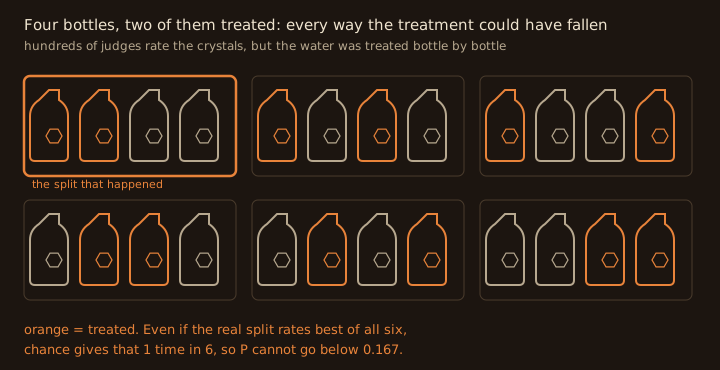
The water was treated bottle by bottle, with two treated bottles in each study, and counted that way no test can reach a P below 1 in 6 (2006) or 1 in 15 (2008), whatever the judges saw. In simulated worlds with no effect at all, counting each judge's rating as independent comes out “significant” about four times in ten.
Two treated bottles and two controls, as far as we can tell from secondary sources. There are six ways to pick two bottles of four, so the best possible one-tailed P is 1/6, about 0.17.
Two treated, two nearby controls, two distant controls, 50 photos each. Treated against nearby: 1/6 at best. Against all four controls: 1/15, about 0.067.
In simulated studies with no effect at all, 2 against 2 bottles, 10 photos each and 100 judges, a test that treats every rating as independent says “significant” 41 % of the time.
With 10 treated bottles and 10 controls and a real effect, the bottle-level test finds it 76 % of the time.
The claim, as presented. The paper reports that about 2,000 people in Tokyo directed intention at water in a California lab, and that 100 blind judges rated crystals from that water as more beautiful (P = .001, one-tailed).
Explore (Radin, Hayssen, Emoto and Kizu), “Double-blind test of the effects of distant intention on water crystal formation”, September 2006 · the episode
The registry’s note on sources. Read from the Institute of Noetic Sciences summary (2026-10-10); the journal's full text could not be opened. The 2006 bottle and photo counts (two treated and two control bottles, about 40 photos) come from secondary sources; the 2008 replication's counts come from the paper itself (J Sci Exploration 22(4), 2008, fetched 2026-11-14).
Read before the run, 2026-11-14. The 2008 replication (Radin, Lund, Emoto and Kizu, Journal of Scientific Exploration) reports its design in full. Its main test does nest photos within bottles and gives P = .03; that test assumes six bottle averages are normally distributed, which six bottles cannot check. Its distant controls were rated slightly more beautiful than the treated water. The authors themselves note uncontrolled freedoms in the experiment. The 2006 paper’s full text could not be opened; its counts here are from secondary sources.
Preregistered in PREREG.md (commit c708b20) before any code. Self-graded, with no outside review. Lab files are listed at the foot of the page.
The checks
The test fixed in advance: an exact randomization test on bottle averages, one-tailed, the bottles being what the intention was aimed at. It assumes nothing about how ratings are spread. Fixed before any bottle average was seen; none is published.
| Check | Result | Numbers |
|---|---|---|
| 2006, by bottle (holds only below 0.05) | does not hold | smallest possible P 1/6 ≈ 0.167, whatever the ratings |
| 2008, by bottle | does not hold | treated v nearby 1/6; treated v all controls 1/15 ≈ 0.067 |
| 2008, all three groups at once | observed | exact floor 1/15; the paper’s normal-theory test gives 0.033 |
| No-effect worlds, photos as units, no bottle differences | pass | 5.0 % false alarms (gate 3–7 %) |
| No-effect worlds, bottles as units | pass | 0 % false alarms at every setting |
| Every rating counted as independent | red, as it should be | 41 % false alarms with no bottle differences; 43 % with small ones |
| 10 v 10 bottles, a real effect | red, as it should be | found 76 % of the time |
How fast photos-as-units goes wrong. If bottles differ a little on their own, as bottles of water from the same source still might, counting each photo as independent raises the false-alarm rate from 5 % to 9 % when bottles carry 5 % of the variation, 11 % at 10 % and 16 % at 20 %.
- Water. This is about what the designs can show, not a measurement of crystals.
- The 2006 counts against the paper itself: its full text could not be opened. If they differ, the 2006 line is re-run.
- Whether the photographer’s choice of which crystal to shoot could carry the effect. The 2008 authors raise the risk themselves.
Read: Radin, Lund, Emoto and Kizu, J Sci Exploration 22(4) (2008); the 2006 abstract via IONS. Prior art: the 2008 paper’s own nested test. I haven’t found a published randomization floor for these designs; that is not a claim that none exists.
One engine, three claims
This episode shares one instrument with two others. It asks the same question each time: how many chances did the claim get, and what does chance look like after the same selection? The Munich dowsers had 104 test series, and the best one was reported. The balance bracelet demo gives you a second try and credits the band. The water crystals got hundreds of judges and thousands of ratings for water that was treated in two bottles.
In all three the effect is real as a selection, and none of them survives counting the chances. The same machine can say yes: a planted skilled dowser, a planted band effect and a study with enough bottles all come out positive.