The best of 104 guessers
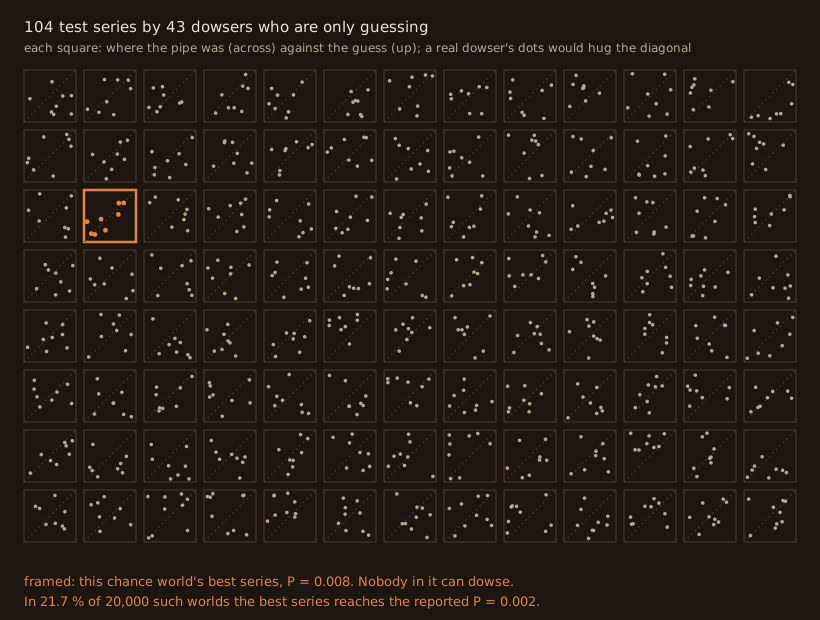
In 1987 and 1988 a team in Munich tested dowsers on a hidden water pipe in a barn: 43 dowsers, 104 test series, 843 single tests. A few series looked far better than chance, and the best was reported at a chance probability of 0.2 %. We built 20,000 worlds in which the same people, in the same layout, are only guessing, and picked the best series the same way. About one world in five has a best series that good.
The verdict
Nothing there
Picking the best of 104 chance test series gives a run as good as the Munich best about one time in five (21.7 % of 20,000 simulated worlds), and chance alone gives seven series below 5 % about one time in four, so the reported best dowsers are what best-of-many chance looks like. Six planted skilled dowsers stand out at P = 0.0002, so the test can say yes.
With nobody able to dowse, 21.7 % of 20,000 worlds still have a series at P ≤ 0.002, the probability reported for the best run. A result is shown only if that share is below 5 %.
Enright counted 7 of the 104 series below P 0.05. Chance gives 5.3 on average, and 7 or more in 27.4 % of worlds.
In 88.9 % of chance worlds at least one of the 43 dowsers has trials that, combined, fall below P 0.05.
Plant six dowsers who find the pipe to within about a metre, and their best series stands out at a corrected P of 0.0002.
The claim, as presented. The article reports that a few exceptional dowsers located a hidden water pipe better than chance over 843 double-blind trials.
Skeptical Inquirer (H.-D. Betz), “Follow-up: Dowsing Successful”, September 1999 · the episode
The registry’s note on sources. Read from the source named here by a research subagent (2026-10-09); paraphrase, not quotation. No video was watched.
Read before the run, 2026-11-14. Betz’s 1999 letter defends the result: the best run had a chance probability of 0.2 %, that dowser’s trials combined stay below 5 %, and the full analysis gave P = 0.0007. Enright’s article in the same magazine, January 1999, argues that the best series were picked from 104 after the fact and did not repeat. The test is of the episode’s question: does the best series beat what picking the best of many chance guessers gives?
Preregistered in PREREG.md (commit c708b20) before any code. Self-graded, with no outside review. Lab files are listed at the foot of the page.
The checks
Written down before the code. The layout follows Enright’s account: 104 series of 8 or 9 tests (843 in all), pipe and guess on a 10 m line, a one-sided correlation test per series. 20,000 chance worlds.
| Check | Result | Numbers |
|---|---|---|
| The best of 104 series (shown only if below 5 %) | not shown | 21.7 % of chance worlds reach P ≤ 0.002; predicted about 19 % |
| Seven or more series below P 0.05 | not shown | 27.4 %; chance averages 5.3 |
| Some dowser below P 0.05 overall | not shown | 88.9 % |
| Chance series are fair | pass | 5.06 % fall below P 0.05 (gate 4.5–5.5 %) |
| Six planted skilled dowsers | red, as it should be | best series P = 2.9×10⁻⁶; corrected 0.0002 |
| The selection forgotten | red, as it should be | reads the 0.002 as 0.0018: “shown”. That gap is the whole episode. |
- The overall analysis that gave P = 0.0007. Enright calls its method nonstandard, and we have no raw data to redo it.
- The pipe positions, which Enright reports were not spread at random along the line.
- The screening of about 500 candidates before the main tests. Betz and Enright disagree about how it worked, so the simulation leaves it out; it could only make chance look better.
Read: J. T. Enright, “Testing dowsing: the failure of the Munich experiments”, Skeptical Inquirer 23.1 (1999); H.-D. Betz’s letter and Enright’s reply, Skeptical Inquirer, September/October 1999. Prior art: Enright made this argument; this episode puts a number on it. No novelty claimed.
One engine, three claims
This episode shares one instrument with two others. It asks the same question each time: how many chances did the claim get, and what does chance look like after the same selection? The Munich dowsers had 104 test series, and the best one was reported. The balance bracelet demo gives you a second try and credits the band. The water crystals got hundreds of judges and thousands of ratings for water that was treated in two bottles.
In all three the effect is real as a selection, and none of them survives counting the chances. The same machine can say yes: a planted skilled dowser, a planted band effect and a study with enough bottles all come out positive.