The second try
A hologram wristband was sold with a shop-floor demo: test your balance, put the band on, test again. A 2011 double-blind study on 42 college athletes gave each person one try with the real band and one with a fake, in random order. We reanalysed its printed numbers. The second try beats the first on every test, whichever band is worn, and the band itself makes no detectable difference.
The verdict
Real effect, different reason
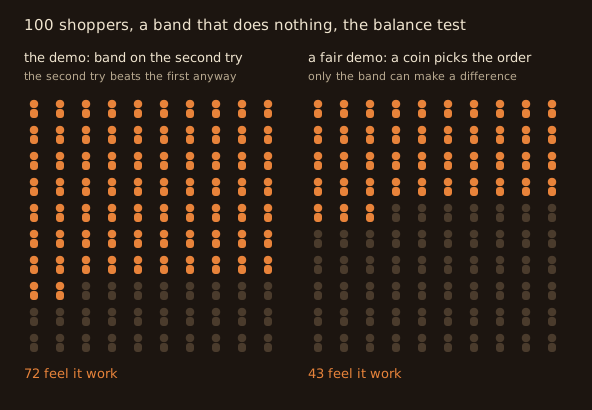
In the published crossover data the second try beats the first on every test whichever band is worn, while the band itself makes no detectable difference, so a demo that always tests without the band first shows 62 to 72 % of people “improving” with it. Three preregistered checks missed because the assumed test-retest correlation was too low; this verdict rests on an addendum declared after the first run.
Read it with the misses. The first run missed three preregistered checks, so under the original rule this episode had no verdict. The study does not report how strongly each athlete’s two tries correlate, and the range we wrote down in advance (0.5 to 0.8) was too low: the paper’s own significant results need about 0.7 for strength and 0.9 for the jump. An addendum, written after the first run and before the re-run, took that correlation from the paper’s own results, and the re-run passed. The verdict rests on that addendum.
From the first try to the second: flexibility up 9.1°, balance up 1.7 kg, strength up 2.4 kg, jump up 1.8 cm. The band against the fake: −0.3°, −0.5 kg, +0.6 kg, +0.5 cm.
At the correlation the paper’s own results imply, the band’s effect has P = 0.92, 0.29, 0.61 and 0.56 on the four tests.
With the band always second, 69, 72, 62 and 63 % of people do better “with the band”. With the order left to a coin: 49, 43, 53 and 54 %.
On simulated athletes with a real band effect as big as the second-try effect, the same analysis finds it on every test, and never mistakes it for the order.
The claim, as presented. Power Balance promoted its hologram wristband as improving balance, strength and flexibility; the ACCC release reports the company admitting it had no credible scientific basis for those claims.
Australian Competition and Consumer Commission, “Power Balance admits no reasonable basis for wristband claims”, December 2010 · the episode
The registry’s note on sources. Read from the source named here by a research subagent (2026-10-10); paraphrase, not quotation. No video was watched.
Read before the run, 2026-11-14. The study is Porcari and colleagues, a letter in the Journal of Sports Science and Medicine (2011), funded by the American Council on Exercise. It reports no difference between the real band and the fake on any test, and that all four tests were better on the second try regardless of band. It suggests the second try is a warm-up or learning effect, and that this explains why public demonstrations seem to work. This episode checks those printed numbers against each other and shows the demo as a selection.
Preregistered in PREREG.md (commit c708b20) before any code; Addendum 1 (bbdf64b) after the first run, declared as such, before the re-run it governs. Self-graded, with no outside review. Lab files are listed at the foot of the page.
The checks
The paper prints means and spreads for the real band against the fake (Table 1) and for the first try against the second (Table 2). Read as a balanced crossover, 21 + 21 (the split is assumed), each difference has a paired test once the athletes’ two-try correlation is known. It is not reported, so the analysis sweeps it.
| Check | Result | Numbers |
|---|---|---|
| Second try at least as big as the band, all four tests | pass | 9.1 vs 0.3; 1.7 vs 0.5; 2.4 vs 0.6; 1.8 vs 0.5 |
| Band within chance, correlation 0.5 to 0.8 | pass | lowest P 0.110 (balance, 0.8) |
| Second-try effect significant at correlation 0.5 | missed | strength P = 0.118, jump P = 0.347 |
| A planted band effect is found (at 0.7) | not red for the jump | median P 0.19; flexibility and balance red |
| A planted band effect is not mistaken for order (at 0.7) | not red for the jump | the plant is too small to see at that correlation |
| Check | Result | Numbers |
|---|---|---|
| Correlation used | from the paper | flexibility 0.5, balance 0.5, strength 0.7, jump 0.9 |
| Band within chance | pass | P 0.92, 0.29, 0.61, 0.56 |
| A planted band effect is found | red, as it should be | median P 0.004, 0.0008, 0.036, 0.041 |
| … and not mistaken for order | red, as it should be | order P 0.47–0.54 while the band is found |
One more thing the sweep shows. The band’s effect on balance would reach P 0.05 only if each athlete’s two tries correlated at 0.9 or more, and then it points the wrong way for the claim: 11.6 kg with the band against 12.1 with the fake.
- The raw data. Every number here is rebuilt from the letter’s printed means and spreads.
- The exact shop-floor demo, which pushes on an outstretched arm. The study measured balance as a force in kilograms.
- Wearing the band for days or weeks. The study tested it on the spot, as the demo does.
Read: Porcari et al., J Sports Sci Med 10 (2011) 230–231; the ACE press release (March 2011); the ACCC media release (December 2010). Prior art: Porcari and colleagues reported both findings. No novelty claimed.
One engine, three claims
This episode shares one instrument with two others. It asks the same question each time: how many chances did the claim get, and what does chance look like after the same selection? The Munich dowsers had 104 test series, and the best one was reported. The balance bracelet demo gives you a second try and credits the band. The water crystals got hundreds of judges and thousands of ratings for water that was treated in two bottles.
In all three the effect is real as a selection, and none of them survives counting the chances. The same machine can say yes: a planted skilled dowser, a planted band effect and a study with enough bottles all come out positive.