Spirals turn up in shells, ears, antennas and brass. These episodes ask what a coil really does to a wave.
Tested · verdict in
Level 2 of 52-D wave simulator
You’ll learn. Why coiling a tuba barely moves its notes, unless the bends are tight.
The question. Does coiling a tuba change its sound?
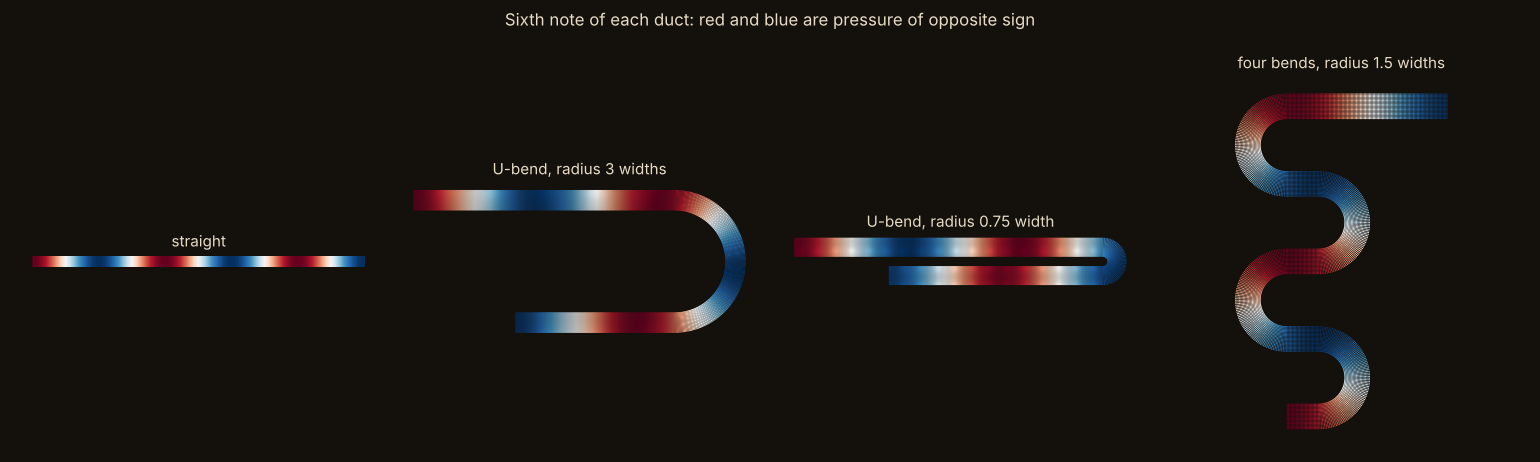
Nothing there In a 2-D model, coiling a tube gently, with bends at least three tube widths in radius, moves none of its first eight notes by more than 4.3 cents, below what an ear can pick out; tight bends do push notes sharp, by up to 18 cents for one U-bend and 24 cents for four moderate bends.
Tested · verdict in
Level 3 of 52-D wave simulator
You’ll learn. How a spiral twists the waves that leave it, and how a software bug once faked a bigger result.
The question. Does a Kozyrev mirror do anything?
Real effect, different reason A spiral does twist the waves that escape it, by ordinary reflection. In equilibrium the twist is zero, and the old +19.05 was an integrator artifact. The mechanism is textbook prior art.
Tested · verdict in
Level 3 of 52-D wave simulator
You’ll learn. Why a spiral mirror brightens some spots but cannot heat anything above its surroundings.
The question. The episode's actual claim: a spiral concentrates an ambient energy.
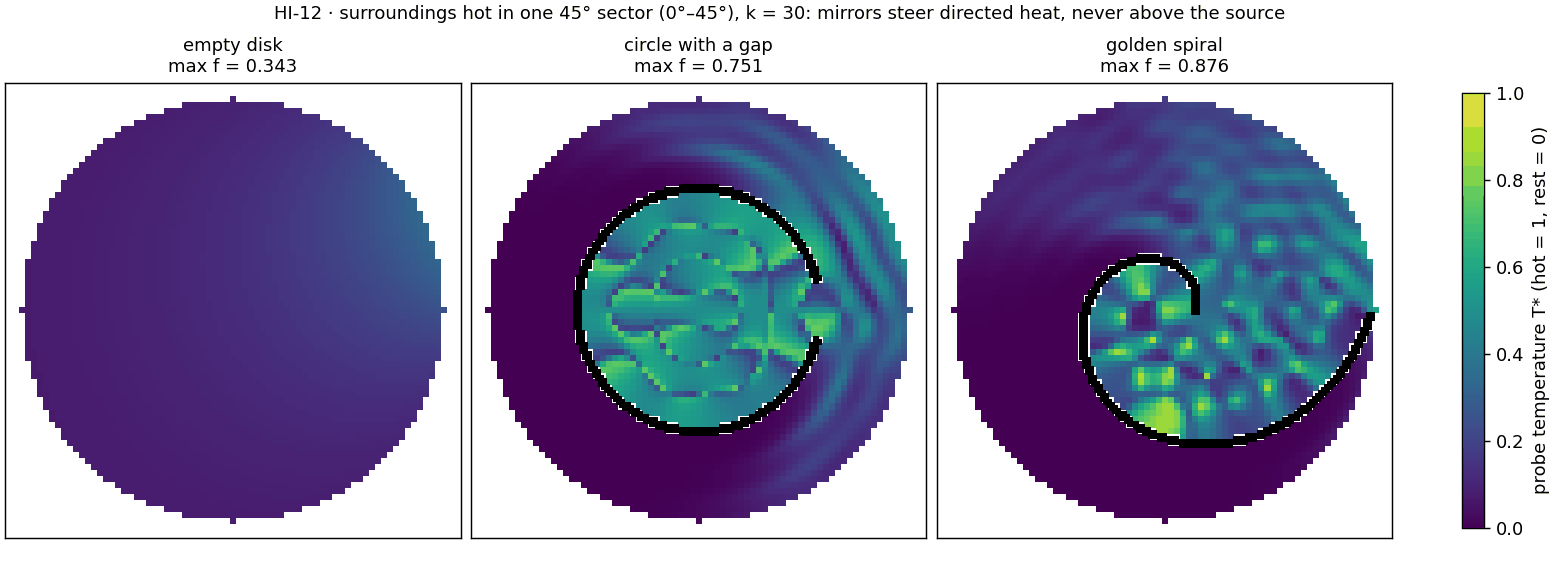
Real effect, different reason In a 2-D wave model the spiral raises ambient wave energy in spots, by up to about 1.5x at the frequencies sampled, as any reflector does. A probe at the same temperature draws no net power from it, and in this model no passive probe ends up hotter than its hottest source.
Tested · verdict in
Level 3 of 52-D wave simulator
You’ll learn. When sound can turn a spiral like a windmill, and why something always has to power it.
The question. Can a Kozyrev mirror be a motor as a rotor?
Real effect, different reason In the 2-D model a Kozyrev spiral turns when something powers it: a speaker inside pushes it by recoil, and a sound beam it partly absorbs can drag it round on a nearly frictionless mount. A lossless spiral in a steady plane wave settles at one angle, uniform noise does nothing, and whether the 3-D build turns is untested.
Tested · verdict in
Level 3 of 52-D wave simulator
You’ll learn. What the coil in your inner ear does to sound waves, and what it does not do.
The question. Does the coil help us hear bass?
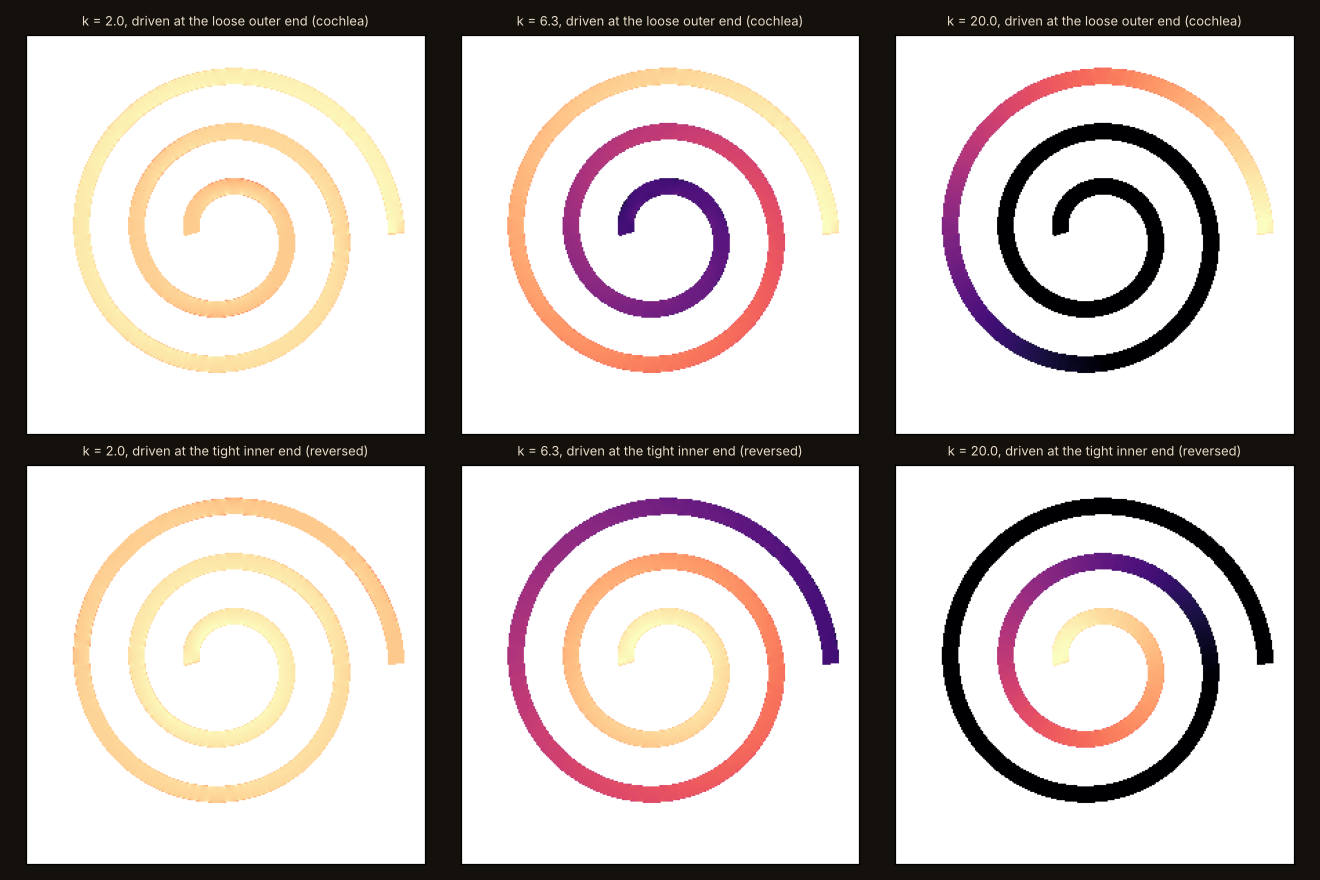
Real effect, different reason In a 2-D toy duct coiled like a cochlea, the coil does push wave energy toward the outer wall, by 1 to 5 %, but more for high pitches than low ones, so in this toy the push is real and the bass advantage is not; the toy has no membrane, and the published model's effect lives in the membrane's short, slow waves.
Tested · verdict in
Level 4 of 52-D wave simulator
You’ll learn. Why a log spiral sends sound out in a steady beam over four octaves, though not the way antenna theory predicts.
The question. Is a log spiral really scale-free?
Real effect, different reason In a 2-D wave model a log spiral does send sound out in a steady beam across more than four octaves, steadier than a spiral of constant width, but not by turning with frequency as the antenna principle predicts: the sound winds out along the arm and leaves through its mouth, and the end of the arm aims it.
Tested · verdict in
Level 4 of 52-D wave simulator
You’ll learn. Whether a ring of microphones can count a drone's blades and tell which way it spins.
The question. Can a mic ring read a rotor's blade count and spin direction?
Nothing there In a 2-D wave model a ring of 12 microphones does not reliably read a rotor's blade count: 16 of 20 near the centre against a bar of 18, every miss beside a reflecting wall, and 4 of 20 farther out; the spin direction held up much better, right for 36 of 40, though that was counted after the run.
Tested · verdict in
Level 4 of 52-D wave simulator
You’ll learn. Whether twisted sound can sort left-handed shapes from right-handed ones.
The question. Can twisted sound separate left- from right-handed objects?
Real effect, different reason In a 2-D wave model twisted sound does push a three-armed pinwheel and its mirror image apart, by about 6 % of the force on them, but a plain wave pushes them apart nearly three times harder per unit of sound energy, so the shape's handedness, not the beam's twist, does the sorting.