The shape sorts, not the twist
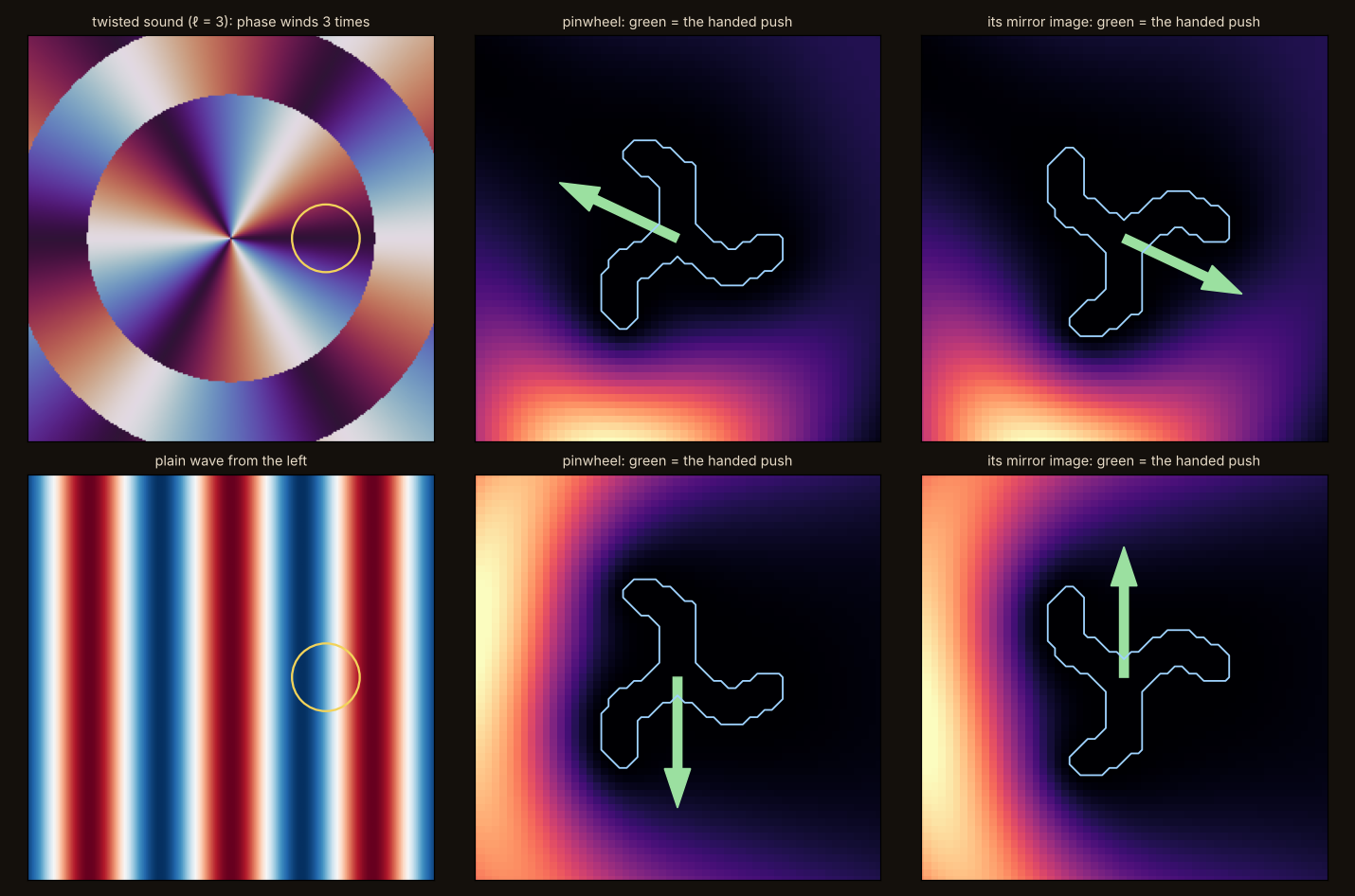
Twisted sound, a beam whose phase winds round its axis, carries a spin of its own. Could it push left-handed objects one way and right-handed ones another? In a 2-D wave model it does push a three-armed pinwheel and its mirror image apart, by about 6 % of the force on them. But a plain wave pushes the same pair apart nearly three times harder per unit of sound energy. The sorting comes from the shape.
The verdict
Real effect, different reason
In a 2-D wave model twisted sound does push a three-armed pinwheel and its mirror image apart, by about 6 % of the force on them, but a plain wave pushes them apart nearly three times harder per unit of sound energy, so the shape's handedness, not the beam's twist, does the sorting.
How the verdict was set. Read literally, run 1 gives nothing there: the handed push was only 4.0 times the change between two grids, against a bar of 5. Before running again, an addendum said why that was treated as a resolution failure (the pinwheel’s arms were 2.4 grid cells thick), fixed one finer run, and said that a second failure would make the verdict nothing there with no more runs. That choice was made after seeing run 1, and it is on the record. Run 2 passed.
In twisted sound the pinwheel and its mirror image feel different forces. The difference is 7.6 times the grid’s own error and keeps its direction (1.3°) and size (8 %) when the grid is halved.
Per unit of incident sound energy at the pinwheel, a plain travelling wave pushes the pair apart 2.75 times harder than the twisted beam.
In twisted sound the two pinwheels feel opposite torques, −2.7×10⁻⁵ and +4.8×10⁻⁶. Torque was not a gate; this is a reading made after the run.
The lab’s own question, not a claim from a show: can twisted sound separate left-handed from right-handed objects?
In optics, twisted light has been used to sort chiral particles (Tkachenko and Brasselet, Nat. Commun. 2014). This episode asks whether, in sound, the twist is what does the sorting.
Preregistered in PREREG.md (commit 2d99032) before any code; Addendum 1 (9e853f3) after run 1 and before run 2. Self-graded, with no outside review. Lab files are listed at the foot of the page.
The setup
A small sound-soft pinwheel with three hooked arms, and its exact mirror image, placed on the first bright ring of a twisted beam J3(kr)e3iφ at k = 30. The same pair also sits in a field with no twist (ℓ = 0) and in a plain travelling wave.
The push is the time-averaged radiation force, read from the flow of momentum through two circles round the pinwheel. The handed push is the difference between the forces on the two mirror images in the same field, divided by the incident sound energy at the pinwheel.
The checks
Every check below was written down before the code; the finer grid of run 2 was set in Addendum 1 before it ran.
| Check | Result | Numbers |
|---|---|---|
| The wave engine’s own tests and planted bugs | pass | 15 passed; all caught |
| Force read on two circles agrees | pass | within 0.51 % (bar 2 %) |
| … with a sign in the momentum flux flipped | red, as it should be | 142× disagreement |
| Field with no twist: mirror images get mirrored forces | pass | 3.4×10⁻¹² |
| Twisted sound: handed push resolved | pass | 7.6× grid change (bar 5); 1.3°; 8.4 % |
| Plain wave against twisted, per unit energy | 2.75 | above 0.5, so: different reason |
Run 1, on a coarser grid: the two circles agreed within 0.77 %, the flipped sign was red, the mirror check passed, and the handed push failed its resolution bar (4.0×, 4.7°, 38 %). Plain against twisted read 2.09. All of it stays in the lab files.
The reading
A chiral shape in any sound field feels a sideways push that depends on its hand: a plain wave already pushes the pinwheel and its mirror image in opposite directions, as symmetry requires. Twisted sound adds to that, but in this model it does not do it better. The shape’s handedness does the sorting.
The comparison is per unit of sound energy at the pinwheel; another yardstick, total power or peak loudness, would move the 2.75. It is the one the preregistration fixed.
- Real particles in a fluid: streaming, viscosity, drag, Brownian motion.
- Other shapes, sound-hard bodies, other amounts of twist.
- 3-D fields.
Prior art: Tkachenko and Brasselet, Nat. Commun. 5, 3577 (2014); Shi et al., Light Sci. Appl. 9, 62 (2020); Toftul et al. on radiation forces and torques in optics and acoustics (arXiv:2410.23670); acoustic vortex tweezers (Baudoin and co-workers). Sideways forces on chiral bodies in a plain flow are classical. I haven’t found this exact test written down; no novelty is claimed.