The ghost sat on the quiet spot
An engineer saw a grey figure in his lab, then found a fan filling the room with a 19 Hz hum. We rebuilt his room as a wave model. The room does ring near 19 Hz. But the desk, halfway down, is where the air moves most and the pressure swings least.
The room, ringing
The verdict
Real effect, different reason
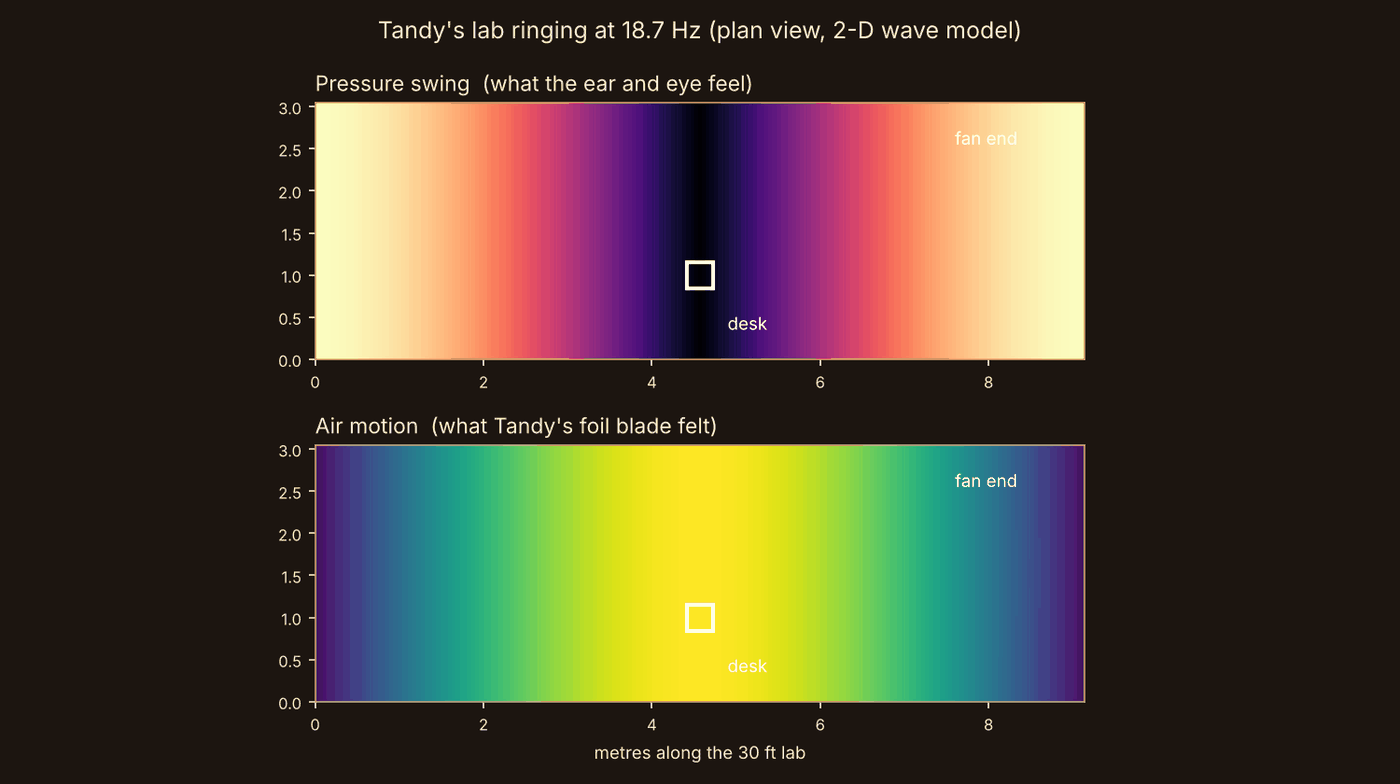
Tandy's 30 ft lab, closed at both ends, does ring at about 19 Hz (18.8 Hz in theory, 18.7 in the wave model). But the spot halfway down the room, where his foil blade shook hardest and where he sat, is where the air moves most and the pressure swings least, under 1 % of its value at the end walls. The standing wave is real; the desk sat on its motion peak, not its pressure peak. Separately, 7 Hz lies outside the alpha band (8–12 Hz), and neither figure appears in Tandy's paper.
A 30 ft room closed at both ends has its lowest note at c/2L = 18.8 Hz (18.4 to 18.9 from 10 to 25 °C). The wave model puts it at 18.7 Hz.
At that note the pressure swing at the middle of the room is 0.8 % of its value at the end walls. The draft gate wanted a pressure peak at the desk; it failed, as the preregistration predicted.
Air motion peaks at the middle and falls to 5.6 % at the far wall. Tandy’s foil blade peaked at the desk and stopped at the far end, which fits a motion peak exactly.
The alpha band is 8 to 12 Hz (8 to 13 in the clinical glossary). Neither 7 Hz nor alpha appears in Tandy and Lawrence’s 1998 paper.
The claim, as presented. The episode presents engineer Vic Tandy's lab 'ghost' as about 19 Hz infrasound from a fan, resonating with the eye, and presents about 7 Hz as the most dangerous frequency, linked to the brain's alpha rhythm.
The Why Files, “The Fear Frequency | Sonic Weapons, Havana Syndrome”, November 2021 · the episode
The registry’s note on sources. Read from the podcast transcript on podscripts.co by a research subagent (2026-10-09); not yet checked against the video. Close paraphrase, not quotation.
Preregistered in PREREG.md (commit 00fb5a0) before any code; Addendum 1 after run 1, before run 2, fixing a measurement bug. Self-graded, with no outside review. Lab files are listed at the foot of the page.
The setup
Tandy and Lawrence’s 1998 paper describes the lab as about 30 ft long and 10 ft wide, made from two garages back to back, with doors at one end and a window at the other. They found the hum with a fencing-foil blade in a vice, slid along the floor: it shook hardest level with the desk, halfway down, and stopped at the far end.
The model is a 2-D plan view of that room with rigid walls, driven by a small source near one end, swept from 10 to 30 Hz. At the lowest peak it maps two things: the pressure swing, which the ear and any pressure-driven resonance respond to, and the air’s motion, which is what pushes a thin blade.
The checks
Every check below was written down before the code. Misses stay on the page.
| Check | Result | Numbers |
|---|---|---|
| The wave engine’s own tests | pass | 15 passed |
| Rigid box against the formula | pass | 18.661 vs 18.755 Hz, 0.5 % |
| … with soft walls instead | red, as it should be | first peak 58.2 Hz |
| Lowest note within ±1.5 Hz of 19 Hz | holds | 18.43 / 18.76 / 18.92 Hz at 337 / 343 / 346 m/s |
| Pressure peak within 1 m of the desk | fails, as predicted | peaks 4.48 m away, at the end walls; 0.79 % at the desk |
| Air-motion peak within 1 m of the desk, near zero at the far wall | pass (run 2) | at the desk; 5.6 % at the far wall |
| … run 1 | fail, measurement bug | fake gradient at the side walls; fixed by Addendum 1 |
| … with pressure in place of motion | red, as it should be | 99.9 % at the far wall |
| 7 Hz inside the alpha band | no | alpha is 8–12 Hz |
The miss. Run 1’s air-motion map read the stored zero inside the side walls as a steep gradient, so it looked like the pressure map. An addendum, committed before run 2, keeps the average two grid steps away from every wall. Run 1 stays on record. What it does not show: whether Tandy’s eye resonated. If an eye is shaken by pressure, the desk is the worst seat in the room; if it is shaken by air motion or a vibrating floor, the best. This model cannot tell which.
- Whether infrasound causes these experiences, and the eye’s response.
- The real 3-D room: furniture, the doors’ give, the fan’s true position.
- The episode’s material on sonic weapons and Havana syndrome.
Prior art: Tandy & Lawrence, “The Ghost in the Machine”, J. Soc. Psychical Research 62 (1998), read in full; Tandy, “Something in the cellar”, JSPR 64 (2000); room modes are textbook acoustics. This is a replication of their calculation. I haven’t found the pressure-null point in print, which does not mean it isn’t there.