Four thousand times too quiet
A secondhand story from 1939 has monks lifting a stone slab up a cliff with an arc of drums and trumpets. Sound does push on things, and lab levitators use it. We added up the push on the slab, giving the instruments every advantage we could think of.
Nineteen instruments, one slab
The verdict
Nothing there
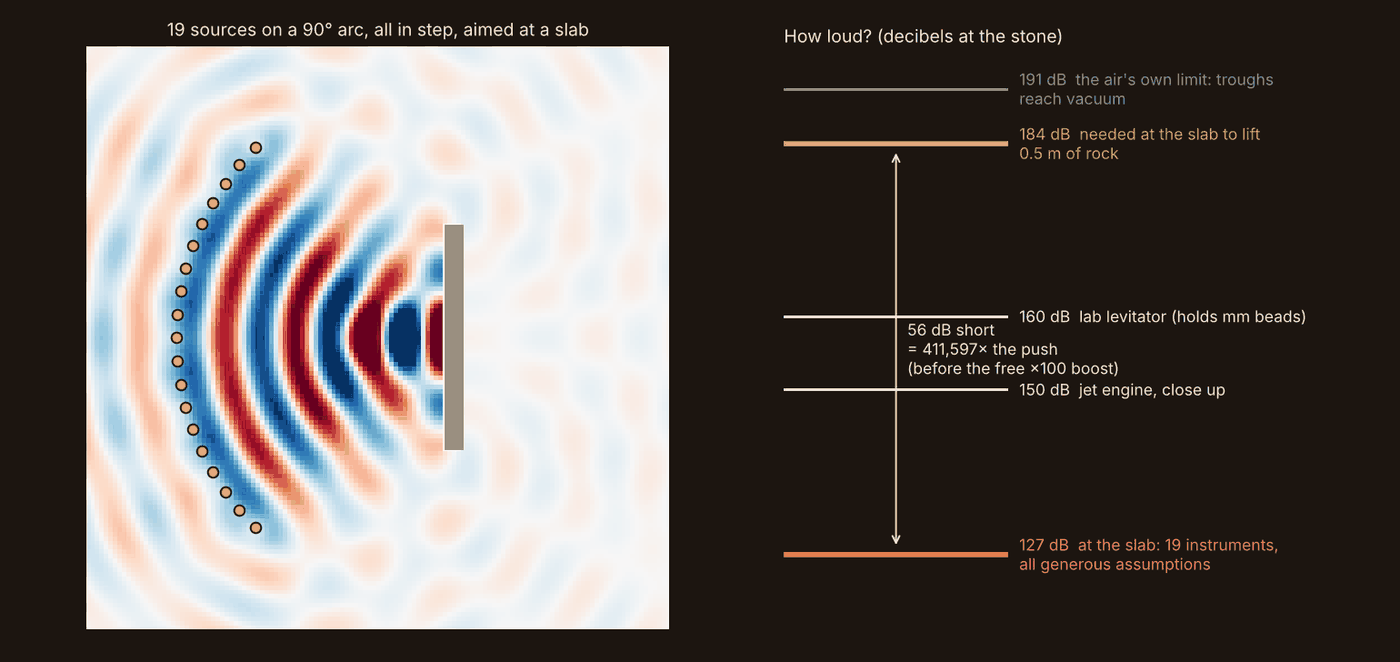
Even granting nineteen instruments far louder than any real drum, all perfectly in step, with no losses over the 63 m and a free hundredfold boost, sound pushes on the slab with about 3 Pa. Lifting 0.5 m of rock takes 13,000 Pa, 4,100 times more. The levitator physics the episode cites is real, but it holds millimetre beads at around 160 dB; it does not scale to a stone. Whether the 1939 event happened cannot be tested.
Thirteen drums at 140 dB and six horns at 130 dB at 1 m, louder than any we know of; all arriving in step; no loss over 63 m; a rigid slab; a free hundredfold resonant boost.
The push comes to 3.2 Pa. A slab 0.5 m thick weighs 13,000 Pa per square metre of face; a 0.1 m slab, 2,600 (820 times short).
Without the free boost, the slab would need 184 dB at its face. At 191 dB a sound wave’s troughs reach vacuum.
Lab levitators hold millimetre beads at nodes spaced half a wavelength apart, at around 160 dB. The physics is right; the scale is not.
The claim, as presented. The episode retells a secondhand 1939 account from Tibet in which an arc of drums and trumpets lifts a stone slab up a cliff about 250 m high, and compares the set-up to a laboratory acoustic levitator.
The Why Files, “The Science of Ancient Acoustic Levitation | How The Pyramids Were Built?”, March 2021 · the episode
The registry’s note on sources. Read from the podcast transcript on podscripts.co by a research subagent (2026-10-09); not yet checked against the video. Close paraphrase, not quotation.
Preregistered in PREREG.md (commit c9969a3) before any code; Addendum 1 after run 1, before a diagnostic that cannot change the verdict. Self-graded, with no outside review. Lab files are listed at the foot of the page.
The setup
The account, as retold in a 1994 translation, puts 13 drums and 6 trumpets on a 90° arc 63 m from a slab 1 m by 1.5 m, which rises to a cave about 250 m up. The slab’s thickness is not given, so we take 0.5 m, and 0.1 m as a kinder case.
Sound pushes on a surface that reflects it with a steady pressure of twice its intensity over the speed of sound. The wave model checks the two steps that matter before the sum: that 19 in-step sources add to 19 times one, and that a rigid face doubles the pressure on it.
The checks
Every check below was written down before the code. Misses stay on the page.
| Check | Result | Numbers |
|---|---|---|
| The wave engine’s own tests | pass | 15 passed |
| 19 in-step sources add to 19× one | pass | 19.15 |
| … with random timing | red, as it should be | 5.26 |
| Rigid face doubles the pressure | missed (wrong reference) | 0.77; point by point, declared before it ran, 2.00 |
| … soft face | red, as it should be | 0.27 |
| Push reaches the slab’s weight | fails, as predicted | 3.16 Pa vs 13,000 (0.5 m) and 2,600 (0.1 m) |
| Each instrument would need over 194 dB | prediction missed | 174 dB with the free boost; 194 without |
Two misses. The rigid-face check compared the face’s average with the single brightest point of the free field, which a focused beam makes unfair; measured point by point, the face reads 2.00. And the prediction that each instrument would need more than 194 dB forgot the free boost: with it, 174 dB each. Neither changes the gate the verdict rests on.
- Whether the 1939 event, or a film of it, existed.
- Sound used some other way: shaking a slab to help it slide, or loosening ground.
- Nonlinear effects such as acoustic streaming.
Prior art: the account’s numbers come from a 1994 translation quoted on the Straight Dope message board and from Ancient Origins (2019). Critiques found reason without numbers; I haven’t found a published pressure budget for this account. Radiation pressure, coherent addition and spreading loss are textbook acoustics.