Any quiet bell rings
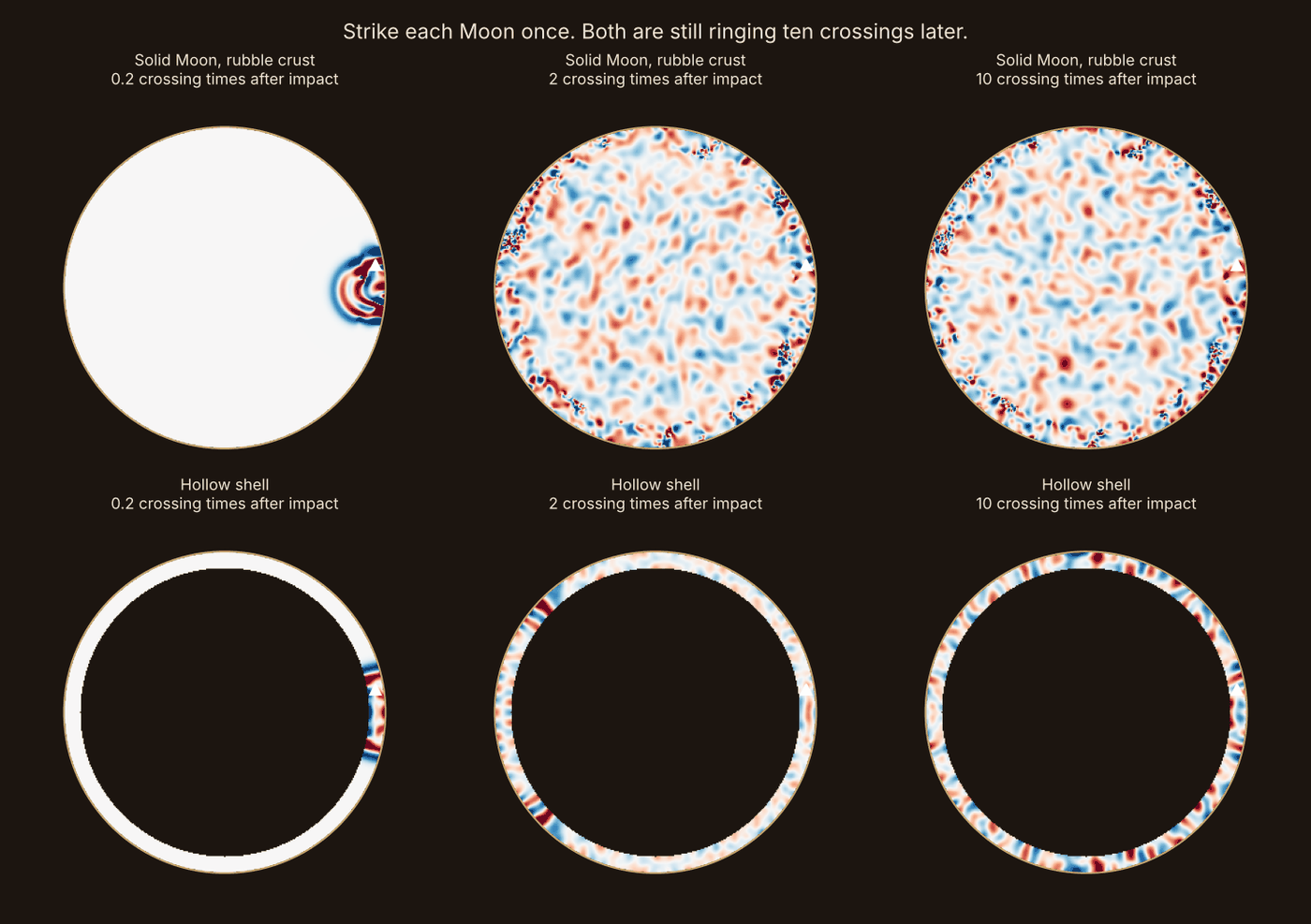
When spent Apollo hardware hit the Moon, the seismometers kept ringing for close to an hour. The episode reads that as a sign of a hollow Moon. We struck a solid Moon and a hollow one in a wave model, with the same low loss. Both ring for a long time.
Two Moons, one strike each
The verdict
Real effect, different reason
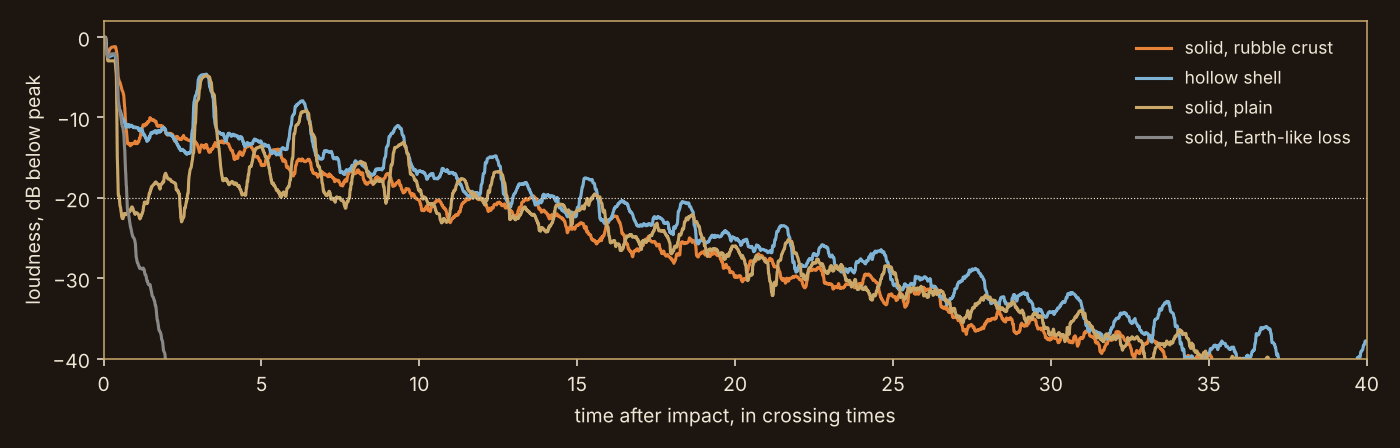
The ringing is real, and a solid Moon does it too. Struck once in a 2-D wave model, a solid Moon with a rubbly crust rings for 13.7 crossing times, 87 % as long as a hollow shell (15.6); a plain solid one rings 15.7. Give the same Moon Earth-like loss and the ringing is gone in under one crossing. How long a body rings is set by how little energy it loses, and the dry Moon loses very little. Its moment of inertia, 0.393, also rules out a thin shell (0.667).
With the same internal loss, the solid Moon with a rubbly crust rings to −20 dB for 13.7 crossing times, the hollow shell for 15.6: 87 %, over the preregistered 80 % bar. A plain solid Moon rings 15.7.
Give the same solid Moon Earth-like loss and the ringing lasts 0.7 crossings, about 5 % as long.
Dry lunar rock loses very little energy: a quality factor near 5,000 in its scattering layer (Dainty and colleagues, 1974).
The Moon’s moment of inertia, 0.393, sits 300 standard errors from a thin shell’s 0.667. Mass is concentrated toward its middle.
The claim, as presented. The episode presents the Apollo 12 and Apollo 14 impact signals, which it says rang for more than an hour and over three hours, as consistent with a hollow Moon, and mentions the mainstream dry-rock explanation briefly.
The Why Files, “The Moon Revealed: It's a Hollow Spaceship”, August 2022 · the episode
The registry’s note on sources. Read from the podcast transcript on podscripts.co by a research subagent (2026-10-09); not yet checked against the video. Close paraphrase, not quotation.
Preregistered in PREREG.md (commit 8bd9078) before any code. Self-graded, with no outside review. Lab files are listed at the foot of the page.
The setup
Two bodies in a 2-D wave model, each struck once at its edge, with the same small internal loss. One is solid, with an outer 15 % of slower, rubbly, randomly varying rock. The other is a hollow shell a tenth of the radius thick. A seismometer sits near the impact, at a short range like the Apollo stations.
Ringing time is counted from the first arrival until the sound falls 100 times below its peak, in units of the time a wave takes to cross the body. A plain solid Moon, and the same solid Moon with Earth-like loss, are run alongside as controls.
The checks
Every check below was written down before the code. Misses stay on the page.
| Check | Result | Numbers |
|---|---|---|
| Energy kept with no loss | pass | drift 0.16 % |
| … with an unstable time step | red, as it should be | blew up |
| Travel time to the far side | missed | 13 % off; the check forgot the source’s own delay |
| Solid with crust rings at least 80 % as long as the shell | holds | 13.66 vs 15.64 crossings, 87 % |
| Solid with crust builds up at least 3× more slowly | missed | both peak at once |
| Earth-like loss cuts it below 30 % | pass | 5.4 % |
| Moment of inertia against a thin shell | pass | 304 standard errors apart |
Two misses. The Apollo records build up slowly over minutes before they fade. This toy crust did not reproduce that: so close to the impact, the direct pulse is the loudest thing the seismometer hears, for every body. The slow build-up is what the 1974 diffusion model explains; this run did not test it. The travel-time check was written without allowing for the source’s delay. Neither touches the gate the verdict rests on.
- A 3-D elastic Moon with P and S waves and a core.
- Real lunar velocity profiles and the measured codas themselves.
- The episode’s other material: orbits, spacecraft, and the rest.
Prior art: Dainty, Toksöz, Anderson, Pines, Nakamura & Latham, “Seismic scattering and shallow structure of the Moon in Oceanus Procellarum”, The Moon 9 (1974): diffusion in a 25 km scattering layer with Q near 5,000; Dainty & Toksöz, PEPI 26 (1981); the Apollo Passive Seismic Experiment papers; Konopliv et al. 1998 and Williams et al. 2014 for the moment of inertia. This is a toy replication of the 1974 explanation.