The spin is easy; the blades are not
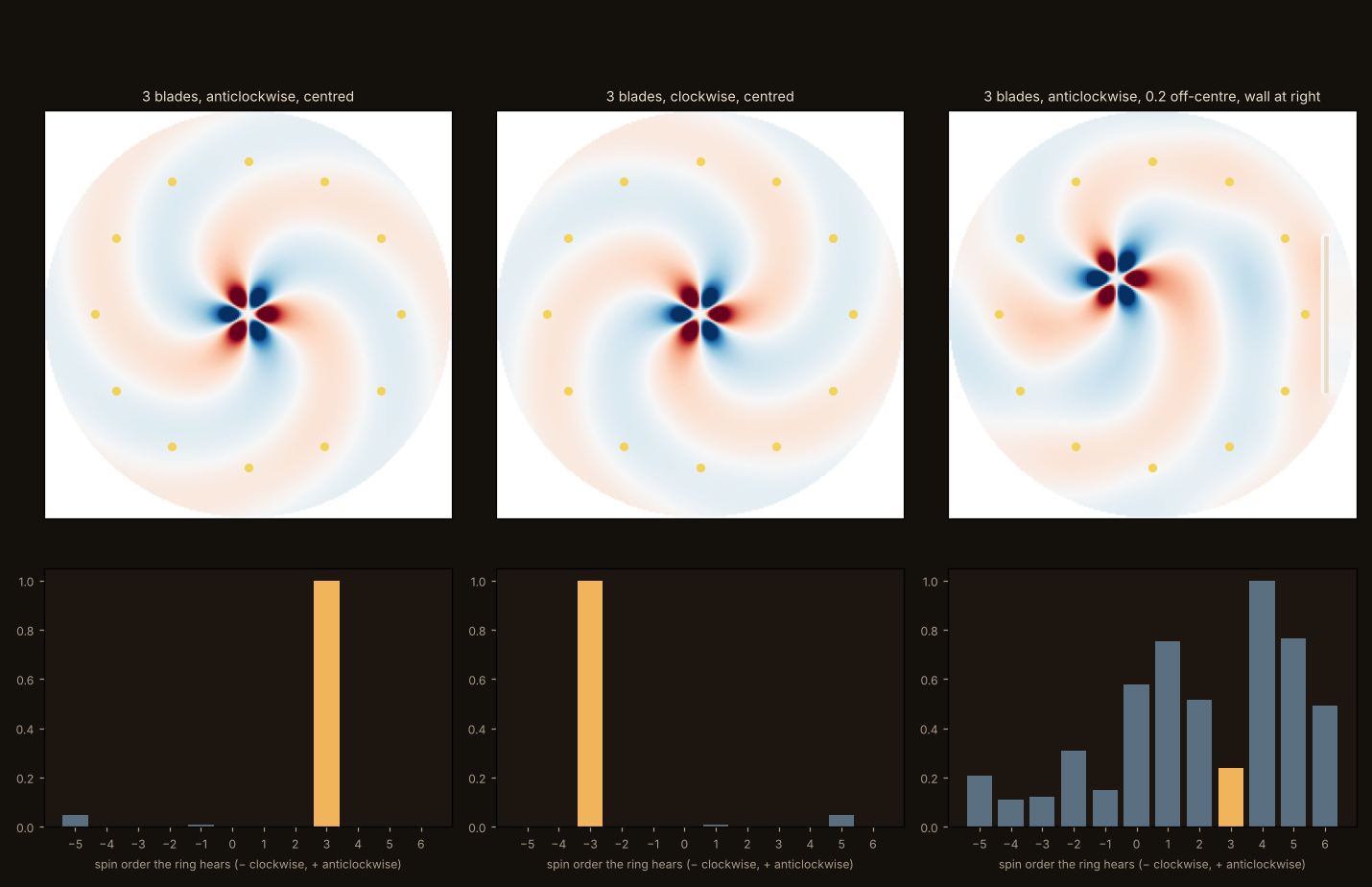
A rotor’s hum spins as it leaves: a three-bladed rotor sends out three spiral arms of sound, turning the way it turns. Could a ring of microphones read the blade count and the spin from that? With a rule fixed before the test rotors existed, it got both right for 16 of 20 rotors near the ring’s centre. The bar was 18, and every miss had a wall nearby.
The verdict
Nothing there
In a 2-D wave model a ring of 12 microphones does not reliably read a rotor's blade count: 16 of 20 near the centre against a bar of 18, every miss beside a reflecting wall, and 4 of 20 farther out; the spin direction held up much better, right for 36 of 40, though that was counted after the run.
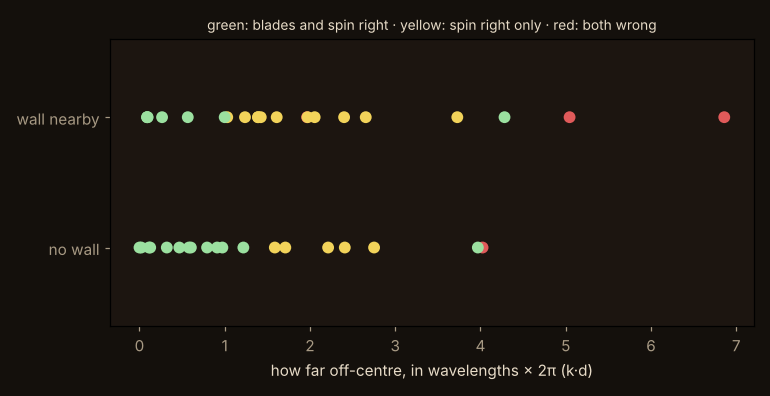
16 of 20 rotors had both blade count and spin right. All four misses had the reflecting wall.
Between 0.1 and 0.3 from the centre, 4 of 20. A pure tone spreads over neighbouring orders, and the loudest lands one away.
The spin direction alone came out right for 19 of 20 near rotors and 17 of 20 far ones. That count was made after the run, from the stored readouts, and is not a gate.
The lab’s own question, not a claim from a show: can a ring of microphones read a rotor’s blade count and spin direction from its sound?
The physics behind it is Tyler and Sofrin’s (1962): a bare rotor’s blade-passing tone spins in order s·B, where B is the blade count and s the spin. The question is whether a simple ring can read that order off a rotor that is not centred, with a wall nearby.
Preregistered in PREREG.md (commit 317e2de) before any code and before the 40 test rotors were drawn (seed 2026111407). Self-graded, with no outside review. Lab files are listed at the foot of the page.
The setup
The rotor’s tone is a ring source spinning in order s·B. Twelve microphones sit on a circle of radius 0.6, with 10 dB of noise. The rule, fixed in advance, is the simplest one: take the loudest spin order on the ring; its size is the blade count, its sign the spin.
Forty test rotors were drawn at random after the rule was written: 2 to 5 blades, either spin, a range of pitches, a reflecting wall in about half. Twenty sit within a small distance of the centre and are graded; twenty sit farther out and are reported.
The checks
Every check below was written down before the code. Each planted fault had to turn its check red once.
| Check | Result | Numbers |
|---|---|---|
| The wave engine’s own tests and planted bugs | pass | 15 passed; 8 of 8 caught |
| A clockwise rotor’s readout mirrors the anticlockwise one’s | pass | 5.2×10⁻¹⁴ |
| A non-spinning ring prefers no direction | pass | 6.8×10⁻¹⁵; loudest order 0 |
| … with the microphone order reversed | red, as it should be | spin right for 0 of 20 |
| Near rotors: blade count and spin both right | failed | 16 of 20 (bar 18) |
| Rotors farther off-centre | reported | 4 of 20 |
| Finer grid, first 5 rotors | pass | same readout; within 1.8 % |
The reading
The blade count is fragile and the spin is not. Off-centre, a pure tone of order B spreads over its neighbours; a wall adds a mirror-image rotor spinning the other way. The loudest-order rule then lands one away from B, but usually on the right side of zero.
A smarter rule, one that fits the rotor’s position or uses more microphones, might do much better. This test does not say. The spin result is worth a preregistered test of its own.
- Finding the tone in a real spectrum.
- Real drones: 3-D, four rotors, flow noise.
- Smarter rules or more microphones.
Prior art: Tyler and Sofrin, SAE 620532 (1962); azimuthal mode detection with microphone rings in fan ducts (NASA, DLR and NLR reports); Martinez-Carranza and Rascon, Sensors 20, 7276 (2020). I haven’t found this exact test written down; no novelty is claimed.