The push is real; the bass is not
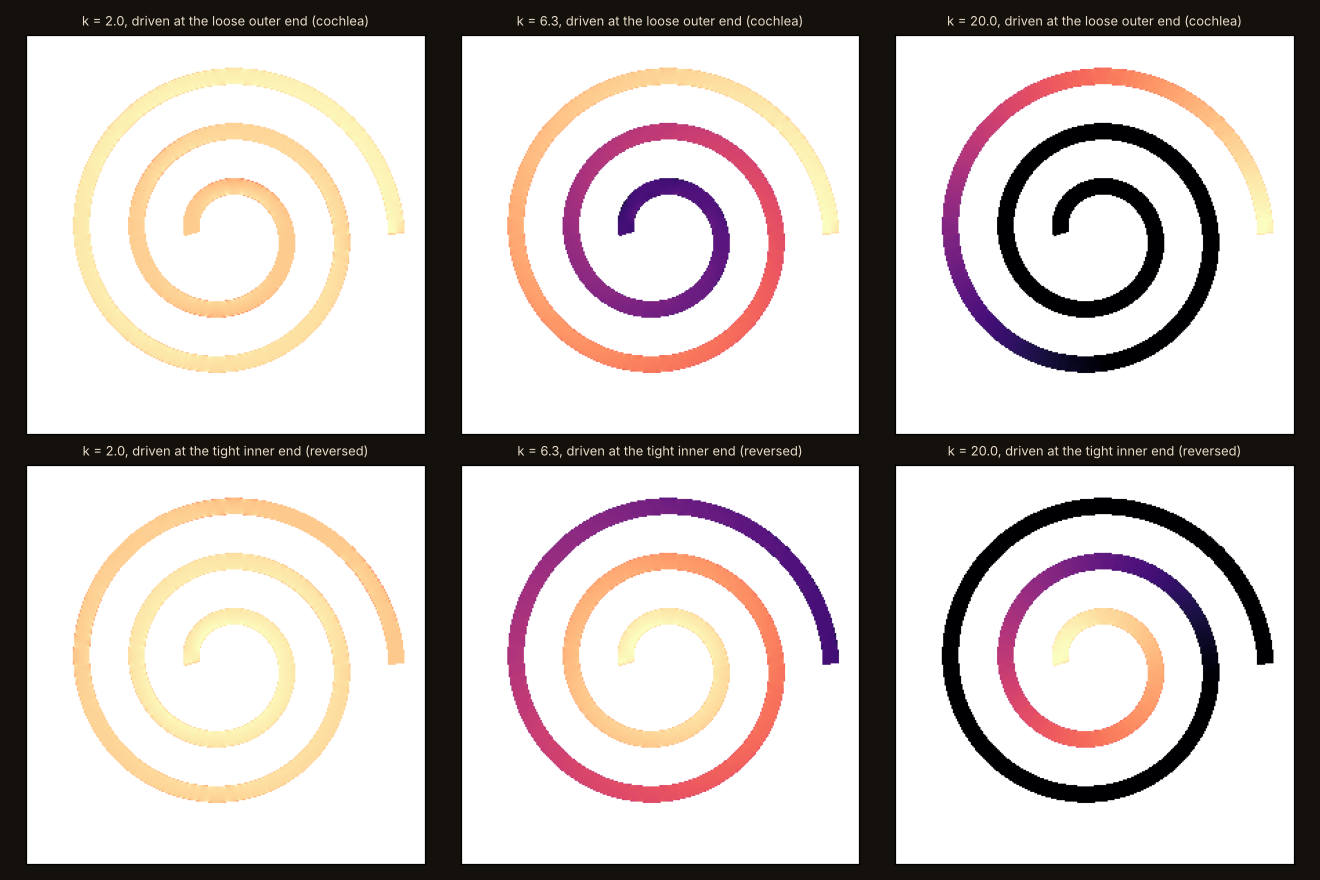
A published model says the cochlea’s coil pushes low-pitched sound toward its outer wall, helping us hear bass. We built a 2-D toy: a coiled duct filled with a medium that slows and soaks up waves along its length, so each pitch dies out at its own place. The coil does push energy outward, at every pitch. But in this toy it pushes high pitches harder than low ones.
The verdict
Real effect, different reason
In a 2-D toy duct coiled like a cochlea, the coil does push wave energy toward the outer wall, by 1 to 5 %, but more for high pitches than low ones, so in this toy the push is real and the bass advantage is not; the toy has no membrane, and the published model's effect lives in the membrane's short, slow waves.
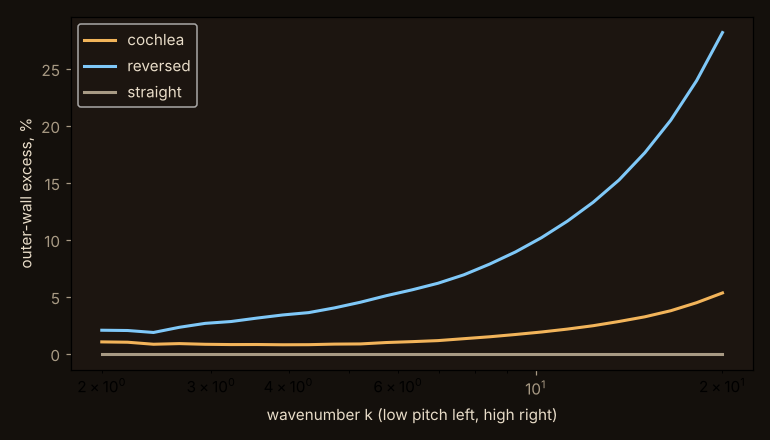
At every one of 25 pitches the coiled duct carries more energy along its outer wall than its inner one: 1.008 to 1.053 times as much.
The tilt grows with pitch, not the other way round: rank correlation +0.86, where the claim needed −0.6 or below.
Driven from the tight end, so that high pitches stay in the tight turns, the coil tilts low pitches 2.91 times more, where the claim needed half or less.
A published proposal. The cochlea’s coiling concentrates low-frequency energy at the outer wall (Manoussaki, Dimitriadis and Chadwick, Phys. Rev. Lett. 96, 088701, 2006). No show is cited for it in the lab’s registry.
This toy is not that model. The published model has a membrane carrying a short, slow travelling wave; this duct has rigid walls and a slowing medium in its place. The episode tests the coil’s push in the toy, not hearing.
Preregistered in PREREG.md (commit 5c40719) before any code, together with the engine extension it needed (a graded medium, with two new tests and a ninth planted bug). Self-graded, with no outside review. Lab files are listed at the foot of the page.
The setup
A duct 0.06 wide, coiled two and a half turns from radius 0.62 in to 0.12, with rigid walls. Its medium slows and absorbs waves more and more along its length, so each pitch dies out at its own place, as in a cochlea.
The measure is the tilt: the wave energy along the outer wall divided by the energy along the inner wall, over the whole duct, at 25 pitches from k = 2 to 20. A straight duct with the same medium is the control. The same coil driven from its tight end is the test of where the push comes from.
The checks
Every check below was written down before the code. Each planted fault had to turn its check red once.
| Check | Result | Numbers |
|---|---|---|
| The wave engine’s own tests and planted bugs, with the graded medium | pass | 17 passed; 9 of 9 caught |
| Straight duct: no tilt | pass | 5.6×10⁻¹⁶ |
| … driven on one half only | red, as it should be | 0.074 |
| The coil tilts outward at every pitch, at least 1.05 somewhere | pass | 1.008 to 1.053 |
| The tilt is larger for lower pitches | failed | rank correlation +0.86 |
| Driven from the tight end, low pitches tilt less | failed | ratio 2.91 (bar 0.5) |
| Finer grid, N = 721 against 481 | pass | inside the bound at every pitch |
The reading
A wave going round a bend leans on the outer wall, more for short waves and tight bends. In this toy that growth with pitch beats the fact that low pitches reach the tight end of the coil. That is the different reason: the push is a whispering-gallery tilt, and it favours the treble here.
To keep the duct to one wave across, its waves never get as short, compared with the duct’s width, as the cochlea’s travelling wave does near its best place. The published model works in that regime, with a membrane, and this toy cannot reach it. Nothing here contradicts the 2008 comparison across mammals.
- The basilar membrane and its short travelling wave.
- Fluid viscosity; 3-D; the ear’s active amplification.
- Anything about hearing, in decibels or otherwise.
Prior art: Manoussaki, Dimitriadis and Chadwick, PRL 96, 088701 (2006); Manoussaki et al., PNAS 105, 6162 (2008). The whispering-gallery tilt in curved ducts is textbook. I haven’t found this exact test written down; no novelty is claimed.