Gentle coils keep the notes
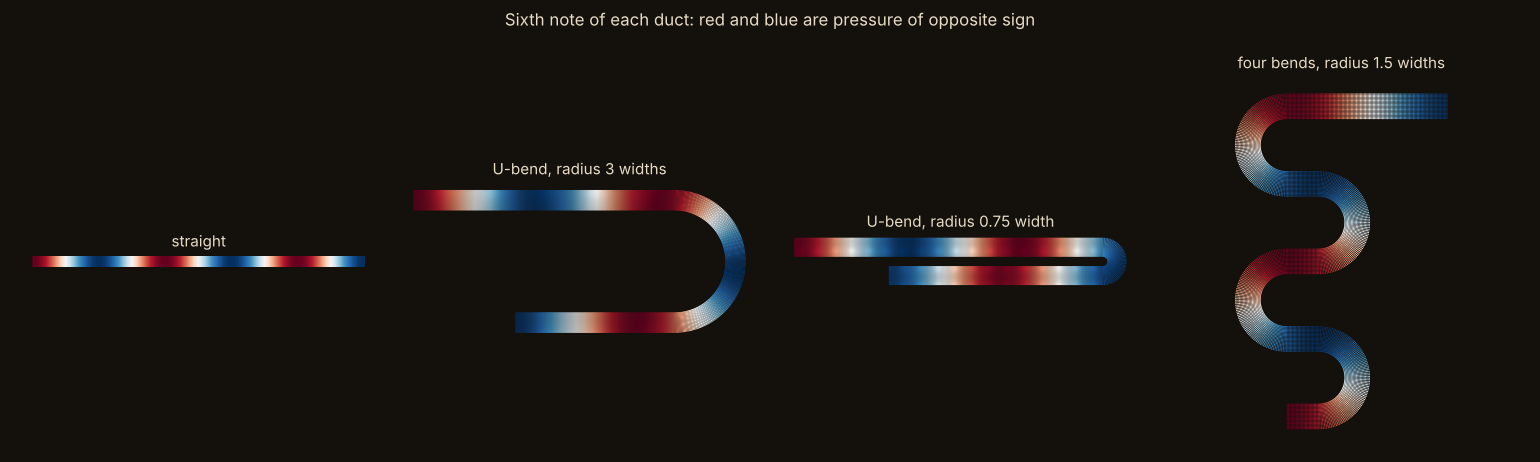
Does coiling a tuba’s tube change its sound? We bent a closed tube in a 2-D wave model and measured its first eight notes. Gentle bends, three tube widths or more in radius, move no note by more than 4.3 cents, under the roughly 5 cents a trained ear can pick out. Tight bends do push notes sharp.
The verdict
Nothing there
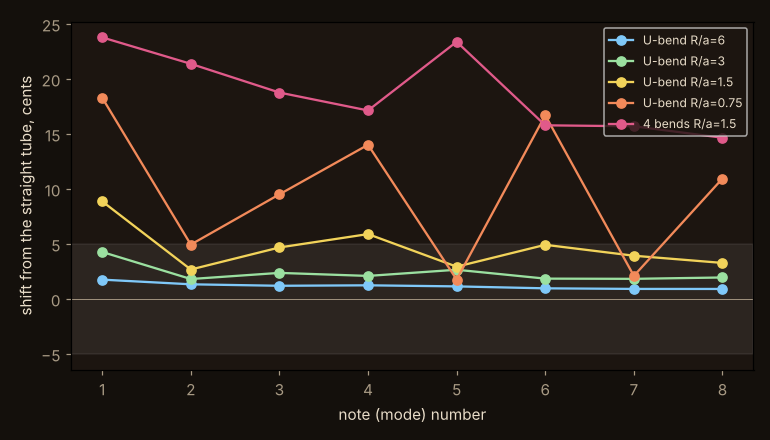
In a 2-D model, coiling a tube gently, with bends at least three tube widths in radius, moves none of its first eight notes by more than 4.3 cents, below what an ear can pick out; tight bends do push notes sharp, by up to 18 cents for one U-bend and 24 cents for four moderate bends.
How the verdict was set. It took four runs. Runs 1 and 2 drew the tube on a square grid, whose staircase walls made errors that looked like a bend effect, so their own convergence checks failed. Run 3 used a solver in the tube’s own curved coordinates and missed its exact-answer check, by up to 1.7 cents against a bar of 0.5. Run 4 is run 3 on a grid twice as fine, with the same bars, and everything passed. Each change was written down and committed before the run it governed.
U-bends of radius 6 and 3 tube widths move the first eight notes by at most 1.75 and 4.27 cents.
A U-bend of radius 0.75 widths moves notes by up to 18.3 cents, always upward. Four bends of radius 1.5 add up to 14.7 to 23.8 cents.
On the square grid, coiling seemed to flatten notes by tens of cents. The fitted solver says gentle coiling sharpens them by about 1 to 4. Had run 1 been believed, this page would say the opposite.
A folk question. Does coiling a brass instrument’s tube change its sound? No show is cited for it in the lab’s registry.
It has a published answer (Félix, Dalmont and Nederveen, J. Acoust. Soc. Am. 2012, and earlier work). This episode does not compare its numbers with that answer; it checks the question from scratch in a simpler model.
Preregistered in PREREG.md (commit 4f5709c) before any code; Addenda 1 (7b858f7), 2 (4f1edc2) and 3 (3435957), each before the run it governs. Self-graded, with no outside review. Lab files are listed at the foot of the page.
The setup
A closed rigid tube 1.2 long and 0.04 wide, with walls that reflect sound and closed ends, in 2-D. Straight, then bent: one U-bend of radius 6, 3, 1.5 or 0.75 tube widths, or four bends of radius 1.5. Every shape has the same centre-line length.
The solver works in the tube’s own coordinates, along and across, so a bend is a smooth change of scale and not a staircase. It was checked against the exact notes of a half-ring, from Bessel functions, before it measured anything. A note’s shift is in cents against the straight tube.
The checks
Run 4’s checks, set in Addendum 3 before it ran. The earlier runs are listed after the table.
| Check | Result | Numbers |
|---|---|---|
| Straight tube: notes in the ratio 1 : 2 : 3 … | pass | within 0.008 cent |
| The bend alone against exact Bessel roots | pass | 0.05 to 0.43 cent off (bar 0.5) |
| … with the bend treated as straight | red, as it should be | up to 162 cents off |
| Finer grid, 80 cells across against 40 | pass | at most 0.06 cent |
| Gentle bends: no note moves 5 cents or more | pass | at most 4.27 cents |
| Tight U-bend moves a note more than 5 cents | pass | up to 18.3 cents |
The earlier runs. Run 1, square grid 8 cells across: shifts moved up to 26 cents between grids, no verdict. Run 2, 20 to 60 cells across: still moving up to 4.5 cents, shrinking in proportion to the grid step, no verdict. Run 3, fitted solver 40 cells across: the exact-answer check missed by up to 1.7 cents, no verdict. All their numbers stay in the lab files.
The reading
In this model, coiling is not what makes a tuba sound like a tuba. A gentle coil leaves its notes where they were, to within what an ear can hear. Bends as tight as a tube width or so do start to matter, and they push the notes sharp.
The verdict is about the tube’s notes, not the instrument as heard. The version with a bell radiating into a room could not be run converged in this session.
- The bell and its radiation; the player’s lips.
- 3-D bends (a torus, not a 2-D channel).
- Losses at the walls, wall vibration, and timbre as heard.
Prior art: Félix, Dalmont and Nederveen, J. Acoust. Soc. Am. 131(5), 4164–4172 (2012); Nederveen, on the toroidal bend (JASA, 1998); a HAL report on curvature-induced mistuning (hal-00810850). Titles and venues confirmed; abstracts not read. I haven’t found this exact test written down; no novelty is claimed.