The mirror moves the energy around and keeps none of it for you
The episode presents the Kozyrev spiral as a mirror that focuses an ambient energy. The lab put the golden spiral in a 2-D wave model where everything sits at one temperature, and mapped where the wave energy ends up. It does pile up in spots, as it does next to any reflector. A probe parked in the brightest spot, at the same temperature as everything else, draws no net power at all.
The verdict
Real effect, different reason
In a 2-D wave model the spiral raises ambient wave energy in spots, by up to about 1.5x at the frequencies sampled, as any reflector does. A probe at the same temperature draws no net power from it, and in this model no passive probe ends up hotter than its hottest source.
At one temperature, the spiral’s best spots hold 1.4–1.5 times the free-space wave energy. The disk average stays a little under 1: energy is moved around, not made.
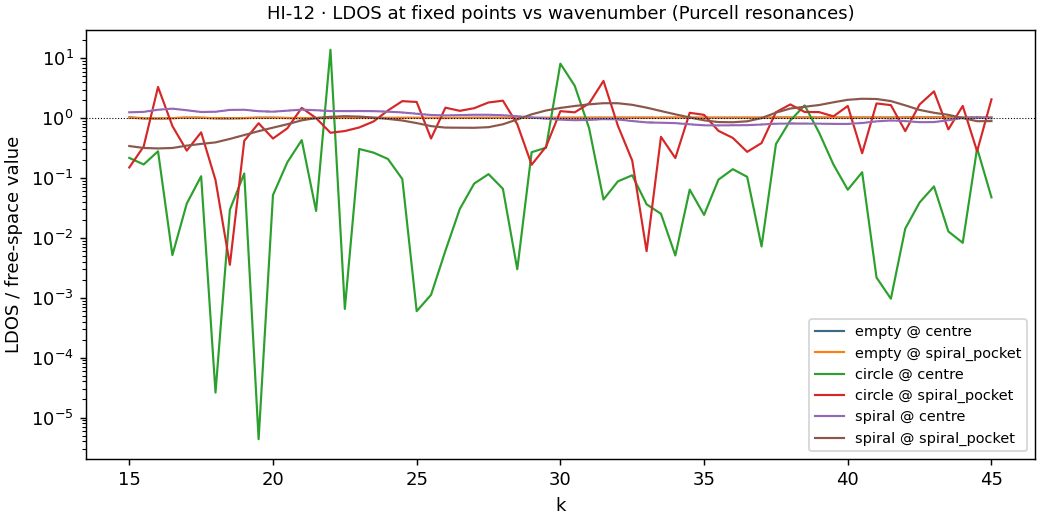
This is the local density of states, the Purcell effect. A single straight wall already reshapes it, and a plain circle with a gap does it far more at its resonances.
A probe at the same temperature as its surroundings gets exactly as much back as it gives. A colder probe does absorb, and only while something keeps it cold.
Make part of the surroundings hot and the mirror steers that heat onto a probe, 11–20 times the empty-disk power. The probe still stays below the hot source’s temperature.
The claim, as presented. The episode presents Kozyrev mirrors as 'focusing' time energy, together with electromagnetic shielding, and describes the spiral as a Fibonacci spiral (the golden log spiral the lab used in HI-1).
The Why Files, “Bending Time: The Successful Time Travel Experiments using Kozyrev Mirrors”, June 2023 · the episode
The registry’s note on sources. Every claim attributed to The Why Files below comes from the episode's podcast transcript (ep. 113, podscripts.co). A research subagent summarised it (2026-09-28). The same day, before any verdict was published, the specific claims each published verdict rests on were re-checked against the transcript in a second, independent read, and both reads agree. Transcript reads go through a summariser, so treat exact wording as close paraphrase, not quotation.
Checked against the episode transcript: yes, 2026-09-28. The episode says time energy can be focused the same way as light, using mirrors, and that Kozyrev’s device was designed to focus it. “Time energy” is not something an instrument can measure, so the lab tested the nearest physical reading: does a spiral reflector concentrate the energy of ambient waves, and can anything at the concentration point use it?
Preregistered in PREREG.md (commit a44f3da) before any simulation code; Addendum 1 (2679af9) after an outside review and before the code it governs ran. Self-graded, plus one adversarial review by Codex (OpenAI), graded keep. Lab files are listed at the foot of the page.
Field fluctuation against total energy
From the lab’s mapsThe first run mapped how much the wave field fluctuates at each point, |ψ|², and the first headline called that energy. It is half of it. A wave also stores energy in its slope, |∇ψ|², and the slope is largest exactly where the field passes through zero. Slide between the two maps at k = 30.
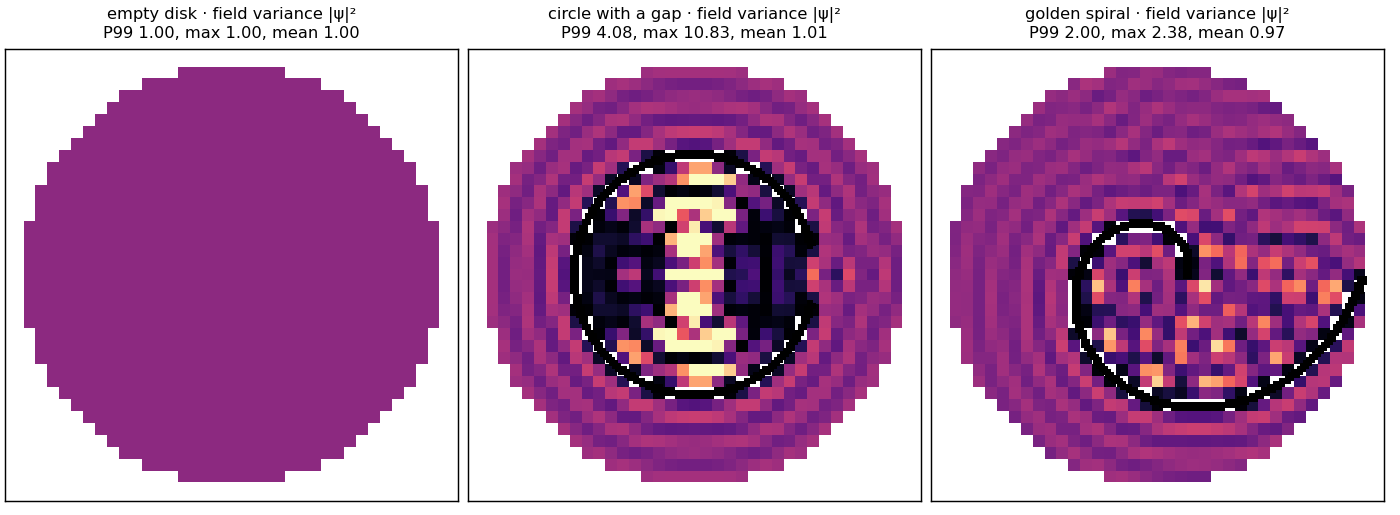
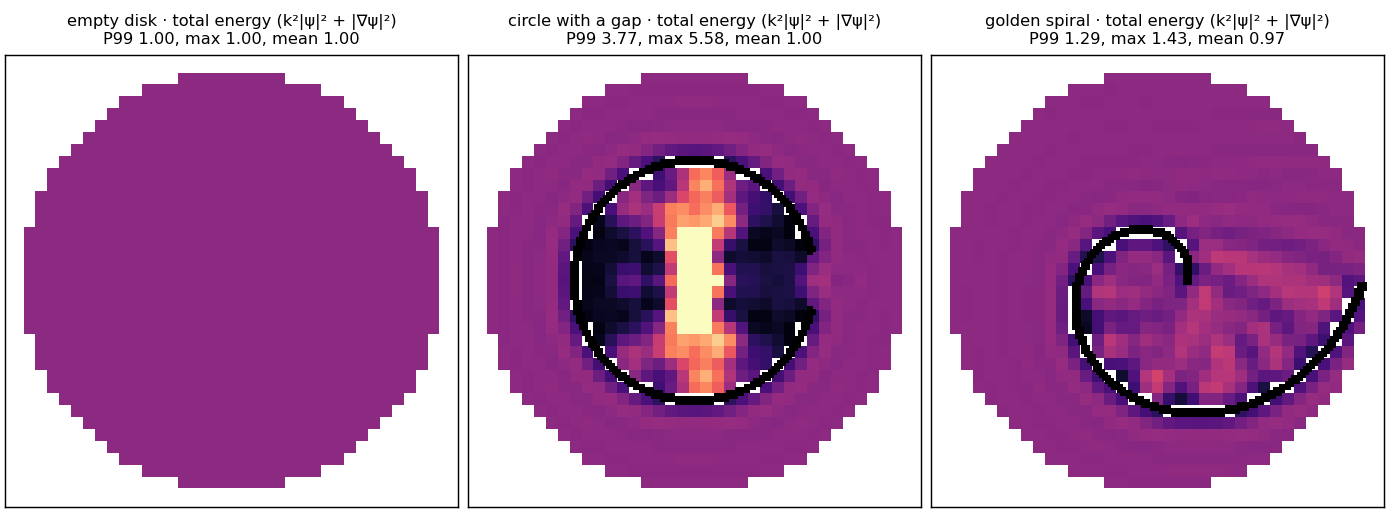
The catch. Codex, a model from another lab asked to attack the result, pointed out that the verdict said “energy” while every map measured field fluctuation. Next to a straight hard wall the two follow different curves: fluctuation goes as 1 − J₀(z) and drops to zero at the wall, while total energy goes as 1 − J₁(z)/z and sits at one half (z = 2kd, d the distance from the wall).
What changed. An addendum fixing the new gates was committed before any new code ran. The total energy was computed from the same exact noise statistics, five solves per map point. It matched the wall curve to within 0.010, 0.009 and 0.014 at k = 20, 30 and 40. Held against the fluctuation curve, the same data missed by 0.42, 0.41 and 0.39, so the check can tell the two apart.
What it did to the numbers. On the same map points, the spiral’s top 1 % fell from 1.66–2.35× free space to 1.22–1.37×, and its peak from 2.2–2.9× to 1.4–1.5×. The spiral still beat the empty disk by the preregistered 0.20 at all seven wavenumbers, thinly at the top of the band (+0.22 at k = 40).
Why this belongs on the page. The first headline was wrong about its own quantity, and a reviewer outside the lab found it before publication. The old wording stays in the lab’s results file, marked as withdrawn, next to the new one.
The contrast, side by side
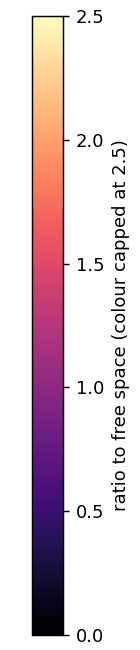
Ratio to the empty grid’s own average, on the same points (spacing 0.04, disk of radius 0.70), at one temperature everywhere. P99 is the level the top 1 % of the disk reaches.
| k | Fluctuation P99 / max / mean | Total energy P99 / max / min / mean | Empty disk, energy max / min | Circle, energy P99 (not converged) |
|---|---|---|---|---|
| 15 | 2.35 / 2.86 / 0.92 | 1.37 / 1.51 / 0.13 / 0.92 | 1.0008 / 0.9992 | 1.08 |
| 20 | 2.15 / 2.34 / 0.94 | 1.27 / 1.39 / 0.09 / 0.93 | 1.0004 / 0.9997 | 1.06 |
| 25 | 2.02 / 2.65 / 0.96 | 1.31 / 1.51 / 0.15 / 0.96 | 1.0001 / 0.9999 | 147 |
| 30 | 2.00 / 2.38 / 0.97 | 1.29 / 1.43 / 0.16 / 0.97 | 1.0000 / 1.0000 | 3.77 |
| 35 | 1.84 / 2.26 / 0.97 | 1.24 / 1.38 / 0.25 / 0.96 | 1.0000 / 1.0000 | 1.06 |
| 40 | 1.80 / 2.23 / 0.98 | 1.22 / 1.41 / 0.31 / 0.97 | 1.0000 / 1.0000 | 6.10 |
| 45 | 1.66 / 2.23 / 0.98 | 1.23 / 1.42 / 0.35 / 0.98 | 1.0000 / 1.0000 | 4.38 |
Reading it. The empty disk is flat, so the instrument adds no structure of its own. The spiral’s average stays at 0.92–0.98 in both columns: the walls move energy from one place to another. Its minimum is not zero for energy. The lowest values, 0.09–0.35, sit at grid points next to a wall, where the way the grid splits slope energy between neighbours shortchanges the point; the continuum value at a straight wall is one half.
The circle with a gap. At k = 25 its top 1 % reached 259× in field fluctuation and 147× in total energy. A circle with a narrow gap is a resonator, and k = 25 landed near one of its resonances. Its numbers moved by 24–82 % when the grid was refined, so the lab reports only that it resonates. Whether the spiral does more or less than an ordinary circle is open.
A probe at the hot spot
Put a small absorbing patch, with its own thermal noise, at the spiral’s highest-fluctuation point. Three cases, three answers.
Pnet / Pgross ≤ 1.3e-14
Zero, in every geometry. In this model that zero is built in: noise strength follows loss, so a cell gives back exactly what it takes. A separate check with 400 random noise runs gave −0.0061 ± 0.0050, consistent with zero.
Pnet = K (Taround − Tprobe)
The hot spot is better coupled: its conductance K is 1.9–2.9 times the empty disk’s at the same point, matching the local enhancement within 5 %. Power flows only across a temperature difference, and keeping the probe cold takes a sink that something maintains. That is a heat engine on a temperature difference.
Part of the surroundings hot. Heat one 45° slice of the absorbing edge to temperature 1 and leave the rest at 0. A probe at the spiral’s best point then settles well above the empty-disk value, and it draws 11–20 times the power a cold probe gets at the same point in an empty disk. Each row is one wavenumber, with the point and the hot slice chosen for that wavenumber, so these are single-frequency, best-case numbers. A broadband probe at one fixed place was not computed.
| k | Probe point | Hot slice | Probe temperature, spiral / empty | Power to a probe at 0, spiral / empty |
|---|---|---|---|---|
| 15 | (−0.02, −0.26) | 0–45° | 0.644 / 0.108 | 0.0048 / 0.00027 |
| 20 | (0.50, −0.14) | 45–90° | 0.484 / 0.103 | 0.0054 / 0.00046 |
| 25 | (−0.16, −0.18) | 45–90° | 0.675 / 0.102 | 0.0120 / 0.00071 |
| 30 | (0.00, −0.34) | 0–45° | 0.851 / 0.104 | 0.0207 / 0.00104 |
| 35 | (−0.20, −0.10) | 0–45° | 0.531 / 0.102 | 0.0155 / 0.00139 |
| 40 | (−0.14, −0.28) | 0–45° | 0.691 / 0.099 | 0.0255 / 0.00177 |
| 45 | (0.16, −0.32) | 45–90° | 0.855 / 0.095 | 0.0371 / 0.00214 |
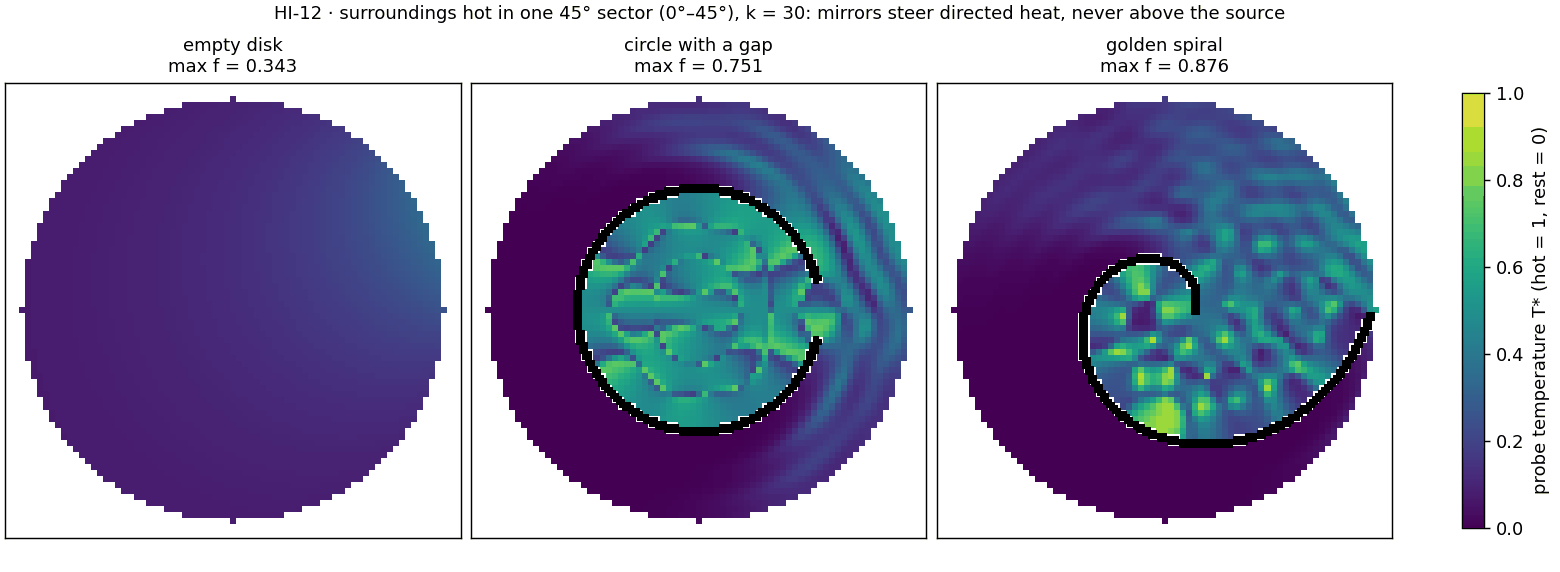
Where the ceiling comes from. In this model a passive probe’s temperature is an average of the source temperatures with positive weights, so it cannot pass the hottest one. The bound is assumed through the bath model; the model illustrates it and does not test it. Add a powered emitter, noise without matching loss, and the probe reads 20–1100 times the hot source: that shows the instrument responds once the assumption is broken, nothing more.
Every gate, including the one that failed
N = 241 grid, seven wavenumbers k = 15–45 unless stated. Identities can only catch code bugs, and each one has a deliberately broken twin that must go red.
| Gate | Result | Numbers |
|---|---|---|
| A1 fluctuation next to a straight wall vs 1 − J₀(2kd) | pass | max error 0.016 / 0.015 / 0.033 at k = 20 / 30 / 40 (limit 0.10) |
| A1r same data against the wrong-wall formula | red, as intended | error 1.69 / 1.34 / 0.91 |
| A1E total energy next to the wall vs 1 − J₁(z)/z (addendum) | pass | max error 0.010 / 0.009 / 0.014 (limit 0.10) |
| A1Er same data against the fluctuation curve | red, as intended | error 0.42 / 0.41 / 0.39 |
| Q0, Q0E the empty disk shows no contrast | pass | top 1 % at most 1.015 (fluctuation), 1.0007 (energy) |
| Q1 fluctuation denser in spots, spiral vs empty, ≥ 0.20 at ≥ 5 of 7 k | pass, 7 of 7 | +1.34, +1.06, +1.07, +1.01, +0.81, +0.82, +0.78 |
| Q1E total energy denser in spots, same rule (addendum) | pass, 7 of 7 | +0.37, +0.27, +0.31, +0.29, +0.24, +0.22, +0.23 (thin at high k) |
| Q2 is the spiral special? Beats the circle by 0.20 at ≥ 6 of 7 k | ordinary, not trusted | spiral ahead at 3 of 7; the circle’s half failed the grid check, so this rests on unconverged numbers |
| P1 a finite probe matches the small-probe limit | pass | temperatures within 0.019 (limit 0.03); conductance ratio within 1.0–4.9 % (limit 10 %) |
| C1 grid N = 481 against N = 241, k = 20, 30, 40 | failed | empty and spiral pass (within 0.04 % and 2.6 %). The circle does not: 4.08 → 3.12 at k = 30 (24 %), 9.50 → 1.67 at k = 40 (82 %). Fluctuation only; total energy was not grid-checked |
| I1, I1E fluctuation and energy match their exact formulas | pass · identity | 3.3e-13 and 7.2e-13 (limit 1e-8) |
| I1s flip the sign of the density of states (added after review) | red | the corrected check reads 2.0. The original check read −2.0, which would have passed: the blind spot Codex found was real, and is now closed |
| I2 same-temperature probe, net over gross | pass · identity | ≤ 1.3e-14 over 21 probe cases |
| I2r probe at 0 or 2, or noise not tied to loss | red | 1.0, 0.333, ≥ 0.67 |
| MC the same zero from 400 random noise runs | pass · statistical | −0.0061 ± 0.0050 (z = −1.2) |
| MCr probe noise doubled | red, weakly | z = −3.6; 16 % from the predicted value (limit 20 %) |
| I3 no passive probe above the hot source | pass · identity | highest 0.893 |
| I3r add a powered emitter | red | 20.5–1126 times the source |
| S1 the mirror-image spiral gives the mirror-image map | pass | to 1.7e-13 |
The failure, kept on the record. The circle with a gap did not converge when the grid was halved. Its sharp resonances most likely sit at slightly different wavenumbers on the two grids, so a fixed-k sample lands on or off one; that cause was not verified. The verdict rule uses only the spiral and the empty disk, which passed. The question “is the spiral special?” stays open.
The outside review
Codex read the preregistration, the code and the results without running anything, and graded the work keep. Each finding, and what the lab did:
| Finding | Action |
|---|---|
| The verdict says energy; the maps measure field fluctuation. | Addendum 1, committed before running: total energy, a new wall check and its broken twin, new contrast gates. The verdict kind stood, and the numbers fell from 2–3× to 1.4–1.5×. |
| “Nothing can harvest it” leaves out the conditions. | The verdict now says same temperature, says that a colder probe absorbs, and limits the ceiling to passive probes in this bath model. |
| The hot-slice temperatures are single-frequency and chosen per wavenumber. | Labelled so, with the absorbed power shown beside them. |
| “Grid-converged” and “broadband” claimed more than was checked. | Narrowed to the two statistics and three wavenumbers actually compared. |
| The hot slices are part of a finite absorbing edge, not beams from a direction. | Stated. Moving the edge outward to test it was not done. |
| One identity check would have passed a sign-flipped result. | Confirmed and closed; the broken twin is in the gate table. |
| The powered-emitter control does not back the ceiling independently. | That inference was cut. |
- Only scalar waves in two dimensions. No electromagnetic fields, no 3-D geometry, no real materials, and nothing of Kozyrev’s actual construction.
- Total energy was not grid-checked; the grid check covered field fluctuation only, at three wavenumbers. The energy maps use a coarser 0.04 spacing.
- Single frequencies only: seven in the maps and a 61-point scan at two points. Resonances between samples were not resolved, and no broadband probe was computed.
- The hot-slice results were not rechecked with the absorbing edge moved or reshaped.
- “Time energy”, time effects, the electromagnetic shielding and the magnetosphere link the episode describes are not tested and get no verdict.
- The background physics (Purcell 1946; Joulain et al. 2003 on thermal energy density near surfaces; Kirchhoff; étendue) is cited from memory. The lab claims no new physics.
- Graded by the lab and by one outside model reading the code as text. Nobody else has rerun it.