Alien Math · Proving Ground · PG-018 to PG-021
Every loophole sends a bill
Black holes made of moving water. A cloak that hides a hard cylinder. A wormhole printed on a flat plate. A mirror that plays sound backwards onto its source. A demon that turns information into work. Each one really does bend a rule. The point of this lab is to find exactly where, and exactly who pays.
How these were run. Every prediction was written into the card and the script before the run. Misses stay on the page as misses, with the reason. Verdicts are one of three words: supports, undercuts, or inconclusive. Each card has a weak, a medium and a strong form of its claim, and the verdict says which form it is about. Nothing here was built in hardware yet; the home builds are designed and waiting.
PG-018 · break thermodynamics
The demon gets paid, then pays more
A Szilard demon that measures which side a particle is on can extract work from a single heat bath. Information really is fuel. The question is what it costs to forget.
| reset time τ | mean work (kT) | ÷ ln 2 | reset success |
|---|---|---|---|
| 3 | 2.282 ± 0.033 | 3.29 | 99.97% |
| 10 | 1.164 ± 0.018 | 1.68 | 100% |
| 30 | 0.854 ± 0.010 | 1.23 | 100% |
| 100 | 0.740 ± 0.006 | 1.07 | 99.97% |
A 3,000-trajectory Langevin simulation of a bit being reset in a double well. Fitting W = W∞ + B/τ gives W∞ = 0.6917 kT, against Landauer's ln 2 = 0.6931. It approaches the floor from above and never goes under it. A noisy demon extracts exactly ln 2 − H(ε), and after paying for the reset its net is zero at best.
A ratchet at one temperature does not move: drift −0.0003 ± 0.0008. Flash it on and off and it moves, but only while something spends 0.3 to 7.6 kT per unit time doing the flashing.
The trap worth knowing about. The same static test on a sharp sawtooth potential produced a fake drift of 98 standard errors. That was the integrator, not physics: the step-size error alone builds a perpetual motion machine, and it shrinks as the step shrinks. Any "free energy from noise" simulation needs this control. As Seen on TV hit the same bug in its first episode.
Weak form
Information can be turned into work, and noise can be rectified.
Medium form
No net cycle from one bath, in either device. 4 of 4 predictions held.
PG-019 · pinch and zoom spacetime
A black hole, a cloak, and a wormhole you can print
Sound that can't get out
Where water flows faster than sound travels in it, sound can't swim upstream. That surface is a horizon, and Unruh showed in 1981 it obeys the same wave equation as a black hole's. Our 1-D simulation reproduces the one-way surface and the redshift.
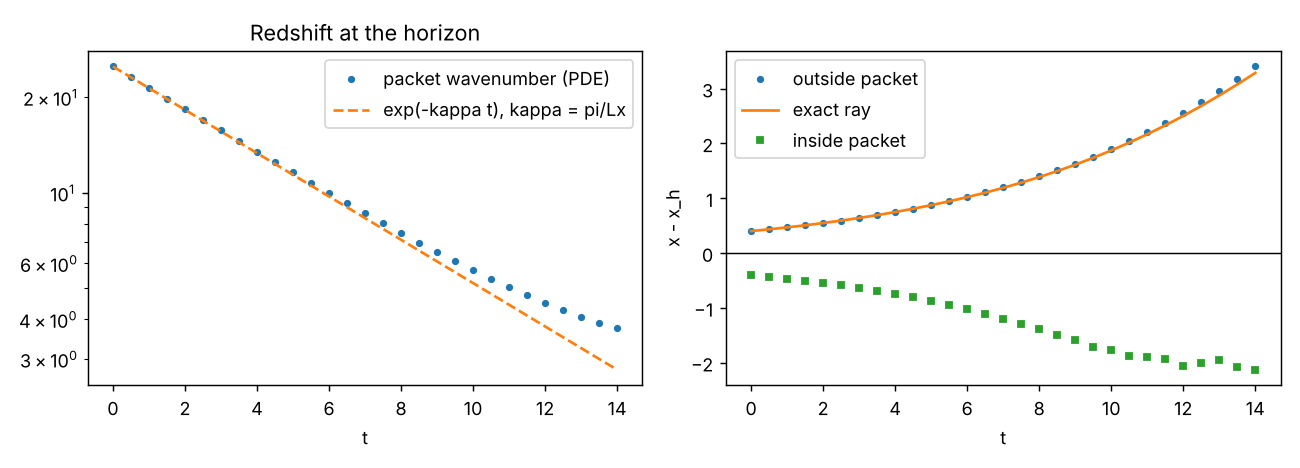
Two of three predictions missed numerically. The redshift rate came out 9.5% low because by the end of the fit window the packet had left the region where the flow is linear; refitting near the horizon (labelled post hoc) gives 2% low. The centroid missed its 0.05 tolerance by 0.01. The bill: the analog Hawking temperature at a surface gravity of 100 per second is 1.2×10⁻¹⁰ K. A bathtub can show the horizon, not the glow. That needs a Bose–Einstein condensate at nanokelvin.
A cloak made of two liquids
A cylindrical cloak built from 20 thin layers of two ordinary fluids cuts the scattering from a hard cylinder by 17 dB at kR = 2, and gets better with more layers (−6.3, −11.4, −17.0, −22.8 dB for 5, 10, 20, 40 layers). All 4 predictions held.
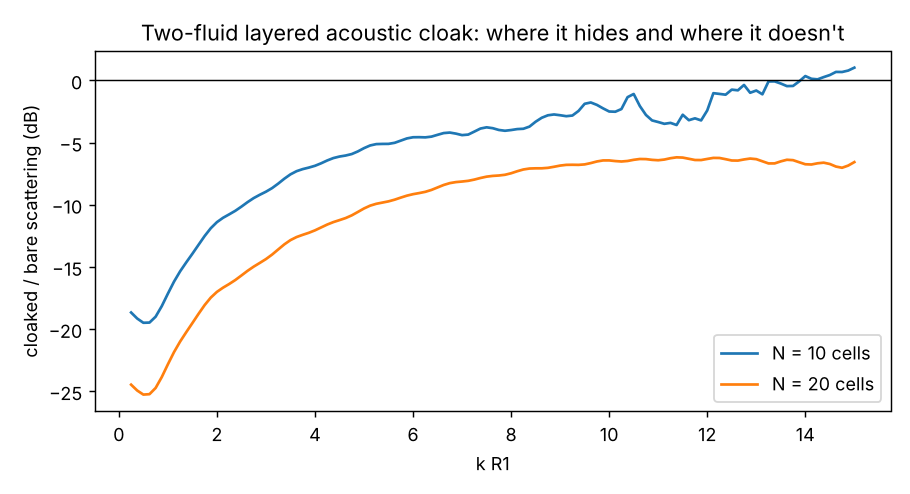
The bill comes in materials. The two fluids in the innermost layer must differ in density by 6,722 to 1 at 20 layers, and that ratio grows with the square of the layer count. It is the perfect cloak's impossible inner surface coming back as a shopping list.
The wormhole lens
The Ellis wormhole, a throat joining two universes, bends light the same way a flat plate does if the plate's refractive index is n = 1 + (a/2ρ)2. The ray deflections through that plate match the exact wormhole formula 2K(a/b) − π to 6×10⁻⁶ radians, and rays aimed inside the throat vanish into a dark disc of radius exactly a. The derivation is short and is probably already in the transformation-optics literature; we don't claim it.
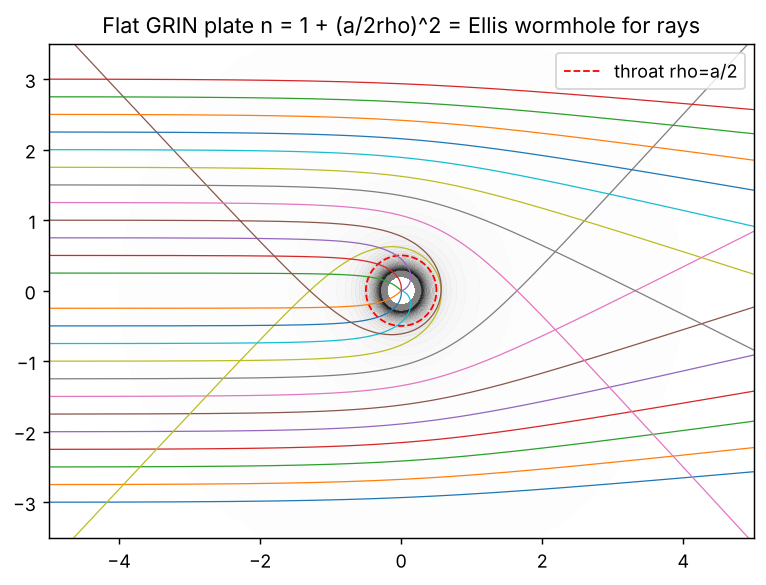
The bill: n goes to infinity at the centre. A 3-D printed pillar plate reaches about n = 1.34, which keeps the lensing for rays with b ≥ 1.15a and loses the throat. One prediction missed: the threshold was estimated by hand at 1.1a, and that estimate was wrong. The site's Wormhole Physics Playground shows the same geometry in 3-D.
Black hole, medium form
Horizon and redshift reproduced; 1 of 3 predictions held, misses explained.
Cloak, medium form
4 of 4 held, with the density contrast as the dominant caveat.
Wormhole lens
3 of 4 held. Lensing yes; the throat is out of reach of simple prints.
PG-020 · the looking glass
Play it backwards and it comes home
Record a pulse on a row of 61 microphones, reverse the recording, and play it back out of the same row. The wave un-scatters and refocuses on the spot where it started. The surprise is what clutter does: through a slab of 170 random scatterers the focus is 3× tighter than through clear space, 7 cells or 0.58 wavelengths, close to the half-wavelength floor. The mess acts as a lens.
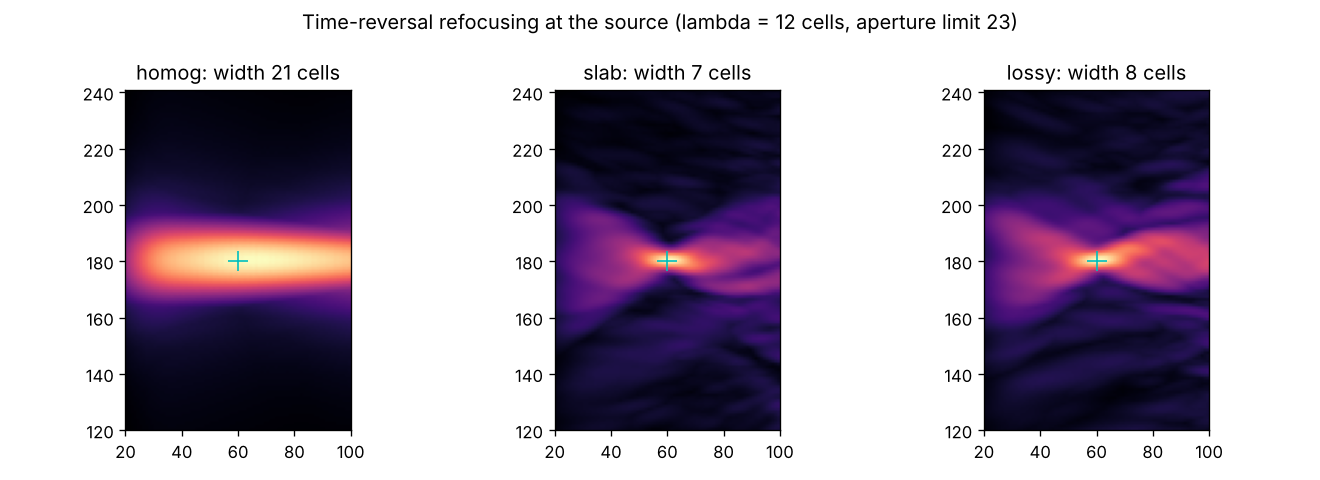
2 of 4 predictions held. Without clutter the focus is a long cigar along the axis, so its brightest point sat 5 cells off the source; the prediction should have been about the transverse position only. And the chosen loss was too weak to cut the contrast by the predicted 30% (it cut 15%). The bill is loss, which is never played back, and the recording itself: only what the 61 elements caught comes home. As Seen on TV asks the related question of whether a Kozyrev mirror focuses anything.
Medium form
Clutter sharpens the refocus beyond the mirror's own aperture. Strong form untested.
PG-021 · phase-shift matter
Teleportation, and the two bits it can't skip
Quantum teleportation moves a qubit's state from one qubit to another with no quantum channel between them at that moment. In a noise-free simulation the fidelity is 1.000; with realistic noise, 0.94 to 0.96, well above the classical limit of 2/3.
The bill is the part people skip. If Bob never hears Alice's two ordinary bits, he holds noise: fidelity 0.496, and none of his measurement statistics depend on the input at all (worst case 1.9 standard errors over 18 probes, against 90.5 for the positive control). Nothing reaches Bob faster than those bits. One entangled pair is used up per qubit moved, and the original is destroyed.
Weak form
The state moves. 4 of 4 simulator predictions held.
Strong form
Faster-than-light or matter transport: ruled out by the no-correction run.
A run on real quantum hardware is done and will be added to this page after review.
Infrastructure · WAVE2D
A check that can actually fail
The Foundry's old wave-scattering gate checked an S-matrix that the candidate supplied, so any unitary matrix passed. That gate could never fail on physics, and an audit said so. The replacement computes the S-matrix itself from a real geometry (a hard cylinder in a channel) and cross-examines it with a second, independent calculation.
- Path 1, an eigenvalue solve, finds a trapped mode: a wave that sits beside the cylinder forever even though the channel is open at both ends (Evans, Levitin and Vassiliev 1994). At a/d = 0.5 it sits at kd = 1.3917.
- Path 2, a scattering solve that never sees path 1's number, shifts the cylinder off-centre so the trapped mode leaks out as a sharp dip in transmission.
- The dips extrapolate back to path 1's value within 1.6×10⁻⁴, with widths growing as offset2.13.
One pre-registered gate missed: at the largest offset the dip had moved 0.03 away, because an offset cylinder is a different obstacle. The extrapolation that fixes it is labelled post hoc. The unitarity check caught a real phase bug in the first version, which is the best sign that it works.
Next
Designed, not yet built
- A 240 mm printable sound lens with 3,054 pillars, from the wormhole profile.
- A laptop speaker and microphone time-reversal mirror, about a minute to run.
- A shaker-driven granular ratchet rotor with its mirror-image control.
Each has its predictions written before it exists.
Back to the Alien Math wing.