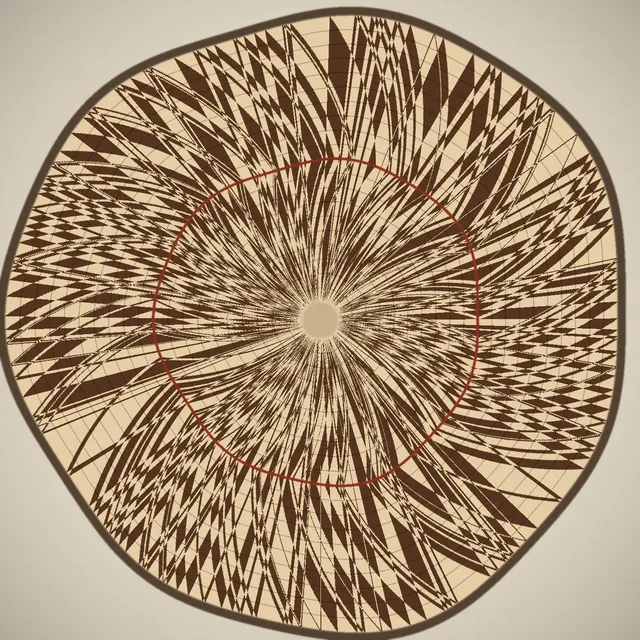
Alien Math · Proving Ground · PG-020 · standing: mixed
Looking GlassLooking Glass
Record a wave as it scatters through a mess. Play the recording backward. The wave un-scatters and lands back on the spot it came from, tighter than it ever could through clear space.
What broke: add heat and the focus dims, then vanishes. In clear space it lands five cells off target. Both are kept in the ledger.
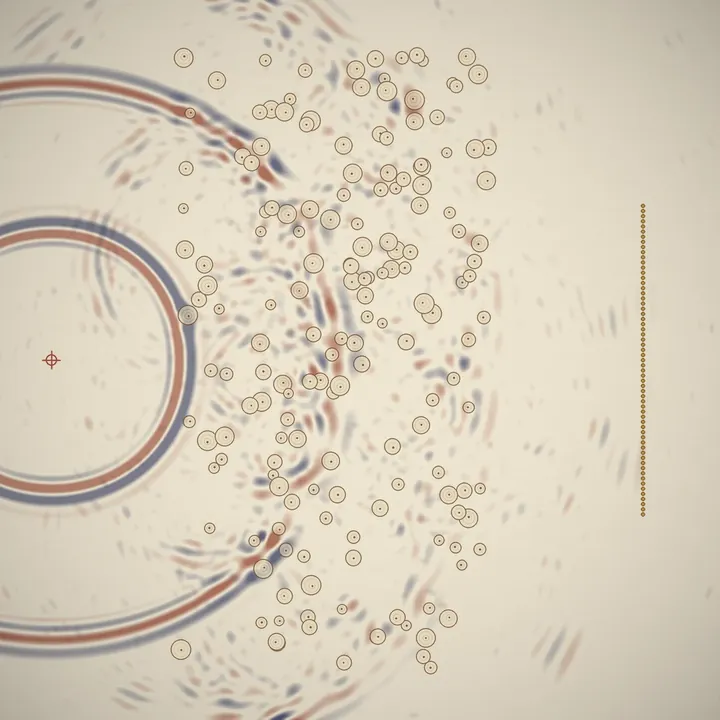
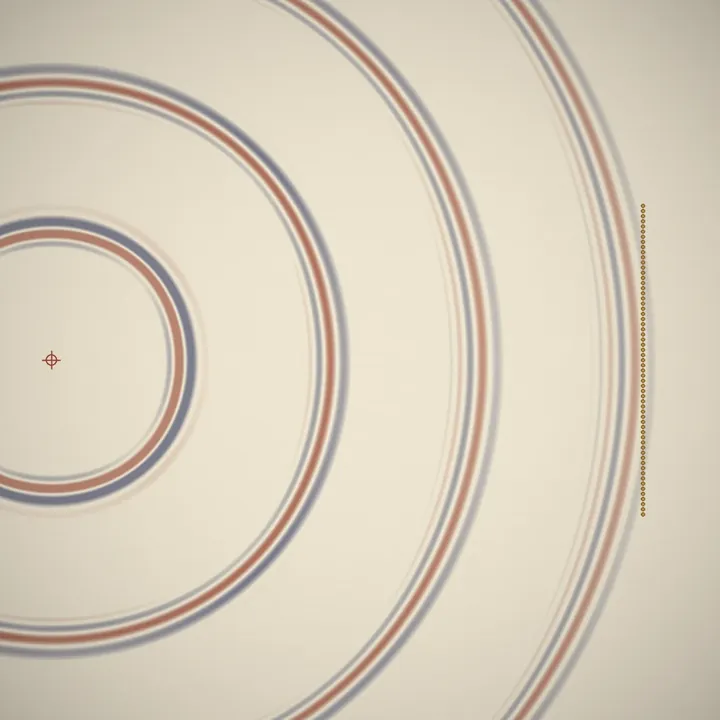
A pulse is on its way through the clutter. Press Fire to send a fresh one and record it.
compressionrarefactionsourcemicrophones (the mirror)focus at the source: waiting
This tank runs live in your browser: a 2D acoustic simulation on a 240 × 150 grid, the same scheme as the lab's run, at a quarter of its size. "Line of mics" is the real experiment: only what the microphones heard gets played back. "Whole tank" flips every velocity at once, Loschmidt's dream mirror, which is perfect until you add heat.
For Josef Loschmidt, who asked, and for everyone who has clapped in an empty room to hear it answer.
Prologue · Vienna, 1876
Loschmidt's dare
In 1876 Josef Loschmidt, physicist in Vienna and an old friend and colleague of Ludwig Boltzmann, raised an objection that still has his name on it. Boltzmann had argued that a gas left alone runs toward disorder, and that the arrow comes out of Newton's mechanics. Loschmidt pointed out that Newton's laws run equally well backward. Take any gas that has just spread out, reverse the velocity of every molecule, and the same laws carry it back to where it started. Entropy would run downhill. So the arrow cannot come from the mechanics alone.
Boltzmann's answer, in the version everyone repeats, was four words: "Go ahead, reverse them." The line is almost certainly apocryphal. His printed reply in 1877 was longer and better: the reversed state is allowed, it is just absurdly rare, so the arrow is a matter of probability. Nobody in 1876 could grab ten to the twenty-odd molecules and turn them round, so the dare sat there for a century.
Then waves took it up. A wave field is a far smaller thing to grab than a gas. In the late 1980s and early 1990s Mathias Fink's group in Paris built what they called time-reversal mirrors: a row of ultrasonic transducers that records a pulse as it arrives, then plays each recording back last sample first. If the medium does not absorb much, the wave equation does not care which way time runs, and the replay converges on the spot where the pulse was born. In 1995 Derode, Roux and Fink sent pulses through a forest of steel rods and found the refocus came out sharper with the rods than without them. The mess acts as a lens. The idea now does useful work in medical ultrasound, underwater communication and touch screens.
This lab took the dare in three sizes. Weak: a recorded wave, re-emitted in reverse, refocuses on its source even after a scattering mess. Medium: the mess makes that focus sharper than the mirror's own aperture allows, approaching half a wavelength. Strong: time reversal can undo any process, lossy and irreversible ones included.
Where they stand today. The weak form is holding: in ten random clutter layouts the refocus landed within one cell of the source every time. The one-speaker room test that would check it in air has not been run yet. The medium form is holding: through clutter the focus shrank from 21 cells to a median of 7, about 0.58 wavelength, in 10 of 10 layouts, and a second, independent solver agreed. The strong form is undercut. Add absorption and the focus loses contrast step by step, then disappears. The card's standing is mixed. Boltzmann's dare works on waves, as long as nothing leaks.
Aside · Wiener got here first
In 1948 Norbert Wiener sat down to name a new science, cybernetics, and the first thing he wrote about was this. Chapter one of his book is called “Newtonian and Bergsonian Time.” It says there are two kinds of world. There is the sky, where the laws run as well backward as forward. And there is the weather, where they do not, and where everything alive has to live.
A looking glass stands in the doorway between the two. What the mirror heard goes home like a planet. What turned to heat stays out in the weather with us. In his next chapter Wiener goes looking for Maxwell's demon, the small creature that tries to cheat entropy by paying attention, and concludes that attention has a cost too. Seventy-eight years later this lab met the weather half in a simulated tank: add a little heat, and the wave no longer comes all the way home.
Interlude · for your ears
Hear it come home
Everything else on this page is numbers and drawings. This part is sound. Clap once in an empty church and the clap leaves you: it breaks on every pillar and is gone in a few seconds. The four buttons below take that loss apart, then hand it back.
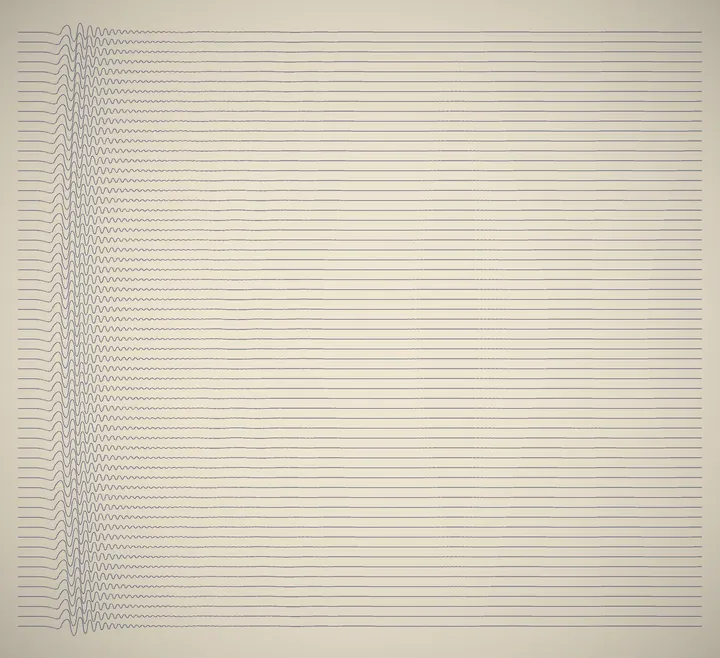
The whole trip as a film, from the lab's wave tank. Out: the pulse through the forest. Back: the reversed tape, with a pause at the focus. The exposure follows the field slowly so the faint echoes stay visible. Silent; press play.
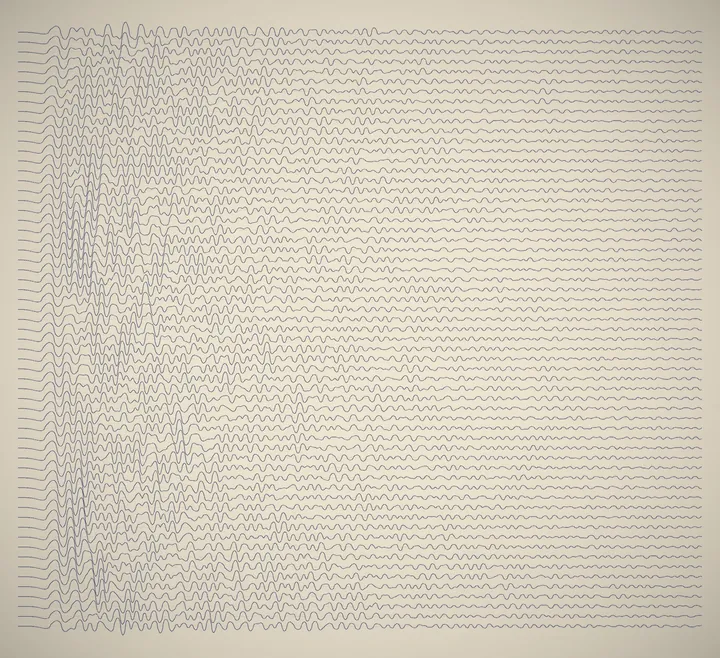
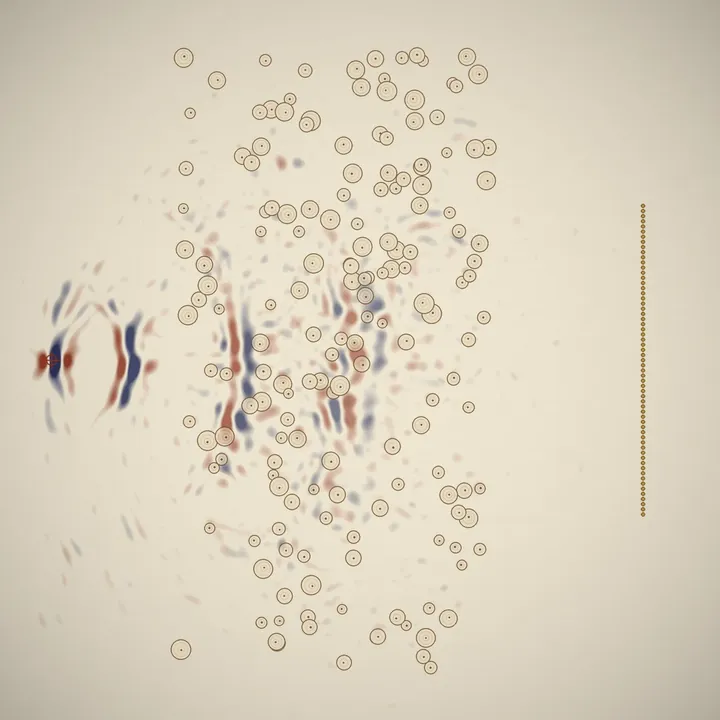
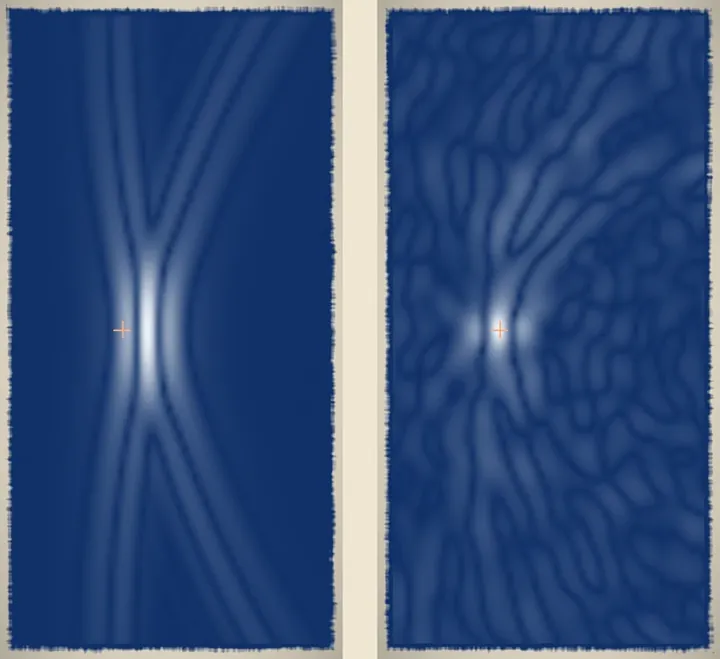
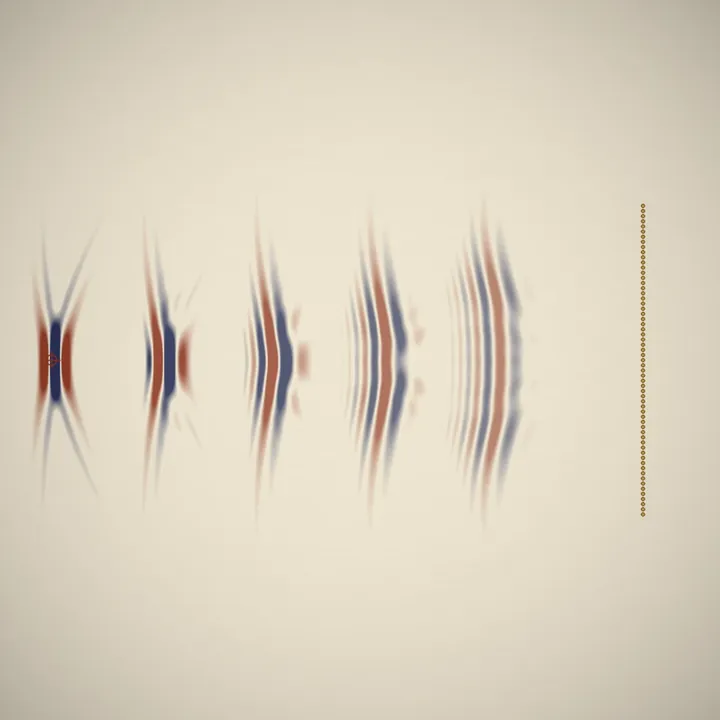
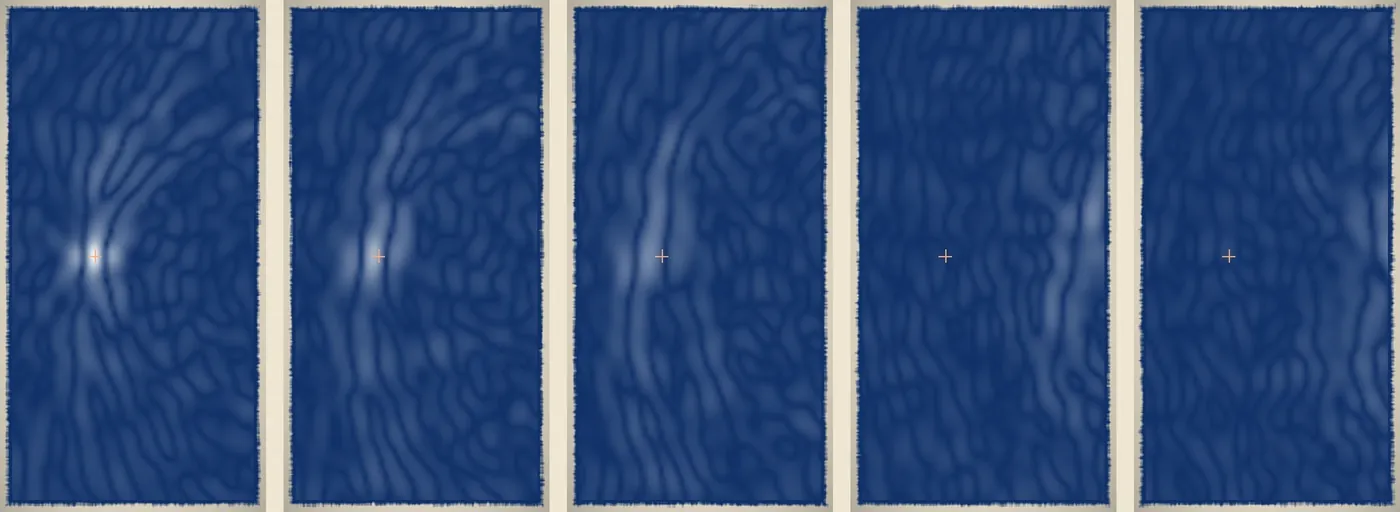
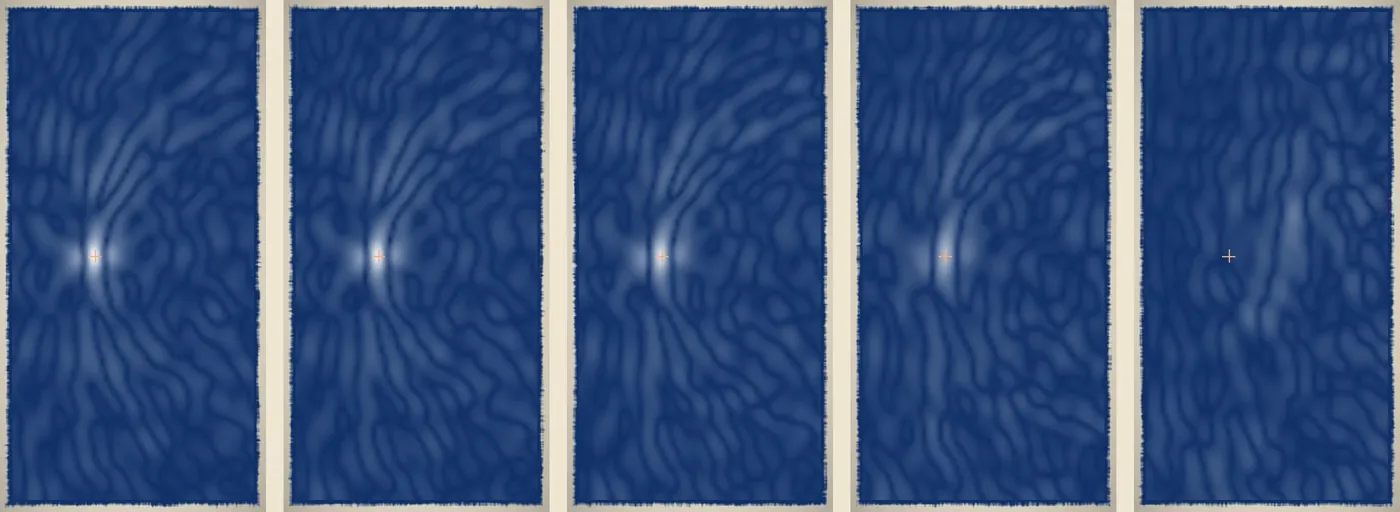
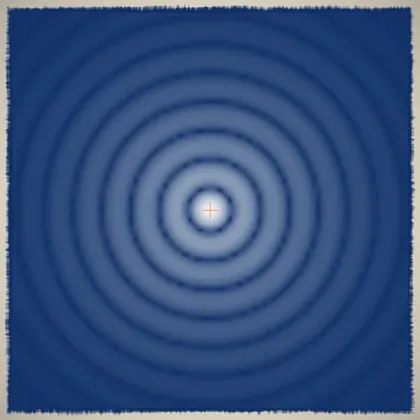
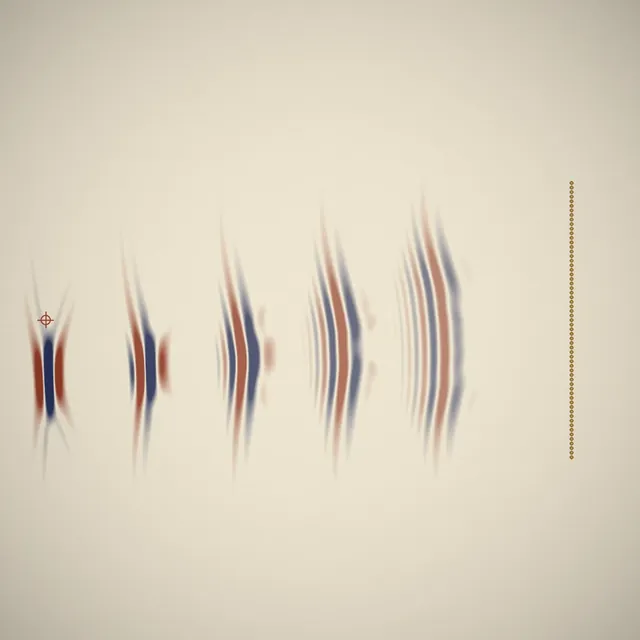
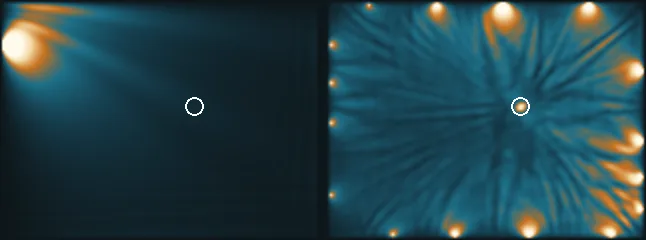
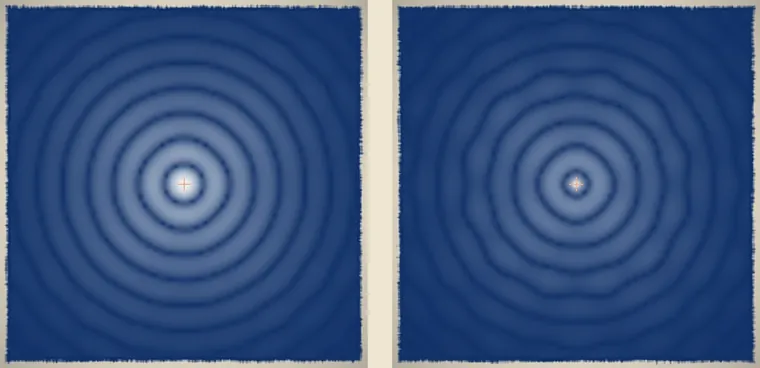
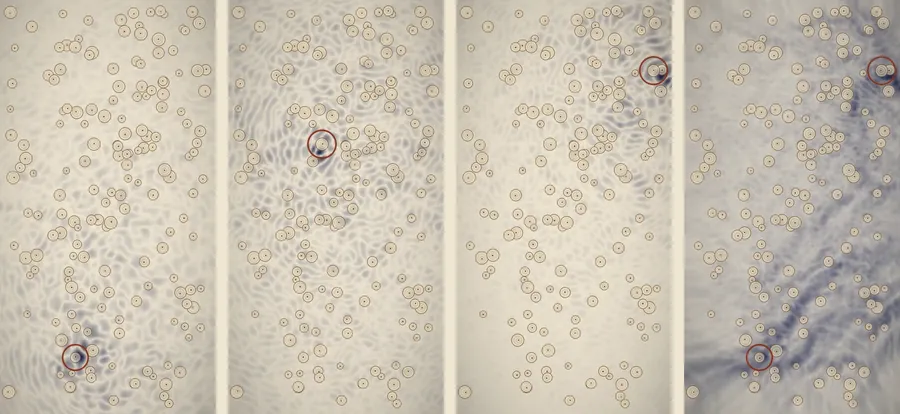
The same three steps as pictures, taken from the lab's wave tank. The pulse goes out through a forest of rods. Sixty-one microphones tape what arrives. The reversed tape gathers back on the cross. These are frames from the wave simulation; the sound buttons below use a simpler made-up room.Where it lands. Left: through clear air, a smear 21 cells wide. Right: through the forest, 8 cells. Each print is scaled to its own peak.
The same three steps with the forest taken away. Each microphone hears one clean wiggle and then nothing, so the tape has no long tail to play back. That missing tail is why the clear-air spot above is the wide one.The same trip with no rods. The wave comes home as a broad crescent.
Start with your volume low. Step 3 has a spike in the middle.
Room:
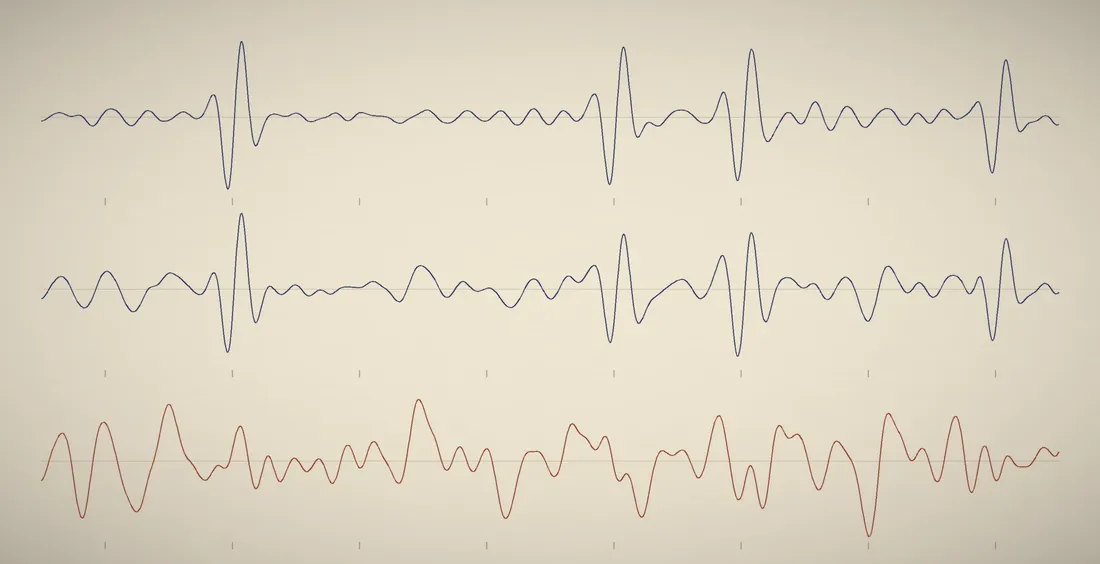
One click, and the room's answer. The sound smears out into thousands of echoes and dies. A microphone across the room tapes it.
The same tape reversed, heard dry. It swells out of nothing and stops dead. Recording studios have used this sound since the 1960s and call it reverse reverb. Nothing has come home yet. This is only a tape played the wrong way round.
Now the backward tape goes out through a speaker where the microphone stood, and you listen where you clapped. The room smears it again, by exactly the same echoes, and the two smears undo each other. You hear a rising hiss, one sharp click, and a falling hiss. The click is your clap, handed back.
Same tape, same room, same speaker. Only your ear has moved. The echoes that reach this spot are different ones, so nothing lines up. You get the same faint hiss and no click. The clap comes home to one place only.
Working out the room…
What you are hearing is a made-up room. Its echo is one click followed by random noise that fades at the rate you chose, the standard statistical stand-in for a reverberant tail, computed in your browser at 16 kHz. No walls, waves or geometry are simulated. “One step sideways” is a second, unrelated echo with the same fade and its click arriving 2 milliseconds later, which is roughly what a real room gives you once you move more than half a wavelength. The two figures are measured from these signals each time you change the room: the level at the focus instant over the average level of the 50 milliseconds either side. The signal recipe, a recording played backward through the response that made it, is the one-channel mirror Draeger and Fink described in 1997; their experiment was in a silicon cavity, not a room. This is not a recording. Fink's group focused audible sound in a real room in 2003 (Yon, Tanter and Fink, “Sound focusing in rooms”), so it has been done and heard. Nobody in this lab has heard it yet, and our own home test is still open: see the letter at the end.
Part 2 · The people before us
People who ran it backward
Running a wave backward has been done for a long time, by people who each found a new way to record the history and play it back. Every one of them also got a bill. Read down the line: what they reversed, and what it cost.
Josef Loschmidt
ran back On paper, every molecule in a gas: flip all the velocities at once and the mixed gas should un-mix, which he raised against Boltzmann's one-way law of entropy.
the bill Nobody can flip every molecule, and the smallest miss in any one of them grows with each collision until the reversed movie runs forward again.
Erwin Hahn
ran back Nuclear spins that had drifted out of step in an uneven magnetic field: a second radio-frequency pulse sent them back into step, and they announced it with an echo.
the bill Only the drift caused by the steady unevenness comes back. The random jostling between spins (relaxation) is gone for good, so the echo is always weaker than the first signal, and weaker the longer you wait.
Mathias Fink and colleagues, Paris
ran back Pulses of ultrasound: an array of transducers recorded what reached it, played each channel back last-in first-out, and the sound converged on the spot it came from.
the bill The array hears only part of the field, so the focus can be no smaller than its aperture allows, and every element has to fire again on fresh power.
Arnaud Derode, Philippe Roux & Mathias Fink
ran back Ultrasound sent through a forest of steel rods in water, recorded beyond it and played back: it refocused on its source, and more sharply than with no rods in the way.
the bill The gain lives in the long scattered tail of the recording, so all of that tail has to be caught and replayed, and the rods must not move in between.
Carsten Draeger & Mathias Fink
ran back Elastic waves in a chaotic silicon cavity, using one transducer: a single channel, recorded for long enough, refocused the wave in both space and time.
the bill It needs a cavity that rings for a very long time with very little loss. Damping shortens the usable recording, and the focus pays for every bit of it.
Medicine: ultrasound targeting
ran back Fink's group and others aimed ultrasound with reversal: record the echo from a target such as a kidney stone, play it back, and the energy lands on the stone. Lithotripsy targeting is the use the card cites.
the bill Bone absorbs. Reversal alone fixed the timing through the skull, but not the lost amplitude; the sharpest focus (Aubry and colleagues, 2003) added an amplitude correction on top. That is loss admitting it cannot be played backward.
Geoffroy Lerosey, Julien de Rosny, Arnaud Tourin & Mathias Fink
ran back Microwaves, reversed onto a cluster of thin copper wires, focused from antennas far away to spots much smaller than the usual half-wavelength limit (reported as about a thirtieth of a wavelength).
the bill The tiny focus exists only inside the wire cluster, which has to be built around the target first, and only in the narrow band where the wires resonate.
Google Quantum AI, “Quantum Echoes”
ran back A circuit on a superconducting chip (Willow, 105 qubits; Nature, October 2025) run forward, one qubit nudged, then the circuit run backward: the leftover mismatch, an out-of-time-order correlator, shows how far the nudge spread.
the bill Every gate leaks a little to noise, so the echo fades as the circuit deepens. Decoherence is the bill, and it grows with every layer you try to undo.
here the lab joins the line
This lab: the FDTD mirror
ran back A simulated 2D pulse sent through a slab of 170 fast inclusions, caught on 61 elements and replayed: it landed on the source 7 cells wide (0.58 wavelength), against 21 cells in clear space.
the bill Only what the 61 elements caught comes back, and loss showed up at once: absorption cut contrast from 5.78 to 4.94 and widened the focus from 7 to 8 cells.
Two predictions missed and stay missed: T1 (the clear-space peak sat 5 cells off along the axis) and T4 (loss cut contrast 15% where 30% was predicted).
This lab: round 2
ran back Ten new clutter layouts, a loss sweep and an independent second solver: 10 of 10 layouts focused on the source, median 7 cells, and the Helmholtz solver gave 21 and 8 with contrasts within 2%.
the bill Loss is the whole bill. Contrast went 5.61, 5.06, 4.71, 4.27, 3.77 while the focus widened from 8 to 16 cells, and at a = 0.032 the focus was gone. The strong form, that reversal undoes lossy processes, is undercut.
This lab: the home build, attacked before it ran
ran back One speaker, one mic, one room: the script was run against synthetic rooms before anyone pressed play.
the bill The room decides. The predicted gain is 11x at a direct-to-reverberant ratio of -10 dB, 2.0x at 0 dB and 1.1x at +10 dB, and a laptop's own speaker sits around +5 to +15, so a run now counts only if the room passes a regime gate.
Same bill every time, in different currency: what the mirror never heard, and what turned to heat on the way.
Plates I–XII · drawn from the run data
Twelve plates, one mirror
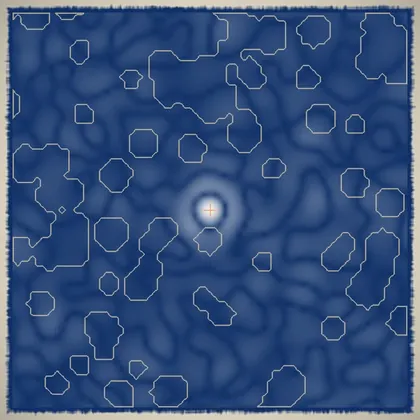
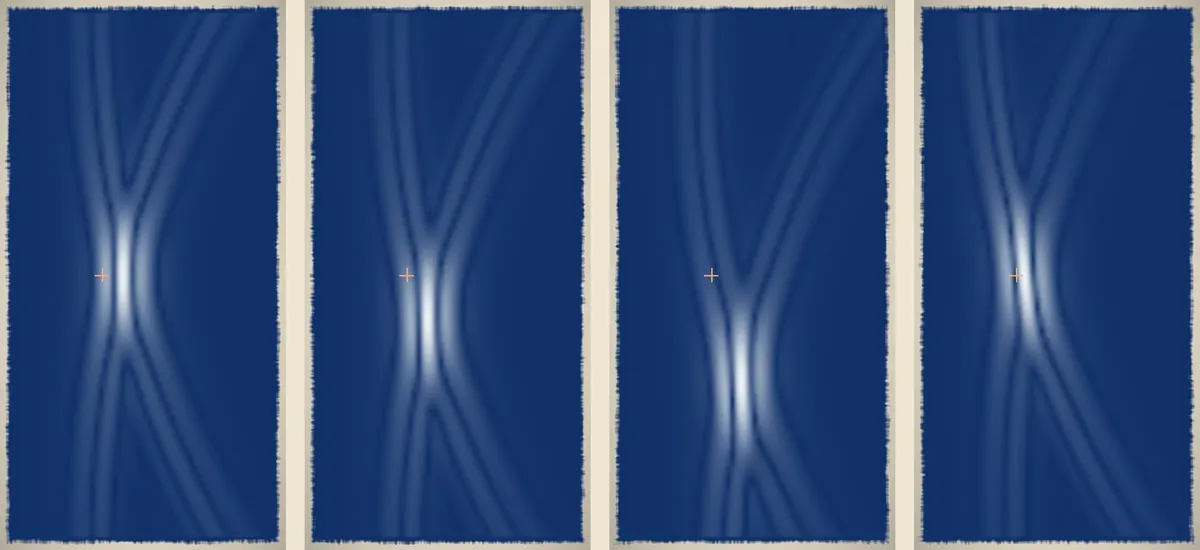
Every plate below is engraved straight from a recorded focus map: how loud the
returning wave got at each point near the source S, the crosshair. The recipe never changes. The
same mirror of 61 microphones records the wave, plays it backward, and sends it home. The only thing
that changes is what sits between them. In clear space the wave comes home as a long smear about
21 cells across. Put a mess of 170 random disks in the middle and it comes home three times
tighter, about 7 cells, in every one of the ten layouts we tried.
How to read a plate. Fine ink lines are contours at 20, 30 and
40 percent of the brightest point; the hatching thickens where the wave was louder. Amber is the
core, everything above half the peak (the −6 dB line that sets the width). Left to right
is x, the direction the wave travels; the mirror sits off the right edge. Top to bottom is
y, across the beam, where the width is measured. One cell is 1/12 of a wavelength (λ).
Plate I
Clear space
Nothing between source and mirror. Width at −6 dB:
21 cells (1.75 λ),
against an aperture limit of 23. Contrast 4.08.
Peak 5 cells from S, along the axis.
A flat mirror only sees S from one side, so it can pin S down across the beam
and barely at all along it. Hence the cigar.
The contrast here is not a fair match for the clutter plates: the long cigar
spreads its energy along the axis, which pulls its contrast down. The skeptic flagged this; the
width is the number to compare.
Plates II–XI: ten layouts of clutter
Same source, same mirror, same recipe. Each plate is a different random scatter of 170 disks in
the slab between them. Each one comes home tight.
Ten of ten narrower than clear space. Median width 7 cells, or
0.58 λ. Every peak within one cell of S. Layout 7 (Plate VIII) is the original
October run, reproduced to four decimals.
Same mirror, same trick. The mess did the sharpening: each disk bounces
a little of the wave to the mirror from an angle the mirror could never see directly, so the
clutter acts like a much wider lens.
Plate XII: the second engraver
One solver can fool itself. So a second one was written from scratch: it works frequency by
frequency (a Helmholtz solver, 201 frequencies) and shares nothing with the first except the
geometry. Here are its two plates, side by side.
XII a clear space · 21 cells · contrast 4.14
XII b clutter, layout 1 · 8 cells · contrast 5.67
The two engravers, side by side
first solver (time steps)
second solver (Helmholtz)
clear space
21 cells, 4.08
21 cells, 4.14
clutter, layout 1
8 cells, 5.61
8 cells, 5.67
Widths match to the cell. Contrasts agree within 2%. Compare XII b with Plate II:
two different methods drew the same picture.
What these plates cannot show: they are 2D, one frequency band, one kind of
disk, all simulated. And the sharpening has a price. Add loss to the clutter and the focus first
widens, then at the highest loss tried it is simply gone.
Plate IV · the loss sweep
Who pays the bill
The playback can return almost everything the wave did on its way out. It can retrace every
bounce off every disk, every detour and every echo, as long as the array heard it. It cannot
return heat. Energy that the medium soaked up and turned into warmth was never recorded, so it
is never played back.
So we made the clutter leak. Same slab of 170 disks, same layout (seed 1), with a small loss
added at every time step, doubled each run: 0.002, 0.004, 0.008, 0.016, 0.032. Drag through the
six plates below and watch the bright core.
a = 0.008
0
.002
.004
.008
.016
.032
Focus width (cells, −6 dB)
13clear space 21
Contrast
4.27clear space 4.08
Clutter still helping: narrower and brighter than clear space.
the long paths die first, and they were the big mirror
Plate IV. Peak pressure near the source after playback, FDTD, slab seed 1,
one plate per loss level. Each plate is scaled to its own peak (for the last one, that peak lies off the plate). Fine lines are contours
every tenth of the peak; the amber core is everything above half the peak (the −6 dB spot, whose
width is the number on the right). Crosshair: the source S. Propagation runs left to right; the
array sits far off the right edge. 1 cell = 1/12 wavelength.
The leak hits the clutter hardest
In clear space a wave goes from the source to the array once and is done. In the slab, some
of it rattles between disks for a long time before it escapes, and that late, multiply scattered
sound is what made the 61-element array behave like a much wider one. Each disk it bounces off
sends a little of the wave toward the array from a new angle, so the clutter acts as a lens you
did not have to build.
Loss charges by the time step. The paths that spend longest inside the lossy slab pay the most,
so they die first. Those are exactly the paths that were making the mirror look bigger. Take them
away and the borrowed aperture shrinks: the core widens from 8 cells to 10, 11, 13, then 16, and
the contrast falls from 5.61 to 5.06, 4.71, 4.27, 3.77.
The moment it flips
At a = 0.016 the lossy slab still beats clear space on sharpness (16 cells against 21) but has
already lost on contrast (3.77 against 4.08). The next doubling ends it. At a = 0.032 there is no
focus on the source at all; the brightest spot lands 64 cells away, in the absorbing sponge,
off this plate. Somewhere between those two runs the clutter turns from the
thing that sharpened the mirror into the thing that wrecks it.
One caveat from the skeptic pass: the clear-space contrast is held down by its long
focus along the axis, so slab-against-clear contrast is not a like-for-like comparison. And a
uniform loss acts a lot like simply cutting the recording short; that control has not been run.
Said in advance, and what happened
Held. B1: contrast falls at every step.
Held. B2: at least a 30% contrast cut by a = 0.016 (it was 33%).
Round one's T4 missed because the loss picked then was too weak; this sweep found the size.
Held. B3: the focus stays on S up to a = 0.016.
Held only vacuously. B4: the focus would be at least 1.5 times
wider at a = 0.032. It did not widen. It vanished, which satisfies the letter of the prediction
and none of its meaning. We count it as a miss in spirit.
That settles the strong form of the claim, that time reversal can undo any process including
lossy ones. The sweep undercuts it. A little loss shrinks the
focus; a little more destroys it. The mirror works on what the wave kept. Heat is the part of the
history nobody kept.
Toy · Loschmidt's billiard table
Waves come home and gas doesn't
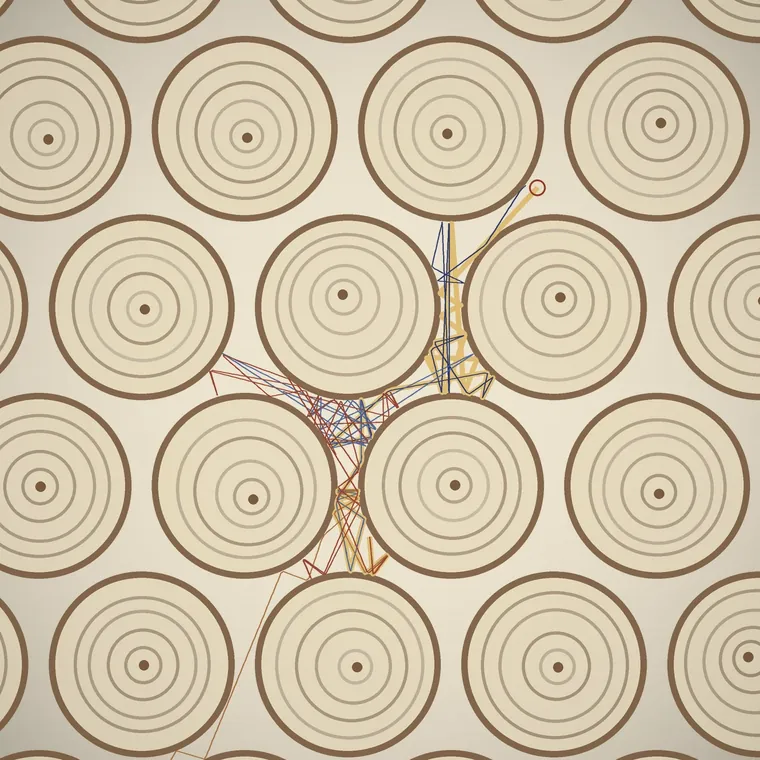
The mirror un-scatters a wave onto its source. Gas never un-spreads itself, even though the laws that move its molecules run backward as well as forward. Loschmidt's dare, from the prologue, can be played on a table. Here are 36 balls racked in a triangle and a cue ball on its way in. Break them, let them rattle, then flip every velocity at once and watch.
step0
runningforward
gap between nudged and clean worldsno nudge yet
10-9whole table
Racked and waiting. Press Run to break.
Faint rings mark where every ball started. With the nudge on, Reverse first shifts the red ball sideways by one billionth of the table's width, then a second set of thin rings shows the un-nudged copy running alongside, so you can watch the two worlds part. To see the reassembly fail, let the break run past about 3,000 steps before you reverse; under 2,000 the billionth has not had time to grow.
The toy keeps its promise
Computers round numbers, and rounding on its own would spoil the trick: the tiny errors made going forward are different from the ones made coming back, and in a chaotic box they grow exactly like the nudge. So every position here is a whole number of units, one billion units across the table, and each step uses a leapfrog rule, next = 2 × now − before + push, with the push rounded to a whole unit. Reverse swaps now and before. Each step back undoes one step forward to the last unit. The idea is Levesque and Verlet's bit-reversible integrator from 1993. In a test run of this exact code, 500 to 8,000 steps forward and the same number back put every ball on its starting spot with an error of zero units.
The nudge wins
Two round balls that collide act like a convex mirror for any error in their aim. Strike a ball a hair off-centre and it leaves at a slightly wrong angle; over the free flight to its next collision that angle turns into a bigger miss, and the next collision bends it again. Each collision multiplies the error by roughly the free path divided by the ball's radius. Multiplication, collision after collision, is exponential growth, and one billionth needs only tens of multiplications to reach the size of the table. Running a system forward, reversing it with a small flaw and asking how much comes back is called the Loschmidt echo. For chaotic particles the echo falls off a cliff. Try a short run and a long one: the miss gets worse the longer you let them rattle before reversing.
The wave comes home anyway
A sound wave in a lossless medium obeys a linear equation. Two waves in the same tank simply add. An error in what the mirror plays back therefore travels as its own small wave alongside the main one, and since the energy of that error wave is conserved it never grows. A billionth of error in the recording gives about a billionth of error at the focus. The clutter scatters the error exactly as it scatters the signal, and amplifies neither. Rays bouncing through the lab's 170 inclusions would be as chaotic as these billiards. The wave field takes no notice, because the wave equation adds; it never feeds an error back into itself.
That is why the mess only helps. In the lab's FDTD runs the same mirror focused to 21 cells through clear space and to a median of 7 cells (0.58 wavelength) through clutter, in 10 of 10 layouts. A second, independent solver got 21 and 8. The leapfrog scheme in that FDTD is exactly reversible too, the same property this toy leans on.
One caveat to keep this straight. Change the medium itself between recording and playback (move a scatterer, warm the water) and the wave's echo does degrade. The damage then follows the size of the change. A billionth of a wavelength of movement costs almost nothing; the billiard table turns the same billionth into everything.
Where the bill goes instead
Waves escape the exponential trap, so they pay in two other currencies.
Loss. Energy that turns to heat is never recorded, so it is never played back. In the round-2 loss sweep the focus contrast fell 5.61, 5.06, 4.71, 4.27, 3.77 as absorption rose to 0.016 per step, and at 0.032 the focus was gone.
Missing channels. The mirror only replays what its 61 elements caught. Through clear space that sets an aperture limit of 23 cells, and the run measured 21. The clutter beats that limit by steering waves that would have missed into the array. Whatever escaped past its edges stays escaped.
The toy only gets away with it because it cheats: it keeps every position exactly, so it holds a perfect record of its own past. A real box of gas keeps no record anyone could read or write. The wave mirror's record is its 61 recordings, and because the wave is linear a finite record is enough.
Part 6 · The home build, without the sound
Carry the speaker across the room
The home version of the mirror needs one speaker, one laptop mic and a room. It measures how the room answers a click, then plays that answer backwards. If time reversal does its job, every echo the room smeared out arrives back at the mic at the same instant, as one spike. Test L1 asks for that spike to stand at least 3 times taller (peak to RMS) than the forward playback.
Before anyone ran it, the lab ran the build's exact pipeline against simulated rooms and found a hole. L1 is decided by how much of what the mic hears comes straight from the speaker and how much comes off the walls: the direct-to-reverberant ratio, DRR. Whether time reversal works barely enters into it.
Drag the speaker across the room. Watch the rings.
Arrow keys move
RT60
Speaker to mic, r
0.25 m
Critical distance, rc
0.70 m
DRR (model)
+8.9 dB
Predicted L1 gain (sim curve)
1.1x
Gate G: DRR at most −5 dB
fails
L1: gain at least 3x
would miss, not counted
Inconclusive: wrong regime. The direct sound swamps the room, so a 1.1x reading says nothing about time reversal.
Forward playback at the mic: the direct click, then the room's smear of echoes
Reversed playback: the echoes arrive together. Spike height is the predicted gain; the dashed line is the forward level (1x)
Plan: a 5.0 m by 4.8 m living room, 2.5 m ceiling, volume V = 60 m³. DRR from the standard diffuse-field model, DRR = 10 log10((rc/r)²), with rc = 0.057 √(V/RT60): 0.70 m at 0.4 s, 0.57 m at 0.6 s, 0.49 m at 0.8 s. These are plausible values for a furnished room, chosen by me, not measured. The gain is read off the simulated curve in home_regime_sim (synthetic rooms, RT60 0.4 s, linear interpolation in measured DRR, held flat past its ends at −15.8 and +14.1 dB). It comes from simulation. No real room has been measured yet. The sketches are drawings, not recordings.
The laptop's own speaker would have faked a miss
A laptop's speaker and mic sit centimetres apart, so the direct sound swamps the room: DRR roughly +5 to +15 dB. With so little echo to gather, the reversed playback has almost nothing to refocus, and the simulated gain falls to 2.0x at 0 dB and 1.1x at +10 dB. Windows mic processing trims the reverb tail as well. The original build would most likely have logged an L1 miss that says nothing about time reversal and quite a lot about the furniture of the experiment.
So the lab amended the test before any hardware data existed. L1 and L2 stay as written. A regime gate G was added: a run counts only if the measured DRR is −5 dB or lower, otherwise it is filed as “inconclusive: wrong regime”. In the simulation, RT60 barely matters: 0.4 s and 0.8 s give the same ratios to two digits below −5 dB.
The setup that should land in the gate
Laptop mic, with mic enhancements off in Windows Sound settings.
A speaker 2 to 3 m away, pointing at a wall, not at the laptop.
A furnished room with the door shut.
With rc = 0.70 m the model puts 2 m at −9.1 dB and 3 m at −12.6 dB, inside the gate, where the simulated curve gives about 8.6x to 11.3x. Aiming the speaker at a wall cuts the direct sound further; the simple model above ignores that, so it is, if anything, pessimistic there.
Close up, the mirror has nothing to reflect. Step back and let the room do the work.
Part 7 · Attacking PG-020
The skeptic's margin
Before a result counts, somebody tries to break it. For PG-020 that meant a reviewer who got the code and not the conclusion, plus a home build that got attacked before it ever played a sound. Below is the notebook page they marked up. The typed lines are the plan or the reading as it stood. Red pencil is what the attack found. Struck text was wrong. Nothing typed has been erased.
home · L1 Reversed playback focuses at least 3x better than forward. Run it on the laptop, speaker and mic as they come.
Could have fooled us: L1 is set by the direct-to-reverberant ratio (DRR), not by whether reversal works. The synthetic rooms give 11x at DRR -10 dB, 4.2x at -5, 2.0x at 0 and 1.1x at +10. A laptop's own speaker sits around +5 to +15 dB, so the build would have logged a miss that says nothing about time reversal.
What changed: regime gate G added before any hardware data: the run counts only if measured DRR is -5 dB or lower, else it reads "inconclusive: wrong regime". Speaker 2 to 3 m away, facing a wall, mic enhancements off. L1 and L2 kept as written.
11-08 wrong regime. The laptop speaker fakes the miss. Gate it on DRR.
fixed before it ran
round 2 · C Second solver: frequency-domain Helmholtz, phase conjugation at the array, 201 frequencies 0.02 to 0.22. Ready to run.
Could have fooled us: the source had no f² weighting and the box rang with low-frequency modes. A broken check can agree with the first solver for the wrong reason, or disagree for the wrong reason. Either way the "independent" in independent solver is gone.
What changed: the first attempt was stopped and none of its numbers were used. Both faults were fixed before the Helmholtz result existed, and the amendment to C was written down before the result. Then it gave widths 21 and 8 (FDTD: 21 and 8), contrasts within 2%.
11-08 missing f² · box modes. Stop it. Fix first, then look.
fixed before the result existed
home · verdict() L2: moving the mic 30 cm kills the advantage. A missed L2 is reported, never counted against the claimcounted against the claim.
Could have fooled us: on the card, "the gain survives moving the mic" is one of the two ways the claim fails. The script could never let that happen, so the most important failure was graded as no failure at all.
What changed: a missed L2 now counts against the claim. A failed rig check (L3 against a phase-scrambled null, or L4, the focus coming back at the moved spot) gives "inconclusive". Also flagged: --simulate builds L2 in, so it tests the pipeline and says nothing about a real room.
11-08 "move the mic" could never lose. Now it can.
fixed
round 1 · T1 Peak within 2 cells of S. Homogeneous: 5 cells off, along the axis.
Could have fooled us: without clutter the focus is a long cigar along the propagation axis (depth of focus about λ(F/D)², about 40 cells), so its brightest cell drifts a few cells along it. The transverse position was exact. The prediction should have asked about the transverse position only, and rewriting it now would turn a guess we never made into a pass.
What changed: nothing in round 1. Round 2 asked the question again for the slab (A3) and it held in 10 of 10 layouts, all within 1 cell.
10-24 the clear-space focus is a cigar. Wrong question, still a miss.
recorded, left as a miss
round 1 · T4 Loss cuts contrast by at least 30%. Absorption 0.004 per step: 5.78 to 4.94, a 15% cut.
Could have fooled us: read alone, T4 says loss barely matters. The direction was right (contrast fell, focus widened 7 to 8); the loss level was too weak to cost 30%.
What changed: round 2 swept the loss as a new, pre-registered prediction (B2): a 33% cut by a = 0.016. That held. T4 still reads missed.
10-24 loss set too weak. 11-08 30% arrives by a = 0.016.
recorded, left as a miss
round 2 · B4 Focus width at least 1.5x wider at a = 0.032: heldheld only vacuously.
Could have fooled us: the focus did not widen. It vanished, and the "peak" sat 64 cells away in the sponge. A tick here would say loss blurs the focus a bit, when what happened is that it erased it.
What changed: the grade says "vacuously" in the record. The plain reading: width doubles by a = 0.016 (8 to 16 cells) as the long paths die and the clutter's virtual aperture shrinks. Between 0.016 and 0.032 the clutter flips from helping to destroying.
11-08 not wider. Gone.
graded vacuous
round 1 · T2 Wavelength 12~9 cells, so the aperture limit λF/D is 23~17 cells. Homogeneous width 21: within 1.5x.
Could have fooled us: the grid wavelength is the nominal 12 cells, but the pulse that actually propagates has an effective wavelength near 9. Against the wrong yardstick the clear-space focus (21) looks narrower than its own aperture limit (23), which muddies the baseline the clutter is measured against.
What changed: T2 was rechecked against the corrected limit and still holds, at 1.2x. Every "in wavelengths" figure on this card, the 0.58 λ included, is in nominal 12-cell wavelengths.
11-08 wrong ruler. T2 survives at 1.2x.
corrected, still holds
round 2 · strong form Loss shrinks, then destroys the focus: reversal does not undo lossy processes. Undercuts.
Could have fooled us: uniform loss costs each path in proportion to how long it travelled, so it hits the late, many-bounce arrivals hardest. Cutting the recording short removes those same arrivals. The sweep cannot yet tell "heat was not played back" from "the coda was shorter".
What changed: the verdict stands. The control that separates the two (loss against a truncated coda) is listed as not run.
11-08 loss looks like a shortened recording. Control not run.
flagged, open
round 2 · contrast Slab contrast 5.61 against clear space 4.08.
Could have fooled us: the clear-space focus is the long cigar from T1, and spreading energy along it depresses its peak contrast. Setting the two contrasts side by side compares different shapes. The same caveat sits on "16 cells wide but 3.77 against 4.08" at a = 0.016.
What changed: the medium-form claim rests on width, which both solvers agree on. Contrast comparisons across media are marked not like-for-like.
11-08 not like-for-like. Compare widths.
flagged
Lab rule
Misses are recorded as misses and never retro-edited.
The red pencil may fix a method, a script or a ruler, and it may say a prediction asked the wrong question. It never changes a grade after the fact. T1 and T4 stay missed. B4 stays vacuous. A better question goes in as a new prediction, locked before its run.
Part 8 · Big claims, attacked
Seven stories people tell about time reversal
Each one was stated in its strongest form, given a gate (what would have to be true), and run. Predictions were written down and hashed before any code ran. All of it is simulation from one day, 2026-11-10, and every line is in the ledger.
The backward tape is a wave from the future
Wheeler and Feynman, and later Cramer, built physics out of waves that converge on their source. A replayed tape looks like one. The gate: a true advanced wave arrives and ends at the source, where an ordinary wave arrives, passes through and leaves. Watched from a ring three wavelengths out, the replayed wave left at full strength (100% of what came in, mirror all the way round). Add a sink at the source that absorbs on cue and 90% of the leaving wave is gone. So the tape is half of an advanced wave, and the sink plays the part of Wheeler and Feynman's absorber. With the mirror on one side only, the same sink cancelled 6%.
Rounds 5 (B1) and 6 (C1). One prediction missed in each: the leaving wave was weaker than predicted on a one-sided ring, and a short pulse focused to 5 cells where I predicted 3 or 4.
Reverse every molecule and the world runs backward
Loschmidt, 1876. Sixty particles bouncing among disks, flipped with a small error and run back. Going from an error of one part in a hundred to one part in a hundred trillion stretched the reversible time from 1 unit to 7: every hundredfold gain in precision buys the same thin slice. Error growth rate 4.4 per unit time. A sound wave fails differently, by the size of the disturbance and not exponentially in time, though faster than I predicted: a nudge of a twelfth of a wavelength cost 42% of the focus where I allowed 40%.
Round 5 (B2). Two held, one missed.
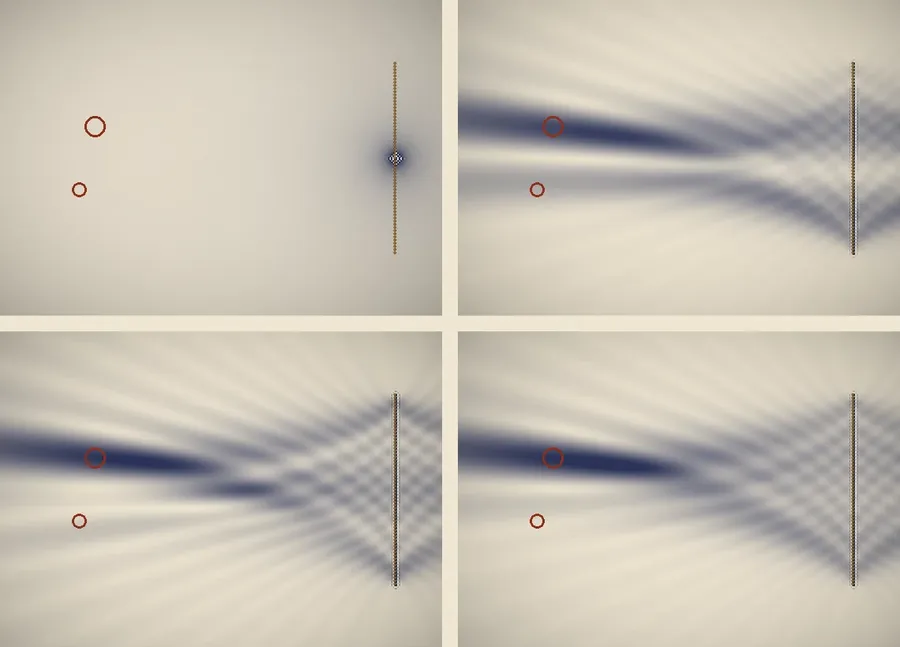
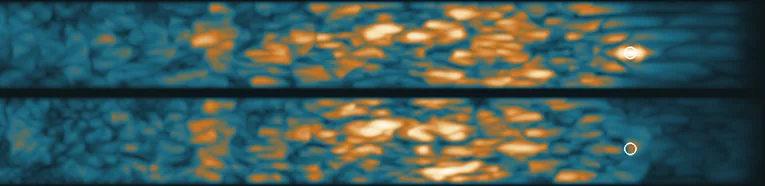
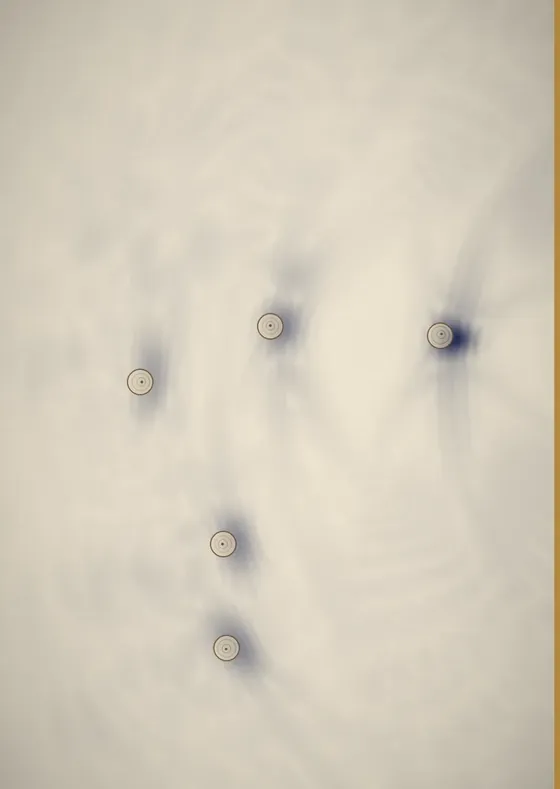
Gold: one particle, 9 time units among the posts. Flip its velocity and run it back. The path flipped with 14 decimal places right gets home, 0.06 off. Every coarser one peels away and is lost.The same table in motion. Gold runs 9 time units forward. Then the velocity is flipped and four copies run back with angle errors from one part in a hundred trillion up to one in a hundred. One gets home.The wave's version of the same dare. Top: every rod moved 0, 1, 2, 3 and 6 cells before the tape comes back. Bottom, round 6: smooth-edged rods moved 0, a quarter, a half, 1 and 3 cells. Each row shares its first print's exposure, so the dimming is real.
Wait long enough and everything comes back
Poincare recurrence, on a toy that recurs exactly: 2,000 two-coloured balls on a ring, flipping colour at marked spots. It greyed out, returned to its start exactly at step 4,000, and ran backward exactly when asked. With one marker wrong on the way back, all but 100 of the 2,000 balls came home, because the ring has no chaos to amplify the error. The textbook decay curve was off by up to 0.11 for this one ring where I allowed 0.05: it holds on average, not ring by ring.
Round 5 (B3). One held, one missed. For a room of air the waiting time has more digits than the room has atoms.
A room is a memory you can read back
Bacot, Fink and colleagues turned water waves around in 2016 with no mirror at all: they changed the wave speed everywhere at once. Simulated here, the whole tank stiffens for four steps, 250 steps after a pulse. Part of the wave turns round and lands back on its source at step 616, where 620 was predicted. At one frequency the spot is 5 cells wide, the half-wavelength floor, and through 120 rods of clutter it still lands, 4 cells wide and 96% as tall. Then a closed, lossy room was given an 8-bit message and jolted 1,500 steps later. The message came back at the source: all 8 bits with no added noise, all 8 with noise ten times the room's own sound, and 5 of 8 wrong with noise ten thousand times stronger. The memory has a floor.
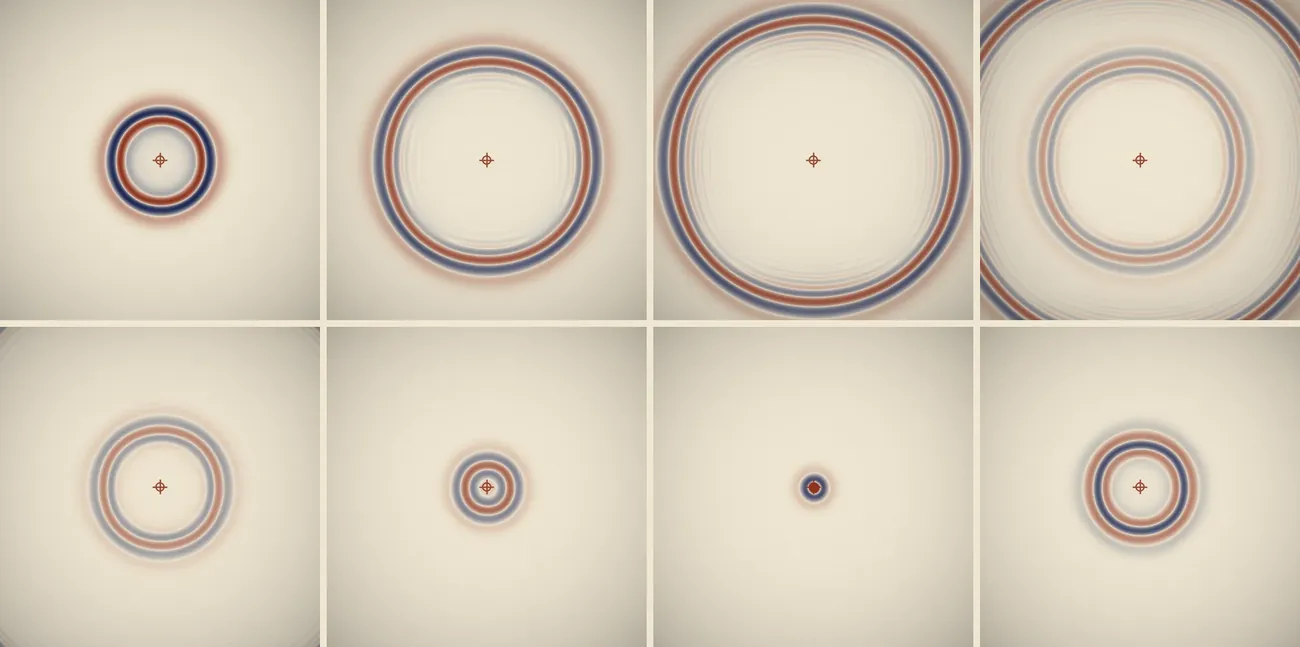
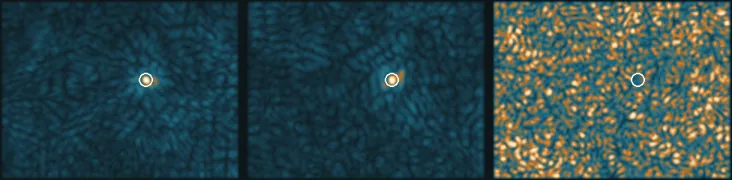
Eight frames of a clear tank, left to right, top to bottom. No mirror anywhere. At the jolt a second ring appears inside the first and runs back to where the pulse began.The jolt as a film. At step 370 the whole tank stiffens for four steps. The film pauses at the refocus, step 616.Where the jolt lands. Left: one frequency in clear water, 5 cells wide. Right: through 120 rods, 4 cells wide. Each print is scaled to its own peak.The pressure at the source as the message 10110010 comes back. Top: no added noise. Middle: noise ten times the room. Bottom: ten thousand times, and the spikes are gone.
Rounds 5 (B4), 6 (C2) and 7 (D4). All ten lines held. A short pulse gave a 3-cell spot in round 5; that number is a loose end below and should not be quoted as beating the floor.
From the club's shelf. An echo as a memory is an old engineering idea. A 1955 paper in the Journal of Applied Physics carries the title “Spin Echo Serial Storage Memory”.
The sleeping brain time-reverses its day
Rats' place cells replay a route backward after a run (Foster and Wilson, 2006). Replay reverses the order of events while each event plays forward, and runs about twenty times faster. Tested on a one-channel room: reversing the tape in chunks loses the focus once chunks reach half a wave cycle, and a 5% speed error kills it. So replay is a reversed index and no time-reversal mirror. The stronger cousin of the claim holds exactly: playing errors backward through a medium equals the brute-force answer to "which way should my guess change", to 13 decimal places, and one such step removed 93.6% of the error. The mirror, the seismologists' imaging step and backpropagation are one operation. Whether neurons use replay that way is a question for a rat.
Rounds 5 (B5) and 7 (D3). B5: two held, two missed (the edge is fuzzier than predicted: quarter-cycle chunks kept 39% where I predicted half; 8-cycle chunks beat forward play by 1.65x where I allowed 1.5x). D3: both held.
The body feels the future
Presentiment experiments report arousal rising seconds before a randomly chosen emotional picture. The standard knockout is expectation bias: tension builds through a quiet run, and a shuffle with fixed counts makes a shock more likely after a quiet run. Simulated with no foresight in the model, that bias faked the effect in only 58% of experiments, where I predicted 90% (independent coin flips: 57.5%, chance). This knockout does not land. That does nothing for presentiment itself; it means this attack should not be quoted as settling it. Analysis flexibility and selective publication remain, and neither can be run from here.
Round 5 (B6). One held, one missed.
Point the mirror at anyone
Send, listen, reverse, repeat (Prada and Fink, 1991). With two reflectors, one twice as strong, the loop's share on the strong one grew 1, 5, 22, 106 times over three rounds. It locks onto the loudest echo and nothing else. A quiet, soft target in a room of hard walls is the last thing it would pick, so without a beacon at the target there is no aim.
Round 5 (B7). Held. This is also the only form of the mirror that is a true feedback loop.
Rounds 0 to 3 of the loop, all on one exposure. The beam finds the larger of the two reflectors without being told where it is.
From the club's shelf. W. Ross Ashby's homeostat of 1948 was a box that kept resetting its own switches until its needles settled. The send, listen, reverse loop is the same kind of machine: nobody steers it, and it settles. This one settles on the loudest echo. The likeness is this lab's reading; Prada and Fink did not put it that way.
Stated, not run
Voices in reversed hiss. Reversing a tape keeps its loudness at every pitch, so reversed speech keeps speech rhythm and vowel colour. Protocol for a person: 20 clips (10 reversed speech, 10 shaped noise), three listeners write what they hear cold, then again after being shown a suggested phrase. Written guess: under 10% agreement cold, over 60% once primed.
Libet's backward referral. Gate only: the timing has to survive being measured without the subject's own clock report.
Price's block universe. Price puts the arrow of time in boundary conditions. The mirror agrees: the replay is a carefully prepared boundary, and wind, loudness and chaos are a list of what the preparation must include. Nothing here can tell his reading from the ordinary one.
Loose ends kept on the books
The whole-room jolt and the 3-cell spot. At one frequency the jolt mirror sits on the half-wavelength floor (5 cells). With a short pulse it focuses to 3 where a ring of speakers gives 5. A treble-heavy pulse through the ring also gives 3, but the jolt's refocus is only 3.8% higher in pitch where I predicted 15%. Open.
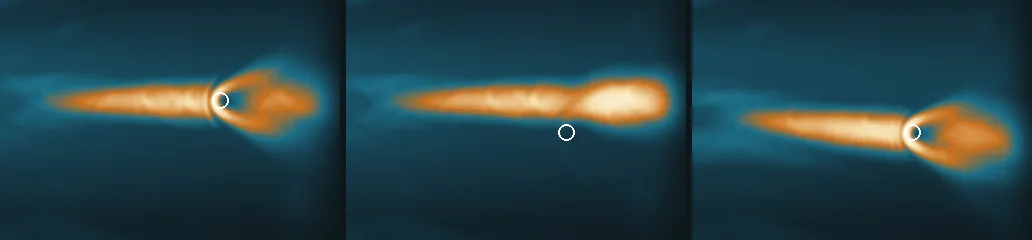
Wind. A steady cross-wind at Mach 0.02 and 0.05 carried the focus 10 and 24 cells downstream, twice the one-way drift. Reversing the wind for the return trip put it back on the source. The mirror can reverse the tape. It cannot reverse the weather.
Top: the return trip in a steady wind blowing down the page. Bottom: where it lands in still air, at Mach 0.02, at Mach 0.05, and at Mach 0.05 with the wind reversed for the return.The return trip in wind, as a film. The wave comes home a little downstream.
Too loud. A wave on the brink of shocking comes back 98.7% intact. After two shock distances 88% of its height returns (I predicted under 85%), after four, 63%.
Bat band. Air alone would take 37 s to kill an echo at 1 kHz and 0.13 s at 40 kHz. It overtakes a furnished room's walls at 15.6 kHz.
Who got there first
None of the physics in this part is new, and a search on 2026-11-10 found a published ancestor for nearly every line. Wind breaking the replay, and a reversed flow repairing it: Roux, de Rosny, Tanter and Fink, 1997. Shocks breaking it for good: Tanter, Thomas, Coulouvrat and Fink, 2001. Clutter losing its memory when the scatterers shift: coda wave interferometry, Snieder and colleagues, 2002. The sink: de Rosny and Fink, 2002. The whole-room jolt: Bacot, Labousse, Eddi, Fink and Fort, 2016. Errors replayed backward as the correction: Tarantola, 1984, with the neural-network link spelled out by Hughes and colleagues, 2019. The expectation-bias attack on presentiment: Schwarzkopf, 2014.
What belongs to this lab is smaller: the effects reproduced in one small tank that anyone can re-run, the predictions written down first, and the misses left in. One thing did not turn up in print after a real search: using the jolt as a message channel, which here is a 2D simulation only. The Wheeler and Feynman label on the sink is a small gloss on Fink and Fort's own language (2017), where the replayed wave is already the advanced one. Not finding something is a weak sign that it is new.
Part 9 · Futures
Where the trick could go
The tank shows one trick: record a wave where it lands, play it backward, and it finds its way home. Here are twelve places people want to take that trick, from one already in shops to one that will never work. Each card has a gauge with three marks (done in the world, demonstrated in a lab, a dream) and a bill. The lab's runs name six charges, and every use pays some of them. Eight cards carry a run of their own: a small simulation, with predictions written down before the code. Thirty predictions, 22 held, 8 missed, and the misses are on the cards. All thirty are in the ledger at the foot of the page.
loss: energy that turns to heat is never played back;
missing channels: only what the mirror caught comes back;
a fresh recording every time something moves: the replay is for one arrangement of the world;
energy to re-emit: the mirror plays back actively, nothing reverses for free;
one-way things: wind and current carry sound one way only, so they have to be reversed by hand or the focus lands downstream;
loudness: past the point where a wave steepens into a shock, part of it becomes heat for good.
fine print on nearly every card: the target has to speak first
To focus on a spot you need a recording of a wave that started there, so something at the target has to call out before you can answer. Where I was unsure whether a use is real, it went one notch toward dream.
Whispering to one person in a crowded room
Where it stands: demonstrated in a lab.in the worldin a laba dream
What would need to be true
The listener has to call out first: a click from a badge or a phone near her ear, recorded by speakers along the walls. The speakers play that recording backward with the words folded in, and the room's echoes carry it to her ear. The room has to be echoey. In the lab's home-build simulation the focus gain was 11x at a direct-to-reverberant ratio of -10 dB and 2.0x at 0 dB, so a dry room kills the trick.
The bill
a fresh recording every time something moves
missing channels
energy to re-emit
She turns her head and the channel she recorded is gone. The home build moves the mic 30 cm mid-run for exactly this reason: if the focus survives the move, it was never about her spot. Round 5 put a number on how still the room must be: when every scatterer shifted by a twelfth of a wavelength (about a centimetre at 3 kHz) the focus lost 42% of its contrast, and by a quarter wavelength it was gone. And it has to be audible sound. Above about 16 kHz the air swallows the echoes before the walls can return them.
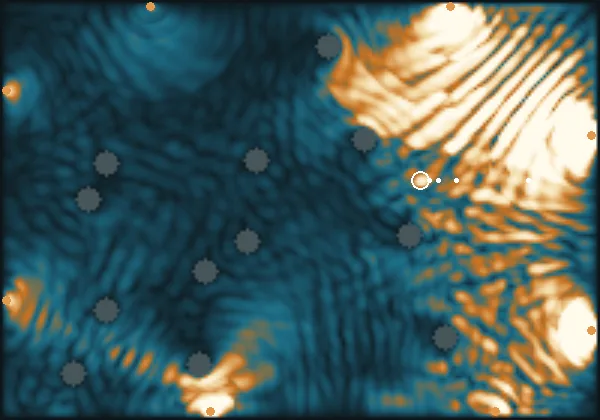
Loudness as the first bit lands. Ring: the listener. White dots to her right: bystanders. Orange dots: speakers. The brightest places sit next to the speakers.
We ran it
Eight wall speakers, a room with twelve pieces of furniture, a 32-bit message. The listener read every bit. So did someone a quarter wavelength away. One wavelength away a bystander still read 78% of the bits, and three wavelengths away the room was only 2.5 times quieter than at her ear. I predicted a clean edge and got both of those wrong. Eight speakers make a focus, and a leaky one.
The ring growing step by step. Each new tree ring is one step, and dark wood is a black ball.
Sound focusing in rooms by time reversal: shown in the lab (Yon, Tanter & Fink, 2003). Nobody sells a private whisper yet. Blomgren, Kyritsi, Kim & Papanicolaou modelled the same question in an ocean waveguide and judged a listener one wavelength off target unable to decode reliably. We read our 21.9% of bits wrong there the other way round: 78% still arrive.
Focusing light through fog, frosted glass or skin
Where it stands: demonstrated in a lab.in the worldin a laba dream
What would need to be true
Light scrambled by a frosted pane is scrambled the same way every time. Shape the incoming wavefront pixel by pixel with a spatial light modulator, or record the scattered light and send back its phase conjugate, and it refocuses behind the pane. You need a guide star at the target (a fluorescent bead, or ultrasound tagging the light at one spot), and the gain grows with the number of segments you control.
The bill
a fresh recording every time something moves
missing channels
loss
Living tissue will not hold still: blood flow reshuffles the speckle within milliseconds, so the recording goes stale almost as soon as it is made. In return the mess is the lens, as in the tank, where the slab sharpened the focus from 21 cells to 7. The same mess is the fragile part. Round 6 moved soft-edged scatterers by a 48th of a wavelength and kept 95% of the focus; a 12th kept 58%.
Left: 256 segments set at random, plain speckle. Right: the same pane after shaping, one bright spot.
We ran it
A random-matrix stand-in for the pane, a hundred panes per size. Shaping 16, 64, 256 and 1,024 segments made the spot 13, 51, 201 and 803 times brighter than the background, within 2% of the textbook formula. Then the pane drifted. Half-similar to the pane that was measured, it kept 25% of the spot. One-tenth similar, the spot was 2.9 times background. All three predictions held.
Vellekoop & Mosk (2007) focused light through opaque paint; Yaqoob et al. (2008) did optical phase conjugation through slices of chicken tissue. Seeing through a living hand is still research.
Aiming the hammer at a kidney stone
Where it stands: demonstrated in a lab.in the worldin a laba dream
What would need to be true
The stone is its own guide star. A probe pulse goes in, the stone echoes it, the array records the echo and fires it back reversed and amplified, so the shock lands on the hard thing and spares the soft tissue around it. Because the kidney rides up and down with every breath, the loop has to re-listen and re-fire faster than you breathe.
The bill
a fresh recording every time something moves
energy to re-emit
loss
Shock waves are expensive pulses, and tissue soaks some of each one up. The tank's loss sweep shows the trend: contrast fell from 5.61 to 3.77 as absorption rose to 0.016 per step. Two later runs bear on this card. The listen-and-fire loop finds the strongest echo by itself: with two reflectors, one twice as strong, the strong one's share grew 1, 5, 22, 106 times over three rounds. And loudness has a ceiling: a pulse on the brink of shocking came back 98.7% intact, but after four shock distances only 63% of its height returned.
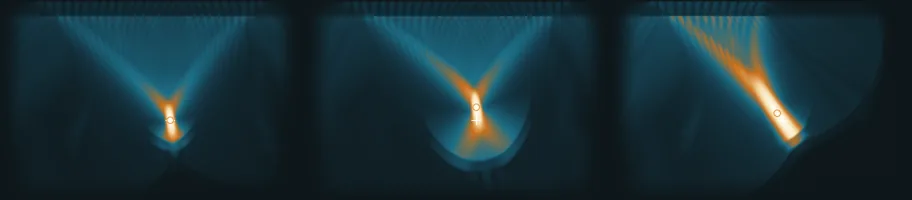
Left: the replay lands on the stone (ring). Middle: the stone has moved and the beam has not. Right: after listening again.
We ran it
A 41-element array, weak clutter, one hard stone. With no baseline to subtract, the replayed echo landed 3.6 cells from the stone's centre. Then the stone moved and the array did not listen again: 94% of the intensity still hit after a third of a wavelength, 70% after two thirds, 30% after one and a third. I predicted 15% or less at that last step and missed. At this aperture the spot is broad, and breathing costs less than I thought. Listening again put the peak back on the stone.
Shock-wave lithotripsy is routine in hospitals. Aiming it by time reversal was built and tested as a prototype (Thomas, Wu & Fink, 1996). I could not confirm routine clinical use, so the gauge stays at lab. The loop that locks onto the loudest echo is Prada, Wu & Fink (1991).
Finding an earthquake or a nuclear test by running the seismograms backward
Where it stands: demonstrated in a lab.in the worldin a laba dream
What would need to be true
Here the replay happens inside a computer. Recorded seismograms are reversed and injected back at the station positions into a model of the Earth, and the waves pile up where and when the event happened. That needs stations around the source on most sides and an Earth model good enough to stand in for the real rock.
The bill
missing channels
loss
Stations sit on the surface and mostly on land, so the mirror has big holes, and the rock's attenuation is guessed. The energy to re-emit is a computer's power bill: the cheapest replay on this page. The same backward pass, run on errors in place of recordings, is how seismologists sharpen the Earth model itself, and it is the same arithmetic a neural network uses to learn. The brain's reverse replay of a route is sometimes called biological time reversal; round 5 tested the literal version (order reversed, each moment played forward) and it does not focus.
Cross: the true source. Orange ring: where the replay put it. Left: right speeds. Middle: model 10% too fast. Right: stations on one side only.
We ran it
Twenty-five stations on the surface, a source 120 cells down, speeds rising with depth. With the right speeds the replay found the source to the cell. A model 5% too fast put it 6 cells too shallow, 10% put it 13, and the sideways position never moved. With stations on one side only the fix slid 5 cells toward them and 7 up, worse than the 6 I predicted. Round 7 checked the arithmetic underneath: replaying the errors backward gave the same correction as brute force to 13 digits, and one step removed 93.6% of the misfit.
Time-reversal imaging of real earthquakes is published (Larmat et al., 2006, on the 2004 Sumatra rupture). Routine event location, test-ban monitoring included, mostly relies on travel-time methods. Replaying the errors backward to correct a model is adjoint tomography (Tromp, Tape & Liu, 2005).
Wireless power that finds one device
Where it stands: demonstrated in a lab.in the worldin a laba dream
What would need to be true
The phone sends a beacon. The charger records how that beacon arrived through the room's reflections and sends power back along the reversed paths, so it gathers at the phone and stays weak elsewhere. Power has to stay under exposure limits everywhere off the focus, including in whoever walks through it.
The bill
energy to re-emit
a fresh recording every time something moves
loss
missing channels
Delivering energy is the whole job, so this one pays the re-emit charge in full, and every metre of air and every absorbing wall takes a cut. Pick up the phone and the charger has to listen again.
Energy summed over time. Left: one antenna, and the energy stays by the antenna. Right: sixteen, with a bright spot at the device (ring).
We ran it
A closed room where a wave crosses about three times before it dies. One antenna replayed the device's beacon and the device got 0.36 times the room's average energy: less than average. Both my one-antenna predictions missed badly, because the zone around the antenna takes most of the budget. Sixteen antennas gave the device 8.6 times the room average with pulses and 7.4 times with one steady tone, both as predicted. A sharp spike at the right moment is not a charge.
Microwave time reversal in rooms and cavities is well shown (Lerosey et al., 2004 and 2007). Beacon-guided charging is being prototyped; I could not confirm efficient room-scale charging in everyday use. Indoor time-reversal power tests have been reported by Ibrahim, Anlage and colleagues at the University of Maryland.
A touch screen that hears where you tapped
Where it stands: done in the world.in the worldin a laba dream
What would need to be true
Tap a pane of glass and the sound that reaches a couple of tiny sensors is a fingerprint of the spot you hit. Record every spot's fingerprint once at the factory. After that, matching a new tap against the library is the time-reversal step done as arithmetic, a correlation in place of a playback.
The bill
a fresh recording every time something moves
Cheap: the finger supplies the energy, and two sensors are enough because the plate rings for a long time. The recording goes stale only if the glass changes. A crack or a resting palm are the usual culprits; in our own run below, one sticker was not enough. A finger held still makes no sound, so this kind hears taps and drags and misses a held press.
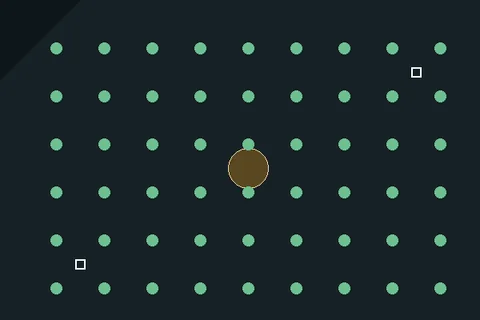
Green: taps the pane still placed correctly after the sticker (brown) went on. All 54. Squares: the two sensors.
We ran it
A plate with one corner cut off, 54 library taps, then 54 fresh taps from a different finger with noise added. Two sensors matched 54 of 54. One sensor matched 54 of 54. Then a sticker went on after the library was made, and it still matched 54 of 54. I predicted 70% or less and was wrong, though one sticker in one place is all this run covers. Taps between library points were the weak spot: 45% were matched to a far-off place, with a match score only 0.62 as high, low enough to reject.
Shown by Ing, Quieffin, Catheline & Fink (2005) and sold commercially as acoustic pulse recognition touch screens.
A message only one submarine can hear
Where it stands: demonstrated in a lab.in the worldin a laba dream
What would need to be true
The submarine pings first. A line of hydrophones hanging from a ship records the ping, reverses it, and sends the message along the same paths; it arrives focused at the submarine and spreads into murk everywhere else. The sea must hold still between ping and reply, and tides and internal waves keep changing it.
The bill
a fresh recording every time something moves
missing channels
loss
The fine print is grim for a submarine: to receive a private message it must first make a noise. The array covers only part of the water column, so some of the ping is never caught. A current adds the one-way charge. In round 5 a cross-wind at Mach 0.02 moved the focus 10 cells downstream, twice the drift of a single trip, and reversing the wind in the replay brought it home exactly. A ship that knows the current can correct for it; one that does not will miss by a predictable amount.
Top: the reply arriving, bright at the submarine (ring). Bottom: the same reply after a 3% change in the sea.
We ran it
A channel 37 wavelengths long and a column of 27 hydrophones. The submarine read 32 of 32 bits. A listener one wavelength shallower got 56% wrong, and one five wavelengths nearer the ship got 38% wrong. The top half of the column alone still delivered every bit, at half the level. Then the sea changed between ping and reply: a 0.3% ripple in sound speed kept 88% of the level, 1% left 30% and one bit in five wrong, and 3% scrambled it. All five predictions held.
An acoustic time-reversal mirror at sea was shown by Kuperman and colleagues (1998), and messages followed (Edelmann et al., 2002). Operational use is not public, so the gauge stays at lab.
A focus sharper than the wavelength allows
Where it stands: demonstrated in a lab.in the worldin a laba dream
What would need to be true
A replayed wave arrives at the target, passes through and leaves the other side, and that leftover half is what stops every focus at half a wavelength. Put something at the target that swallows the wave on cue and the limit lifts. Round 6 ran it: with the mirror all the way round the source, the wave left at full strength; with a fitted sink, 90% of the leaving wave was gone and the ringed spot collapsed to a point. This is as close as the lab gets to the wave-from-the-future picture of Wheeler and Feynman: the tape is half of such a wave, and the sink plays their absorber.
The bill
missing channels
energy to re-emit
The mirror has to surround the target. With a mirror on one side only (round 5) the same sink cancelled 6% of the leftover wave. And the sink is an active device sitting at the target, so this sharpens a spot you can already reach. The one-cell spot in the run is the sink's own near field; read it as the limit lifted, with no resolution figure attached.
Left: the wave arrives and passes straight through. Right: a sink at the target swallows it. The one-cell point is the sink's own near field.As a film. Left: no sink, and the wave passes through. Right: a fitted sink at the source swallows it.
De Rosny & Fink (2002) focused to a fourteenth of a wavelength with an acoustic sink in a cavity. A far-field route is Lerosey et al. (2007). Fink & Fort (2017) already call the replayed wave the advanced solution and the sink its partner. Linking that to Wheeler and Feynman's absorber is this lab's gloss.
A room that notices something moved
Where it stands: demonstrated in a lab.in the worldin a laba dream
What would need to be true
Turn the mirror's weakness into its job. Record a click once, replay it on a schedule, and watch the height of the focus. If anything in the room has shifted, the focus dims. In round 6 a shift of a 48th of a wavelength cost 5%, a 24th cost 17% and a 12th cost 42%, the same figure by two different models of the scatterers. At 3 kHz those are shifts of about 2, 5 and 10 millimetres.
The bill
energy to re-emit
one-way things
It tells you that something moved, with no word on what, and a draught or a change in temperature moves the air itself. In the runs every scatterer moved at once; one chair among many will dim the focus far less. Round 7 moved a single rod among 170: the focus dimmed by 1 to 5%, and replaying the difference between the two tapes landed 2.2, 3.4 and 3.7 cells from the rod. So the room can say where. In round 8 two movers at once were both found, and a rise of about 0.6 °C in the air did not hide them.
The difference between two tapes, replayed. The glow gathers on the rod that moved (circled), among 170. Last panel: two movers at once.Round 7 as a film: the difference between the before and after tapes, reversed into the original forest. It gathers on the rod that moved.
The same idea watches volcanoes and concrete under the name coda wave interferometry (Snieder et al., 2002). Saying where the change is, from echoes alone, is published too, as LOCADIFF (Larose et al., 2010). As a room sensor built on a time-reversal mirror it is this lab's sketch, tested in simulation only.
A wall that draws the room
Where it stands: demonstrated in a lab.in the worldin a laba dream
What would need to be true
Stop aiming at one spot and ask the mirror for a picture. One wall clicks eight times and listens. Subtract what an empty room would have returned, replay the leftover echoes backward inside a model of that empty room, and ink gathers wherever something sent sound back. In round 8 five hidden rods were all found, 2.9 to 4.6 cells off, with no ghosts.
The bill
missing channels
loss
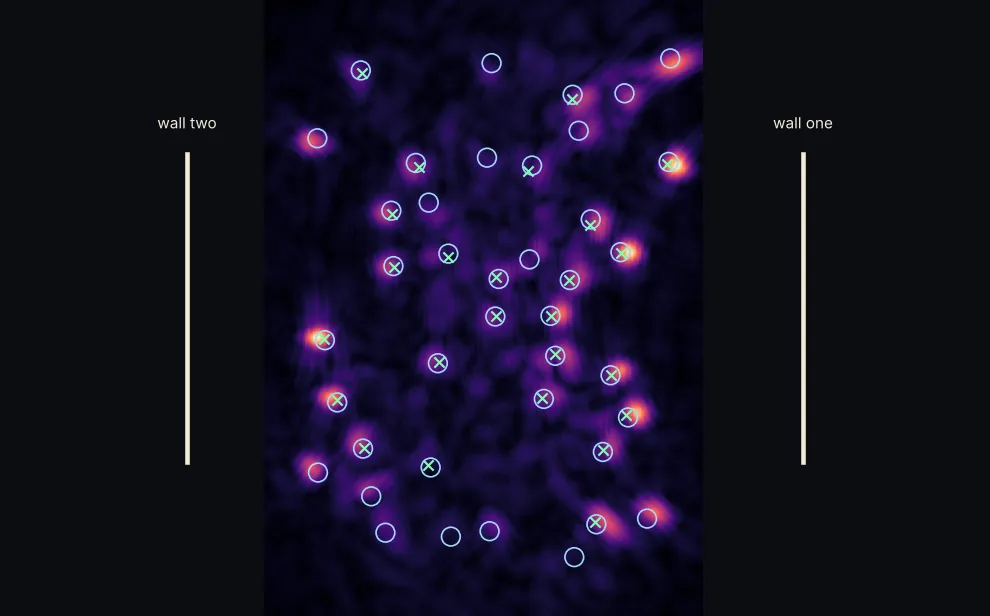
One wall sees only the faces turned toward it, and whatever stands in front hides what is behind. Round 9 took the kindness away in steps. With no empty-room tape at all (the direct wave simply muted) it still found five of five. Noise spread over all frequencies barely touched it, which flatters the method. Round 10 shaped the noise like the click: five of five rods at noise as strong as the echoes, then four, two and one as the noise grew ten, a hundred and a thousand times stronger, with ghosts filling in. In a crowd of forty rods it drew the front ten and none of the back ten. The back row came out (8 of 10) only when the front rods were modelled exactly; with their positions guessed about a sixth of a wavelength off, it drew twenty false spots. Round 11 let the wall tune its own drawing against the echoes: the placement error fell from 2.1 cells to 0.66, and the next pass revealed seven rods from the middle of the room, with thirteen false spots and still none of the back ten. Round 12 asked it to go layer by layer to the back wall, and it stalled a bit past halfway: 23 of 40 rods after the first pass with no false ones, and none of the farthest ten in three passes. Part of the stall is the method, which added 20 candidate rods at once and let the second pass end with a worse match than the first. Round 13 tested the second wall. On the far side it found all ten rods the first wall never saw. Together, with no model at all, the two walls drew 36 of 40 rods with three false marks, and a model built from nothing, one rod at a time, placed 25 rods to within a fifteenth of a wavelength and accepted no false ones. Two predictions missed: I expected that model to hold 30 rods, and I expected the sound that passed straight through the room to change little. Adding it halved the count, 36 to 18, with 21 false marks.
Five hidden rods drawn from one wall (the bar on the right). The ink sits on the faces that look at the wall. Brightness is compressed so the far rods show.Round 13, both walls' echoes added. Rings: the 40 true rods. Bright patches: where the echoes put them. Crosses: the 25 rods in the model built from nothing.
The general method is in daily use: it is how ultrasound scanners and seismic migration draw their pictures. Doing it in a room from one time-reversal wall is this lab's sketch, tested in simulation only. Correcting the model from the echoes is full waveform inversion (Tarantola, 1984; Virieux & Operto, 2009), and going in one layer at a time is layer stripping (Bruckstein & Kailath, 1987). What the tank adds is a count of how far each pass reaches.
My wild one: walls that replay yesterday's conversation
Where it stands: a dream.in the worldin a laba dream
What would need to be true
Every word spoken in a room hits the walls. If the room kept the whole field and nothing turned to heat, reversing it would run the conversation back into the speaker's mouth. That needs the strong form of the claim, reversal undoing a lossy process, plus a recording on every surface of the room.
The bill
loss
missing channels
Loss takes everything. In the tank the focus survived absorption up to 0.016 per step and was gone at 0.032. A furnished room's echo dies in about half a second; yesterday is more than a hundred thousand of those ago, and the sound is warmth in the curtains. A few seconds ago is a different story. Round 5 tried the whole-room version: no microphones, the speed of sound jolted everywhere at once (done with water waves by Bacot, Fink and colleagues, 2016). An 8-bit message spoken into a closed, slightly lossy room came back readable with noise ten times stronger than the echoes, and was lost at ten thousand times. So a room is a memory with a short shelf life and a noise floor.
Slices of echo starting 0.5, 0.9 and 1.5 reverberation times late. The ring marks where the sound was made.
We ran it
The room kept only a late slice of the echo, with a noise floor 60 dB under the loudest moment. A slice starting half a reverberation time late came home 5.1 times above the room's loudest 1%. Starting 0.9 late: still 5.1. Starting 1.5 late, 33 dB under the noise: 0.34, nothing. My first attempt added no noise by mistake, and there the latest slice focused as well as the earliest. Loss alone does not erase the replay. Loss plus a noise floor does. With a half-second echo, yesterday is 10,368,000 dB down. Round 7 also sent the whole-room jolt through 120 rods of clutter, and it came back at 96% of its clear-space height.
The lab tested this joint directly: the strong form is undercut by round 2, and round 5 found the floor. Yesterday stays a dream. The last few echoes do not. The whole-room jolt is Bacot et al. (2016).
Reverse every molecule and unbreak the glass
Where it stands: a dream.in the worldin a laba dream
What would need to be true
Loschmidt's own version, 1876: flip every velocity in the room and the whole scene runs backward. The flip would have to be exact. Round 5 bounced sixty particles among disks, flipped them with a small error and ran them back. Each hundredfold gain in precision bought the same thin slice of extra reversed time: going from one part in a hundred to one part in a hundred trillion stretched the return from 1 time unit to 7.
The bill
missing channels
a fresh recording every time something moves
Every molecule is a channel, and each one amplifies its own error exponentially. Sound gets away with it because a wave averages over all that motion; it fails by the size of the disturbance, not exponentially in time. Waiting for the scene to come back by chance is no better: a toy ring of 2,000 two-coloured balls returned exactly after 4,000 steps, and a real room's waiting time has more digits than the room has atoms.
A shorter run of the same ring, drawn as wood: each tree ring is one step. All pale at the pith, mixed by the rust ring at step 100, where every ball turns around, and all pale again at the bark.
Loschmidt (1876); the ring is Kac's (1959). The lab's runs: Lorentz gas and Kac ring, round 5.
The other end of the shelf
The lab keeps a shelf of ways to bend time. At one end sits the traversable wormhole. The lab's energy-budget work puts its price at negative energy, about -1.1 Jupiter masses per metre of throat, and nobody knows how to collect negative energy in bulk, let alone a planet's worth per metre. At the other end sits the looking glass, which asks only for a good recording: enough channels, little loss, and a world that holds still until playback. Every bill on these cards is payable in ordinary currency, such as more microphones, faster re-recording or a bigger amplifier. Nothing on this page sends a signal into the past; the movie runs backward only where it was recorded, and only as far as nothing has leaked away. That is why the looking glass is the cheap, plain end of the shelf, and why ten of these dreams are engineering problems. The other two are lines the lab drew itself: the loss sweep for yesterday's conversation, and exponential error growth for the molecules.
Interlude · the other kind of recording
A recording you can only read
Ben, who runs this lab, read tree rings before writing software. A tree keeps a recording too. Every year it lays down one ring, wide after a wet year and narrow after a dry one, and a pencil-thin core pulled from the trunk carries that pattern out into the light.
To learn which years a core covers, you slide its pattern of wide and narrow along a master chronology, built from many trees, until the two agree. The method is called cross-dating. A. E. Douglass, an astronomer who went to the trees looking for the sun's cycles, built it in the early 1900s. Try it. Slide the core until it locks.
That lock is a correlation, and it is the same arithmetic as the click in the room and the focus in the tank. You did the sliding by hand. A time-reversal mirror lets the room do it: every echo is slid back by exactly its own delay, and the match shows up as a spike at one place and one moment, the way your core matched at one year and no other. Scroll back to the plates and look at them again. They are rings around a centre too. That last one is only a picture, and no claim is made on it.
Here the likeness ends, and the end is the point. Sound the mirror caught can be sent home. The rain that made a narrow ring cannot. A tree keeps the record and lets the weather go. You can read it, and learn which years were dry and when the fire came, and reading is all anyone can ever do with it. The looking glass lives on the line between those two kinds of recording: the kind you can play back, and the kind you can only read.
The chronology above is invented: 140 made-up years of ring widths in which each year leans on the one before, and a 32-ring core cut from it with measurement noise added. It shows the method and belongs to no real tree. By working standards 32 rings is a short core, and real cross-dating first removes the year-to-year memory before matching. The ticks borrow from the skeleton plot, where a narrower ring gets a longer mark; a real one marks only the narrow years. The picture of the core is drawn to ring width, so its rings do not sit over their own ticks. The toy calls a lock when the match passes 0.75. “The same arithmetic” means both are a sliding match that adds up at one position only; the tree-ring version also rescales at every step, which no room does. On HH-39: Stephen E. Nash, “HH-39: Why Good Science Doesn't Need Eureka Moments”, Sapiens.
10 · Closing the books
The ledger
Every prediction on this card was written down before the run it was meant for. Here they all are, grouped by run, with what happened to each. A miss stays on the page as a miss. Lines nobody has run yet are left open.
heldmissedheld vacuouslynot run
I Round 1: the first FDTD mirror run 2026-10-24
T1
In clear space, the brightest point lands within 2 cells of the source.
missed 5 cells off, along the axis. Sideways it was exact; the prediction asked the wrong question.
T2
In clear space, the focus is about as wide as the mirror's aperture allows (23 cells, within 1.5x).
held 21 cells.
T3
Clutter between source and mirror narrows the focus by at least 30%.
held 7 cells (0.58 wavelength), 3x narrower.
T4
Adding loss to the clutter cuts the focus contrast by at least 30%.
missed a 15% cut (5.78 to 4.94). Right direction, loss level picked too weak.
II Round 2: ten layouts (A), a loss sweep (B), solver checks (C) run 2026-11-08
A1
Clutter focus is at most 0.7x the clear-space width in at least 8 of 10 random layouts.
held 10 of 10.
A2
The median clutter focus is 6 to 10 cells wide.
held median 7.
A3
The focus lands within 2 cells of the source in at least 9 of 10 layouts.
held 10 of 10, all within 1 cell.
B1
As loss rises, contrast falls every step of the way.
held 5.61, 5.06, 4.71, 4.27, 3.77, 2.11.
B2
By loss a = 0.016, contrast is cut by 30%.
held 33%. So T4's miss came from the loss level it picked.
B3
The focus stays on the source up to a = 0.016.
held
B4
At a = 0.032 the focus is at least 1.5x wider.
held vacuously the focus vanished instead of widening; the peak sat 64 cells away in the sponge.
C1 solver check
An independent Helmholtz solver gets the clear-space width within 3 cells of the FDTD.
held exact: 21 and 21.
C2 solver check
The same solver gets the clutter width within 3 cells of the FDTD.
held exact: 8 and 8.
C3 solver check
In the second solver too, clutter focus is at most 0.7x the clear-space width.
held 8 against 21.
III The home build: one speaker, one mic, one room no hardware data yet
L1
The room's echo played backward focuses at the mic at least 3x better than played forward.
not run waiting for a room. Simulated rooms say it holds at DRR −5 dB (4.2x) and misses at 0 dB (2.0x).
pre-registered
L2
Moving the mic 30 cm kills the advantage: the focus belongs to one spot.
not run waiting for a room.
pre-registered
G
Regime gate: a run is graded only if the measured direct-to-reverberant ratio is −5 dB or lower. Outside it the run is logged as wrong regime, never dropped.
not run waiting for a room.
added
L3
Sanity check: the reversed echo beats a phase-scrambled null. Catches a broken pipeline, nothing more.
not run waiting for a room.
added
L4
Positive control for L2: re-measure at the moved spot and the focus comes back to at least 3x.
not run waiting for a room.
added
A laptop's own speaker sits around +5 to +15 dB, where L1 is predicted to miss at about 1.1x. Point the speaker at a wall.
VI Round 3: is loss just a shorter recording, and other settings run 2026-11-09
D1 coda control
Cutting the recording shorter never makes the focus narrower.
held width only grows as the cut shortens.
D2 coda control
Some cut reproduces the width that loss a = 0.008 gave (13 cells).
held a cut at a quarter of the record gives 12.
D3 coda control
No cut at a quarter of the record or longer makes the focus vanish.
held so the collapse under heavy loss is more than a short recording.
E1 loss split
Loss only on the way out, or only on the way back, each lands between full loss and none.
held 4.16 out, 4.27 back, between 3.77 and 5.61.
E2 loss split
The two halves of the loss bill add up to the whole, within 25%.
missed 0.30 + 0.27 = 0.57 against 0.40. The legs overlap; they do not add.
F1 other settings
Clutter still narrows the focus with softer rods, harder rods, and a longer wavelength.
held all three at 0.7x or better.
F2 other settings
Harder rods give a focus at least as narrow as softer rods.
held but flat: all three are 8. The focus sits on its floor.
F3 other settings
At wavelength 18 the clutter focus is 0.5 to 0.85 wavelengths wide.
held 0.78.
G1 published anchor
With a 40-cell mirror, the clear-space focus is at least 50 cells wide.
held 63. Close to guaranteed by optics alone.
G2 published anchor
With the same small mirror, the clutter focus stays at 10 cells or less.
held 10, exactly on the line.
G3 published anchor
The gain from clutter reaches 5x, the regime of the published "about 6 times narrower".
held 6.3x. Qualitative only: the 1995 paper's own numbers were out of reach.
VII 270 real rooms: the home build, run on recorded echoes run 2026-11-09
M1 270 real rooms
In real rooms where the echo dominates (DRR -5 dB or lower), at least 80% refocus 3x better backward.
held 9 of 9. Re-measured from the true first arrival after the outside review: 83%, still held.
M2 270 real rooms
In rooms where direct sound dominates (DRR +5 dB or higher), at least 80% stay below 3x.
held 197 of 197.
M3 270 real rooms
A wrong room's echo gives nothing: 90% of random room pairs stay below 1.5x.
missed 86.6%, median 1.23. Some rooms' echoes look alike.
M4 270 real rooms
The more echo a room has, the better it refocuses: rank correlation -0.6 or stronger.
held -0.81 (-0.73 controlling for length).
Recorded rooms from the MIT impulse-response survey, not a live speaker. They bear out the regime rule: the less direct sound reaches the mic, the more backward beats forward.
VIII Round 4: the outside reviewer's hardest run run 2026-11-09
H1 outside review
Every lossless run lands within 2 cells of the source, measured at the refocus moment.
missed clear space sits 5 cells along the axis again; with only the first arrival the mirror lands 6 to 39 cells off.
H2 outside review
On fresh layouts, measured at the refocus moment, clutter narrows the focus to 0.7x or better.
held 7 against 21 in all three.
H3 outside review
Clutter no taller than the mirror still narrows the focus to 0.7x.
held 9 against 21. Not lensing.
H4 outside review
Loss across the full height, no lossless lanes, cuts contrast by 30%.
held 43%.
H5 outside review
With only the first arrival kept, the focus is at least 1.4x wider.
held 16 against 7. The gain lives in the echoes.
An outside model read the code and pre-registrations cold, without our results, and named the run most likely to sink the claim. This is that run, on fresh layouts. Four of five held.
IX Round 5: wilder angles run 2026-11-10
A1a
Every rod nudged one cell before the replay: the focus stays at most 10 cells wide and within 2 cells of the source.
missed width 11, peak 1 cell off.
A1b
The focus never gets brighter as the rods are moved farther.
missed contrast 26.0, 15.2, 9.4, 10.4, 9.2 for moves of 0, 1, 2, 3, 6 cells. The uptick at 3 is a spot 37 cells from the source.
A1c
Rods moved 6 cells, half a wavelength: the clutter's sharpening is gone.
held width 19, and 39 cells off the source.
A2a
The wind code with no wind gives the clear-air width, 21 cells give or take 2.
held 21.
A2b
A cross-wind carries the focus downstream by one to three times the one-way drift.
held 10 cells at Mach 0.02 and 24 at Mach 0.05. Twice the one-way drift is 9.2 and 23.
A2c
Reversing the wind for the return trip puts the focus back on the source.
held 0 cells off, both winds.
A3a
Too quiet to shock: the pulse comes back at least 95% alike and within 10% of its height.
held 0.9997 alike, 1.002 of its height.
A3b
Loud enough to shock a quarter of the way out: at most 80% alike, or at most 70% of its height.
missed 0.950 and 0.967. The run likely never formed a true shock; viscosity wore the pulse down first.
A4a
At 1 kHz, air alone would take more than 10 s to kill an echo.
held 37.5 s.
A4b
At 40 kHz, air alone kills it in 0.05 to 0.5 s.
held 0.133 s.
A4c
Air overtakes a furnished room's walls (0.5 s) somewhere between 10 and 30 kHz.
held 15.6 kHz.
B1a
The replayed wave passes through the source: on a watch ring it leaves at least 0.7 as strong as it arrived.
missed 0.25 on the registered half ring. 0.61 on the full ring, ungraded.
B1b
With no sink the focus is at least half a wavelength (6 cells) wide.
held 8.
B1c
A sink at the source narrows the focus to 4 cells or less and halves the leaving wave.
missed 8 cells, unchanged. The best-fit sink strength was about zero.
B2a
Bouncing particles: the time you can reverse grows in a straight line with the digits of precision (R² at least 0.95).
held 0.956. Reversible times 7, 6, 4, 4, 3, 1, 1.
B2b
The implied error growth rate is between 0.5 and 5 per unit time.
held 4.45.
B2c
A wave is gentler: rods nudged one cell keep at least 0.6 of the focus contrast.
missed 0.584.
B3a
A ring of 2,000 two-coloured balls fades along the textbook curve to within 0.05 for 200 steps.
missed strayed by up to 0.113.
B3b
Reversed with one marker wrong, the colour balance returns to at least 0.9 of its start.
held 0.9 exactly: 100 of the 2,000 balls end up the wrong colour.
B4a
Whole-room jolt: the wave returns to the source at step 620 within 5%, within 2 cells.
held step 616, on the source.
B4b
Jolt refocus width at most 8 cells with no clutter.
held 3 cells with a short pulse (5 at one frequency, round 6).
B4c
Doubling the jolt gives 1.5x to 2.5x the echo.
held 1.84x.
B4d
Closed lossy room, 8-bit message, no added noise: all bits read back.
held 8 of 8.
B4e
Noise ten times the echoes: all bits read back.
held 8 of 8.
B4f
Noise ten thousand times the echoes: at least one bit wrong.
held 5 of 8 wrong.
B5a
Replay in chunks (chunk order reversed, each chunk played forward): chunks of a quarter cycle or less keep at least half the focus.
missed an eighth of a cycle kept 0.85. A quarter kept 0.39.
B5b
Chunks of two cycles or more do no better than 1.5 times forward play.
missed 1.37, 1.65 and 1.10 for chunks of 2, 8 and 64 cycles.
B5c
An exact reversal played 5% fast keeps at most half the focus.
held 0.17.
B5d
Played at double speed it is no better than 1.5 times forward play.
held 1.07.
B6a
No foresight in the model, fixed-count shuffles: expectation bias alone fakes a feeling-the-future effect in at least 90% of experiments.
missed 58%.
B6b
With independent coin flips the fake effect shows up in 35 to 65% of experiments.
held 57.5%.
B7a
Send, listen, reverse, repeat: after three rounds the strong reflector gets at least 10 times the weak one.
held 106 times (1.05, 4.7, 22, 106).
A cell is a twelfth of a wavelength. A3 and B1 failed for reasons of design and were given a fair retrial in round 6.
X Round 6: the fair retrials run 2026-11-10
C1a
Mirror all the way round, no sink: the wave leaves at least 0.7 as strong as it arrived.
held 1.00 with a pulse, 1.01 with a single-frequency burst.
C1b
Burst, no sink: the focus is 5 to 7 cells wide, the half-wavelength floor.
held 5.
C1c
Short pulse, no sink: 3 to 4 cells.
missed 5.
C1d
A sink at the source cuts the leaving wave by at least half.
held down 90.5% and 89.6%.
C1e
With the sink, the burst's spot is 3 cells or less.
held 1 cell.
C1f
The fitted sink leaves at most 30% of the leaving wave.
held 8.7% and 8.3%.
C2a
The whole-room jolt at one frequency lands on the source, 5 to 7 cells wide.
held on the source, 5 cells, at step 682 against 680.
C3a
Shock-capturing rerun, a quarter of the shock distance: at least 95% alike and 90% of its height.
held 1.0000 alike, 0.996 of its height.
C3b
Four shock distances: at most 80% alike, or at most 70% of its height.
held 0.909 alike, 0.631 of its height.
C3c
The loss is paid at the shock: at least 85% of the height just before one forms, at most 85% after two shock distances.
missed 0.987 just before. 0.883 after two, which is the half that missed.
C4a
Smooth-edged rods, nothing moved: the focus is at most 10 cells wide.
held 7.
C4b
Rods nudged a quarter of a cell: at least 0.85 of the contrast.
held 0.951.
C4c
Nudged one cell: between 0.4 and 0.75.
held 0.585. The same loss as the hard-edged rods of round 5, so it is physics and not pixels.
C4d
Nudged 3 cells: the focus is lost.
held 18.9 cells off the source, width 16.
The one-cell spot in C1e is the sink's own near field. It is not a sharper focus.
XI Round 7: building on what worked run 2026-11-10
D1a
One rod of 170 moves a quarter wavelength: the focus dims by 10% or less.
held 0.9%, 0.7%, 5.3%.
D1b
Replaying the difference between the two tapes lands within 12 cells of the moved rod, in at least 2 of 3 trials.
held 2.2, 3.4 and 3.7 cells. 3 of 3.
D1c
Nothing moved: the difference is exactly zero.
held 0.0.
D2a
The jolt's refocus is at least 15% higher in pitch than a surround mirror's.
missed 3.8% higher. The 3-cell puzzle stays open.
D2b
A treble-heavy pulse through the surround mirror focuses to 4 cells or less.
held 3.
D3a
Errors replayed backward give the same correction as brute force (agreement at least 0.99).
held 1.000000000000000. Sizes agree to 13 digits.
D3b
One correction step removes at least 30% of the misfit, five at least 80%.
held 93.6% and 99.98%.
D4a
The jolt through 120 rods still lands on the source.
held on it, at step 616 against 620.
D4b
Its width is 8 cells or less.
held 4.
D4c
Its height is 0.3 to 1.2 times the clear-air jolt.
held 0.96.
XII Round 8: from pointing to seeing run 2026-11-10
E1a
Two rods move at once: both are found within 12 cells.
held 2.9 and 2.2 cells.
E1b
The two spots differ in brightness by at least 1.2 times.
missed 1.18.
E2a
Air 0.1% faster (about 0.6 °C warmer) swamps the difference: ten times the energy, and the spot leaves the rod.
missed 1.42 times the energy. The spot stayed 3.7 cells from the rod.
E2b
Stretching the second tape in time recovers the warming and the rod.
held factor 1.0009 (true 1.001), 3.7 cells.
E3a
A picture from one wall: at least 3 of 5 hidden rods within 8 cells.
held 5 of 5, 2.9 to 4.6 cells off.
E3b
The rod nearest the wall is found.
held yes.
E3c
At most 2 of the 5 spots are ghosts.
held 0.
XIII Round 9: the camera, stress-tested run 2026-11-10
F1a
Noise as strong as the echoes: at least 4 of 5 rods, at most 1 ghost.
held 5 of 5, no ghosts.
F1b
Noise ten times stronger: at least 3 of 5.
held 5 of 5.
F1c
Noise a hundred times stronger: at most 2 of 5, a floor.
missed 5 of 5, no ghosts. No floor was reached, so it is untested here and not absent.
F2a
No empty-room tape, the direct wave simply muted: at least 3 of 5.
held 5 of 5.
F2b
At most 2 ghosts.
held 0.
F3a
Forty rods: at least 6 of the front ten are drawn.
held 10 of 10.
F3b
At most 3 of the back ten.
held 0 of 10.
F3c
At least 5 ghosts among the top 20 spots.
missed 0.
This round's noise was spread over all pitches, so about a tenth of it fell in the click's band. Round 10 reran it with noise shaped like the click.
XIV Round 10: behind the front row run 2026-11-10
G1a
Put the drawn rods into the model and look again, placing them by guess: at least 3 of the back ten appear.
missed 0. All 20 new spots were ghosts.
G1b
With the front rods placed perfectly: at least 5 of the back ten.
held 8 of 10, with 3 ghosts.
G1c
The guessed placement draws at least 3 ghosts.
held 20.
G1d
Perfect placement beats the guess.
held 8 against 0.
G2a
Noise shaped like the click, ten times the echoes: at least 4 of 5.
held 4, with 1 ghost.
G2b
A thousand times the echoes: at most 2 of 5.
held 1, with 4 ghosts.
G2c
Rods found never rises as the noise grows.
held 5, 4, 2, 1.
XV Round 11: the wall corrects its own drawing run 2026-11-10
H1a
Nudging the model's rods to match the echoes halves the misfit.
held down 50.4% (0.476 to 0.236), barely.
H1b
Median placement error falls to 1 cell or less.
held 0.66 cells, from 2.09.
H1c
The one false rod is deleted or fixed.
held deleted. Three rods were deleted in all, 17 left.
H1d
Looking again after that finds at least 3 of the back ten.
missed 0.
H1e
At most 10 ghosts among 20 new spots.
missed 13.
Ungraded, and the main progress: after the wall corrected its own drawing, the next look showed 7 real rods from the middle of the room. None were from the back ten.
XVI Round 12: layer by layer to the back wall run 2026-11-10
I1a
Layer by layer for three passes: at least 28 of the 40 rods end up in the model.
missed 22.
I1b
At least 3 of the farthest ten are in the model.
missed none.
I1c
At most 5 false rods remain.
held 1.
I1d
The count of real rods in the model rises on every pass.
missed 17, 23, 23, 22.
Part of the stall is the method. Each pass added 20 candidate rods at once, and the second pass ended with a worse match to the echoes (0.207) than the first (0.164). It should have been refused. Not rerun. A second wall is untested.
XVII Round 13: a second wall run 2026-11-10
J1a
A second wall on the far side, alone, finds at least 8 of the ten rods wall one never drew.
held 10 of 10.
J1b
Both walls' echo pictures added together find at least 28 of the 40 rods.
held 36.
J1c
At most 10 of the 40 marks in that picture are false.
held 3.
J1d
At least 10 of the middle twenty rods are found.
held 16.
J1e
Adding the sound that went straight through the room changes the count by 2 or fewer.
missed It halved it: 36 fell to 18, with 21 false marks.
J2a
A model built from empty, one rod at a time, ends with at least 30 of the 40 rods.
missed 25.
J2b
At least 5 of the far ten are in that model.
held 6. One wall had none.
J2c
At most 3 false rods in the model.
held none.
J2d
Median placement error of the model's rods is at most 1 cell.
held 0.78 cells, a fifteenth of a wavelength.
Ungraded, and noticed after the fact: 12 of the 15 rods missing from the model lie beyond the ends of the walls. One layout, no noise, and the empty room known in advance.
XVIII The Futures run: one small simulation per card in Part 9 run 2026-11-10
F1a
Whisper: the listener reads all 32 bits.
held 32 of 32.
F1b
A quarter wavelength away, at most 10% of bits are wrong.
held 0%. That bystander reads everything.
F1c
One and three wavelengths away, at least 25% wrong at each.
missed 21.9% at one wavelength, 71.9% at three.
F1d
At her ear the level is at least 3 times the level three wavelengths away.
missed 2.50 times.
F2a
Frosted pane: the brightening is within 10% of the textbook formula for 16 to 1,024 segments.
held 13.0, 51.5, 201.1 and 803.3 against 12.8, 50.5, 201.3 and 804.5.
F2b
A pane half-similar to the measured one keeps 25% of the spot, give or take 15.
held 25.0%.
F2c
One-tenth similar: at most 4 times background.
held 2.9.
F3a
Stone: the replayed echo peaks within 6 cells of it.
held 3.6 cells.
F3b
The stone moves and nobody listens again: at least 60% still hits after 4 cells, at most 15% after 16.
missed 94% at 4, 70% at 8, 30% at 16.
F3c
Listening again after the move: within 6 cells.
held 3.6 cells.
F4a
Earthquake, right speeds: within 2 cells.
held 0.
F4b
Model 5% too fast: 3 to 12 cells off in depth. 10%: 6 to 24.
held 6 and 13 cells too shallow.
F4c
Sideways error at most 3 cells, whatever the speed error.
held 0 in all four.
F4d
Stations on one side only: within 6 cells.
missed 8.6 (5 sideways, 7 too shallow).
F5a
Wireless power, one antenna: the peak at the device is at least 20 times the room's.
missed 0.33.
F5b
One antenna: 1.5 to 3.5 times the room's average energy.
missed 0.36.
F5c
Sixteen antennas: 6 to 25 times.
held 8.6.
F5d
Sixteen antennas, one steady tone: 4 to 30 times.
held 7.4.
F6a
Tap pane, two sensors: at least 95% of taps placed.
held 54 of 54.
F6b
One sensor: at least 90%.
held 54 of 54.
F6c
Taps between library points go to one of the nearest four at least 80% of the time, with a match score at most 0.7 as high.
missed 55%. The score was 0.62 as high.
F6d
A sticker added afterwards drops it to 70% or less.
missed 54 of 54 still right.
F7a
Submarine, full column of hydrophones: every bit read.
held 0 wrong.
F7b
A listener one wavelength shallower gets at least 20% wrong.
held 56%.
F7c
Five wavelengths nearer the ship: at least 20% wrong.
held 37.5%.
F7d
The top half of the column alone: at most 1 bit of 32 wrong.
held 0 wrong, at half the level.
F7e
Sea 0.3% different on the reply: at least 85% of the level. At 3%: at most 40%, or at least 15% of bits wrong.
held 88%. At 3%, 75% of bits wrong.
F8ra
Late echo: a slice starting half a reverberation time late comes home at least 1.5 times above the room's loudest 1%.
held 5.1.
F8rc
Starting 0.9 late: at least 1.2.
held 5.1.
F8rb
Starting 1.5 late, under the noise floor: below 1.
held 0.34.
The first late-echo run added no noise by mistake. Its three lines were void and are not counted. F8ra to F8rc are the retrial, written down before the rerun.
Totals165 predictions:
121 held38 missed1 held vacuously5 not run
The five open lines all belong to the home build. Sources: RECORD-round1-and-home.md, RECORD-round2.md, round3/RECORD.md, RECORD-MIT.md, round4/RECORD.md, round5/RECORD.md to round13/RECORD.md, round7-futures/RECORD.md, card-PG-020-live.json. Rounds 5 to 13 and the Futures run are simulations from 2026-11-10 and have had no outside review yet.
Dear reader,
The looking glass works, on its own terms. Record a wave, play it back reversed, and it finds its way home. Through a mess of scatterers it lands tighter than the mirror alone could manage: 7 cells against 21, in ten layouts of ten, and again in a second solver.
It cannot run the world backward; every reversal sends a bill. Heat is the first line: energy that leaves as warmth is never played back, and in our sweep the focus dimmed, widened, and then simply left. Missing channels are the second: the mirror returns only what its 61 elements heard. The third is the recording itself: it describes one spot in one room, and moving anything means making a fresh one.
Then we handed the code to an outside reader with none of our results. It found real flaws in how we measured, and we ran the experiment it said would hurt most. Clutter still sharpened the focus, and the sharpening still lived in the echoes.
So the card stands at mixed. The medium form holds. The strong form, undoing lossy processes, is undercut.
One experiment is still open, and you can run it. Put a speaker two or three metres away, pointed at a wall. Turn mic enhancements off, shut the door. Keep the volume low: a focus is sound gathered into one spot. Play the room's echo forward, then backward, and see whether backward arrives three times sharper. Then move the mic 30 cm and see whether the advantage dies. If your room fails the gate, the ledger logs it as the wrong room, and it still counts as a try.