The detector that
was never plugged in
This rung measured nothing, and that is the whole of it. The runner had synthetic frames on hand and refused to use them.
An instrument that will not invent its input
If you cap a camera so that no light can reach it and take a stack of exposures anyway, what is left in the frames — and can a machine tell a broken pixel from a particle that passed straight through the sensor?
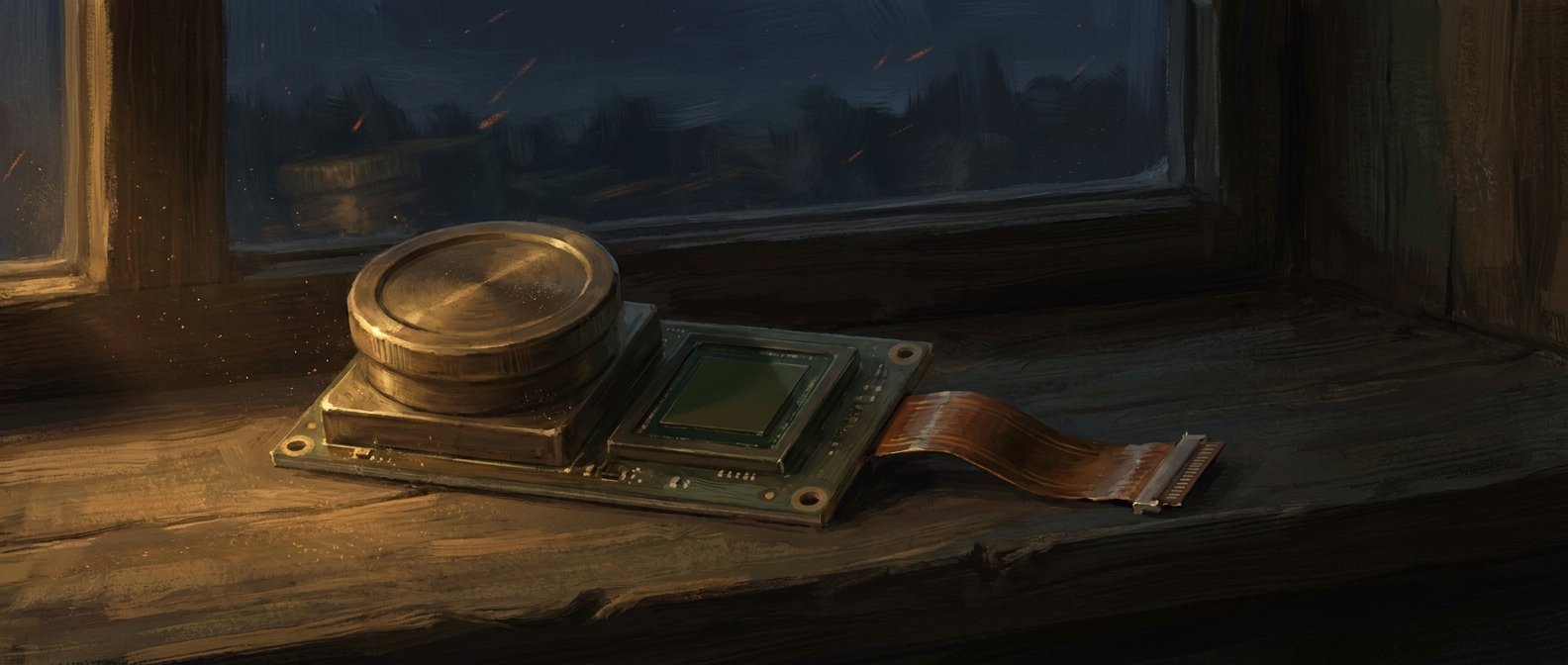
A camera sensor is a grid of several million tiny charge wells. Cap the lens so no light reaches it, expose it anyway, and the frames are not empty. Some of what remains is electrical noise. Some of it is hot pixels — wells that leak, and therefore read bright in every single frame, always in the same place. And a small residue is something else entirely: a charged particle from a cosmic-ray shower passing through the silicon, dumping energy along its path and leaving a short bright streak in one frame and never again. Amateur detectors built on exactly this principle have been run for years on ordinary phones. The separation — always-on versus once-only, blob versus streak — is the whole calibration.
This rung tried to do that on the machine the lab runs on, and could not.
—
reports/2026-07-14-i01.json, the run's own headline
The machine exposed no camera device, and no real capped-sensor dark-frame stack was configured. So the runner returned a hardware-unavailable null and stopped.
That is the entire content of this milestone, and it is deliberate. The lab has synthetic dark frames — it uses them to test the classifier's logic in its own test suite — and it would have been trivial to point the pipeline at them and produce a report full of plausible-looking numbers. The runner refuses to. Synthetic frames never enter a report, and the receipt says hardware unavailable rather than reporting a measurement the machine did not make. An instrument that will fabricate an input when the real one is missing cannot be trusted on the runs where the input is real.
The panel below is therefore not this experiment. It is the classifier — the part that was built and does work — running on frames generated in your browser, clearly labelled as such. It shows you what the separation looks like. It is not a measurement, and the banner across it says so.
left · the current synthetic frame — hot pixels ringed brass and held between frames, transient blobs moss, track-like streaks ember · right · what the classifier has counted so far, against the number of events actually injected (slate) · below · the most recent track-like candidate, magnified, with its fitted principal axes.
Raise the read-noise slider and something counterintuitive happens: the detector finds fewer events, not more. The six-sigma gate is measured relative to the frame's own noise, so a noisier sensor raises its own bar. The slate line keeps climbing at every setting — events are still being injected at the same rate — but past roughly σ = 5 the ember line falls away from it, and by σ = 8 it is flat. That is the one piece of real instrument physics this panel can teach, and it is why dark-frame calibration is done before anything else.
The design the null was protecting is on disk regardless. Persistent bright pixels
are estimated and removed by a temporal median before any transient component
is classified. Accepted inputs are an .npy/.npz stack, a
directory of 2-D .npy frames, or a live capture — and camera acquisition
runs in a disposable child process, so a wedged camera backend cannot wedge the
lab. Every accepted frame carries a per-file SHA-256 into the receipt. None of that ran
here, which is why none of it appears as a number.
There are no measured physics numbers on this rung. The strip above says
no camera / 0 frames / null receipt because that
is what the run produced. A row of impressive-looking thresholds that were never
exercised on real data would be the failure this page is about.